Loading
Topic
checkpointing
16 posts about checkpointing by 3 contributors.
Know checkpointing? Share what you know with developers who are learning it.
+ Follow checkpointingBe the first to follow this
- Articles
- 16
- Contributors
- 3
Articles about checkpointing
- Article · C#
How to Resume a File Processing Job After a Worker Crashes
Learn how to build resumable C# file-processing jobs using durable checkpoints, batch commits, idempotency, leases, and retry-safe recovery after worker crashes.
- Article · AI Agents
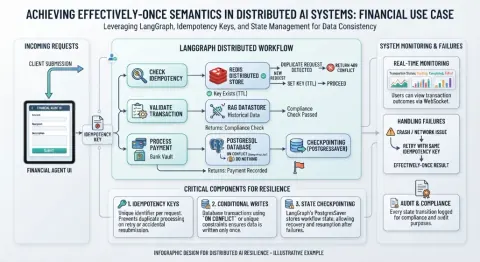
Building Exactly-Once Semantics in Enterprise Multi-Agent LangGraph RAG Systems
Building exactly-once or effectively-once semantics in multi-agent LangGraph RAG systems requires a combination of idempotency patterns, distributed state management, and transactional databases. By leveraging unique identifiers, conditional writes, and checkpointing, enterprises can ensure data consistency even in the face of failures.
- Article · AI Agents
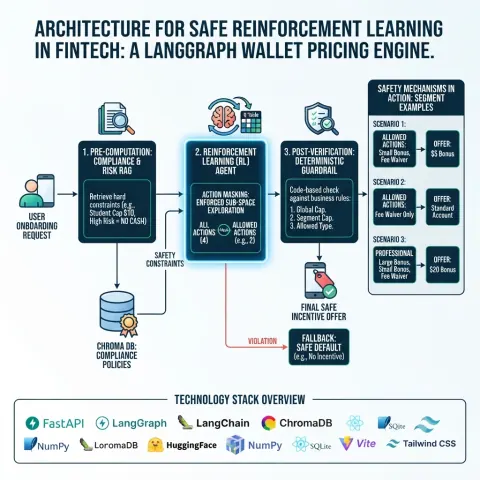
Safe Exploration: Guarding RL-Based Pricing in Digital Wallet Onboarding
Unsafe exploration is not an RL problem it is an architecture problem. By combining RAG-driven constraint retrieval, action masking, and deterministic guardrail nodes within a LangGraph workflow, we create a system where the RL agent can learn and optimize within a provably safe boundary. For digital wallet onboarding, this means better conversion rates without regulatory nightmares.
- Article · AI Agents
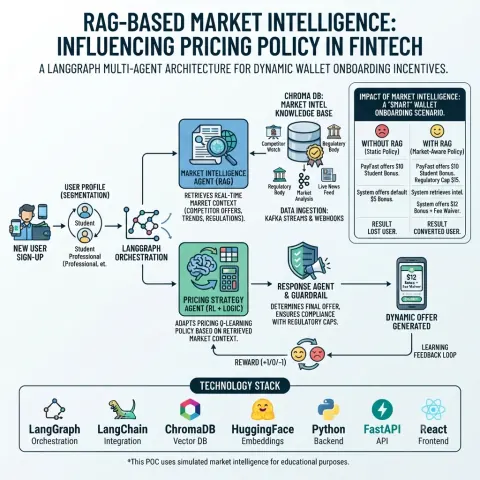
Context is King: How RAG-Based Market Intelligence Drives Dynamic Wallet Pricing
RAG-based market intelligence transforms a pricing engine from a reactive calculator into a proactive strategist. By grounding decisions in real-time external data, we ensure that wallet creation incentives are not just mathematically optimal, but competitively viable. This POC illustrates the power of combining LangGraph, RAG, and RL to build intelligent, context-aware financial systems.
- Article · AI Agents
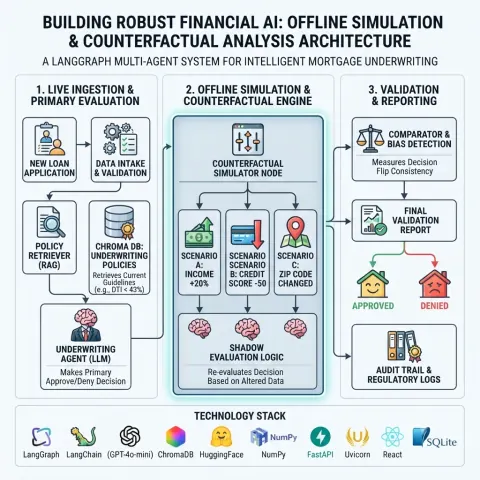
From Simulation to Production: Counterfactual Analysis in AI-Driven Loan Processing
Offline simulation and counterfactual analysis are not just "nice-to-haves"; they are essential safeguards for AI in finance. By integrating these techniques into a LangGraph workflow, we create a loan processing engine that is not only efficient but also transparent, fair, and robust. This approach allows institutions to deploy AI with confidence, knowing that every decision has been stress-tested against a myriad of "what-if" scenarios.
- Article · AI Agents
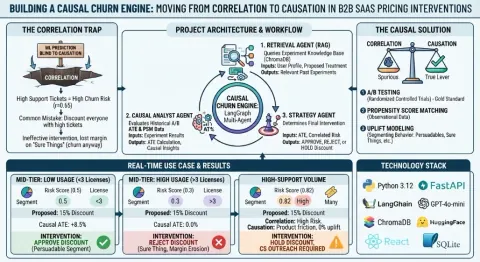
Beyond Correlation: Causal Inference in AI-Driven Churn Prediction and Pricing
Correlation tells you what is happening; causation tells you what to do about it. In churn prediction and pricing, acting on correlation leads to margin erosion and ineffective interventions. By integrating Causal Inference and Uplift Modeling into a LangGraph multi-agent architecture, supported by RAG over historical experiments, enterprises can build pricing engines that are not just predictive, but truly prescriptive.
- Article · AI Agents
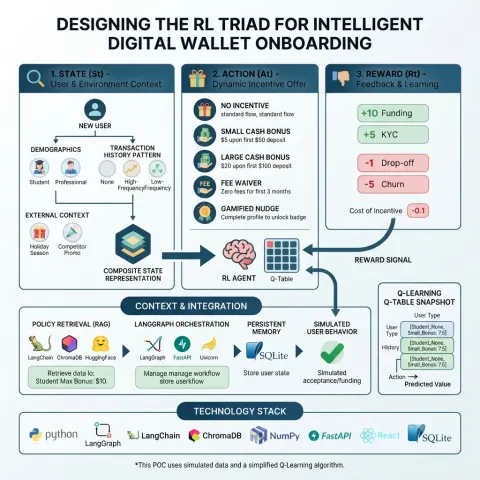
Designing the RL Loop: State, Action, and Reward in a Digital Wallet Onboarding Engine
Designing the State, Action, and Reward is the most critical step in building an RL-powered pricing or onboarding engine. By defining these clearly and wrapping them in a LangGraph multi-agent architecture, we can create systems that are not only intelligent but also compliant and context-aware. This POC demonstrates how to move from static marketing to dynamic, learning-driven user engagement.
- Article · AI Agents
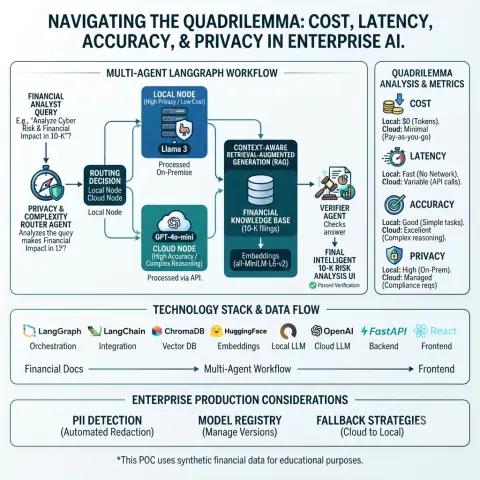
The Four Pillars of Enterprise AI: Balancing Cost, Latency, Accuracy, and Privacy in Financial Reporting
Selecting models for financial reporting is not a binary choice between "cheap" and "accurate." By implementing a Multi-Agent LangGraph architecture with intelligent routing, we can optimize for all four pillars: Cost, Latency, Accuracy, and Privacy. This POC demonstrates how to build a system that is both economically viable and compliant, ensuring that your enterprise AI strategy is robust, secure, and ready for production.
- Article · AI Agents
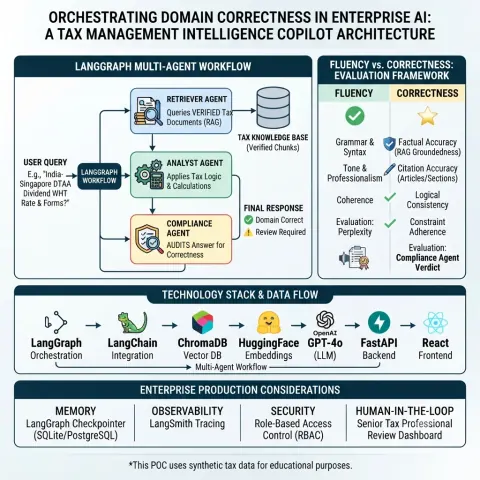
Evaluating Domain Correctness in Enterprise Tax AI with LangGraph
Evaluating LLMs for domain correctness requires moving beyond surface-level fluency. By implementing a Multi-Agent LangGraph architecture with a dedicated Compliance Agent, we can automate the detection of hallucinations and ensure that every tax recommendation is grounded in verified sources. This POC demonstrates that with the right structure RAG for facts, Agents for logic, and State for context we can build AI systems that are not just smart, but also trustworthy and compliant.
- Article · AI Agents
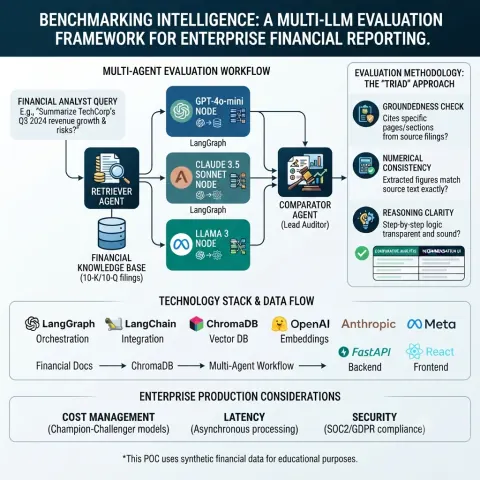
Benchmarking Intelligence: A Multi-LLM Evaluation Framework for Enterprise Financial Reporting
Comparing LLMs for financial reporting is not about picking the "smartest" model, but the most reliable one for your specific data. By building a Multi-Agent LangGraph system that parallelizes evaluation, we can move beyond guesswork. This POC demonstrates how to architect a system that prioritizes groundedness, traceability, and comparative accuracy, ensuring that your financial AI is not just fluent, but fundamentally correct.
- Article · AI Agents
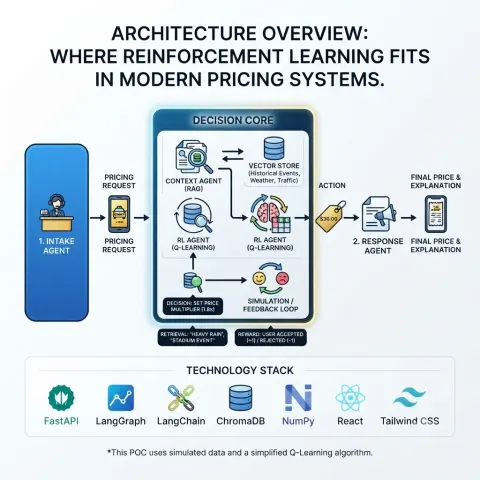
Orchestrating Intelligence: Integrating Reinforcement Learning into a Dynamic Pricing Engine with LangGraph
Reinforcement Learning fits into the architecture as the adaptive decision-maker. By wrapping it in a LangGraph workflow, we can combine its learning capabilities with the contextual awareness of RAG and the structural integrity of Multi-Agent Systems. This POC demonstrates how to build a pricing engine that doesn't just react to data, but learns from every transaction to optimize future revenue.
- Article · AI Agents
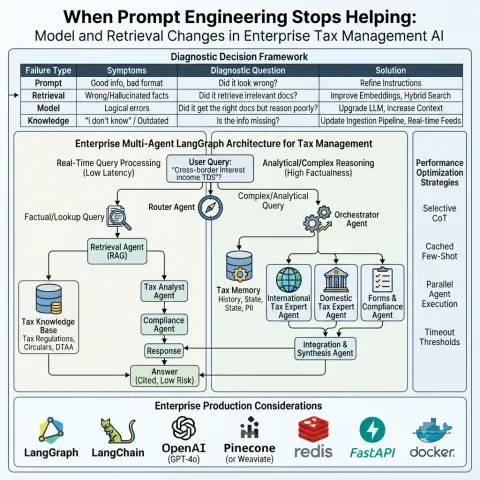
When Prompt Engineering Stops Helping: Model and Retrieval Changes in Enterprise Tax Management AI
Prompt engineering is a powerful tool, but it is not a panacea. In enterprise tax management, the cost of error is too high to rely on prompts alone. By building a multi-agent system with LangGraph, we can isolate failures: if retrieval is poor, we fix the vector store; if reasoning is weak, we upgrade the model; if compliance is risky, we add guardrails. This architectural approach ensures that our AI copilot is not just smart, but also safe, accurate, and auditable. The next step is to integrate real-time regulatory feeds and rigorous evaluation pipelines to evolve this POC into a production-grade platform.
- Article · AI Agents
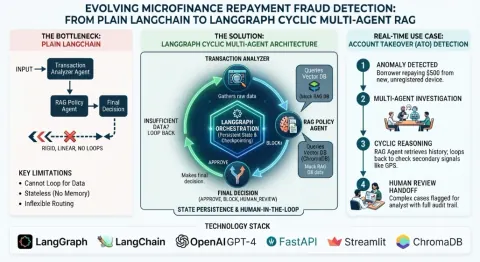
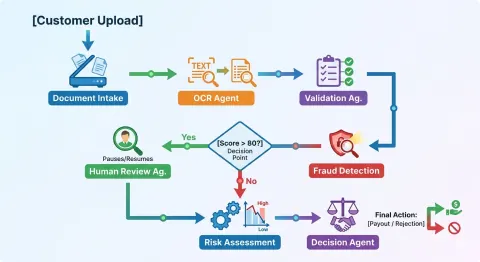
Beyond Linear Pipelines: Why LangGraph Powers Enterprise Fraud Detection in Microfinance Repayment Tracking
The transition from plain LangChain to LangGraph was not just a technical upgrade; it was a fundamental requirement for enterprise fraud detection in microfinance. Plain chains force a linear, rigid path that breaks down when faced with the ambiguity of real-world financial fraud.
- Article · AI Agents
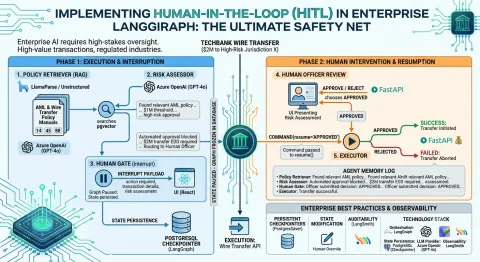
Implementing Human-in-the-Loop (HITL) in Enterprise LangGraph: The Ultimate Safety Net
Human-in-the-Loop is not a bottleneck; it is the ultimate safety valve for enterprise AI. By leveraging LangGraph’s native interrupt() and Checkpointer mechanisms, you can build systems that combine the speed and analytical power of LLM-driven RAG with the judgment, accountability, and regulatory compliance of human experts.
- Article · Langchain
Handle Agent Memory, Checkpointing, and Recovery in Multi-Agent Workflows Using LangGraph
Master LangGraph for resilient AI: Learn state management, checkpointing, and recovery for robust multi-agent workflows.