Loading
Topic
Concurrent Programming
8 posts about Concurrent Programming by 7 contributors.
Know Concurrent Programming? Share what you know with developers who are learning it.
+ Follow Concurrent ProgrammingBe the first to follow this
- Articles
- 8
- Contributors
- 7
Everything about Concurrent Programming
- Article · Threading
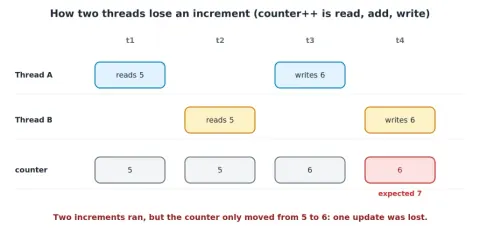
Why Parallel Code Loses Updates: lock, Interlocked, and Thread-Local State, Measured
Concurrency advice is usually delivered as rules: "use lock ", "prefer Interlocked ", "avoid shared state". Rules are easier to remember when you have watched them fail. So I built a deliberately small experiment, incrementing one counter 100,000 times with Parallel.For , and measured what happens w
- Article · C#
C# Discriminated Unions and .NET Channels
Explore the advanced features of C# with a focus on Discriminated Unions and .NET Channels. Learn how Discriminated Unions enhance type safety and pattern matching, and how .NET Channels facilitate concurrent and asynchronous programming.
- Article · .NET
Exploring the Fundamentals of Concurrent Programming in .NET
Concurrency is vital for efficient applications. .NET offers Thread, Multithreading, Task, Async & Await, Threadpool, Lock, and Deadlock tools. Understanding them enhances .NET development for scalable and responsive apps.
- Article · .NET
Exploring the BlockingCollection<T> Class in .NET
In the world of concurrent programming in .NET, developers often encounter scenarios where multiple threads need to communicate and synchronize access to shared data structures. In this article, we'll delve into the BlockingCollection<T> class, explore its features, and learn how it simplifies concurrent programming in .NET.
- Article · GO
Getting Started with WaitGroups in Go
Discover the power of WaitGroups in Go for coordinating concurrent tasks. This beginner's guide will show you how to synchronize goroutines effectively, ensuring smooth parallel execution. Perfect for those new to Go or looking to deepen their understanding of concurrent programming.
- Article · .NET Core
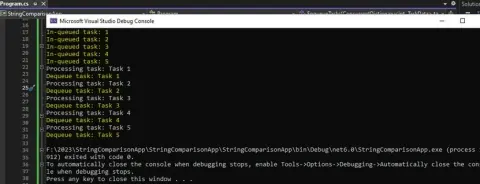
Queue & Dequeue with Concurrent Dictionary in .NET Core
In multi-threaded applications, efficient handling of concurrent data structures is crucial to ensure thread safety and performance. While .NET Core provides a variety of thread-safe collections, each with its own strengths and use cases, there are scenarios where we might need to implement queue and dequeue functionality.
- Article · .NET
Exploring Frozen Collections in .NET 8 With Benchmarking
Frozen Collections is a new .NET 8 feature that can be used to create Dictionaries and Sets for faster read operations when you don’t need to make changes after the creation. In this article, I present how to work with these collections and demonstrate the performance difference when compared with other collections.
- Article · Coding Best Practices
Programming in Practice Discipline
Programming in Practice is a discipline that systematically applies engineering principles to the program design, development, and implementation of algorithms, program text editions, and testing. It is a part of the software engineering discipline, which also involves project management, software distribution, maintenance, and evolution of software systems. Programming in Practice can be deployed tanks to widely accepted best practice rules and design patterns for well-defined subdomains as follows: sequential programming, concurrent programming, real-time programming, parallel programming, and distributed programming.