21 posts about .NET Developer by 6 contributors.
Know .NET Developer? Share what you know with developers who are learning it.
What is Model Context Protocol (MCP), and why is it becoming important for AI applications and developers?
Learn what availability means in System Design and how systems can continue serving users when individual components fail. This practical guide explains Single Points of Failure, redundancy, load balancing, health checks, and failover using simple real-world architecture examples.

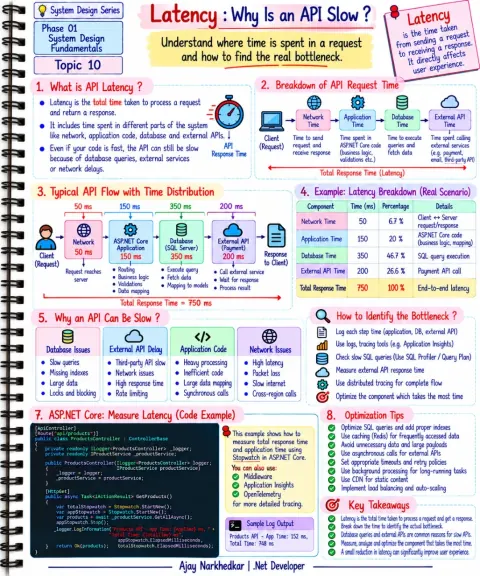
Learn how to understand and troubleshoot API latency from a System Design perspective. This practical guide explains how network time, ASP.NET Core processing, database queries, and external API calls contribute to total response time, with a real latency breakdown and a simple ASP.NET Core timing example.
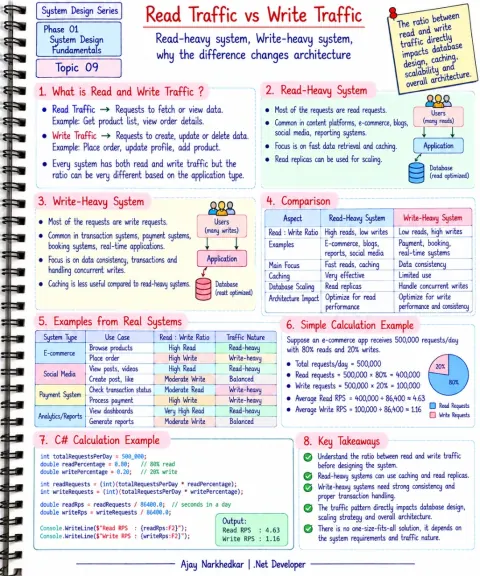
Understand how read-heavy and write-heavy workloads affect System Design. This practical guide explains read and write traffic, caching, read replicas, database performance, transactions, concurrency, and how a simple read/write traffic calculation can influence architecture decisions in .NET applications.
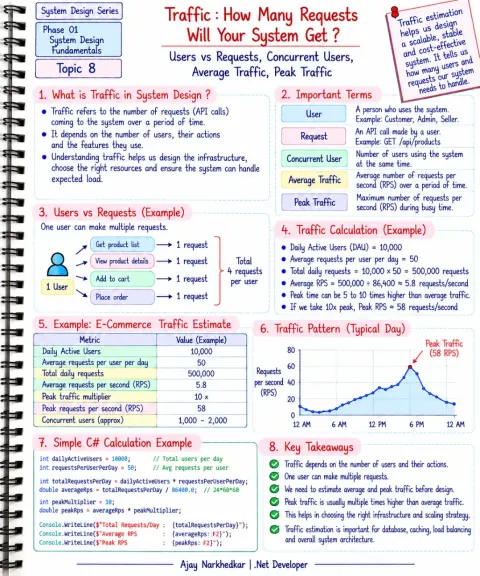
Learn how to estimate application traffic before designing a scalable system. This practical guide explains the difference between users, requests, concurrent users, average traffic, and peak traffic, with an e-commerce example and a simple C# calculation for estimating requests per second.
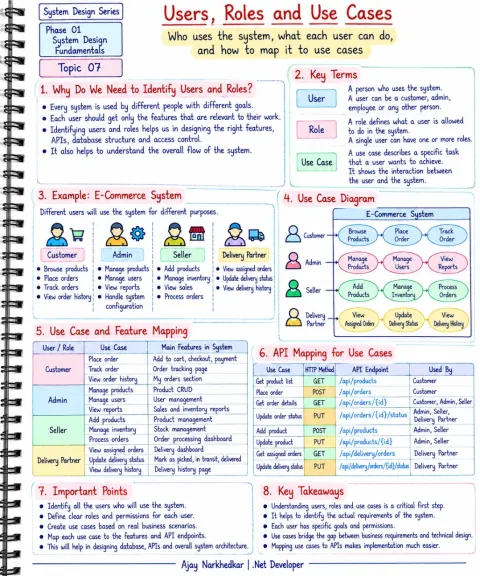
Learn how to identify users, roles, permissions, and use cases before designing APIs and architecture. This practical guide uses an e-commerce system to show how business requirements can be mapped from users and roles to use cases, features, and ASP.NET Core APIs.
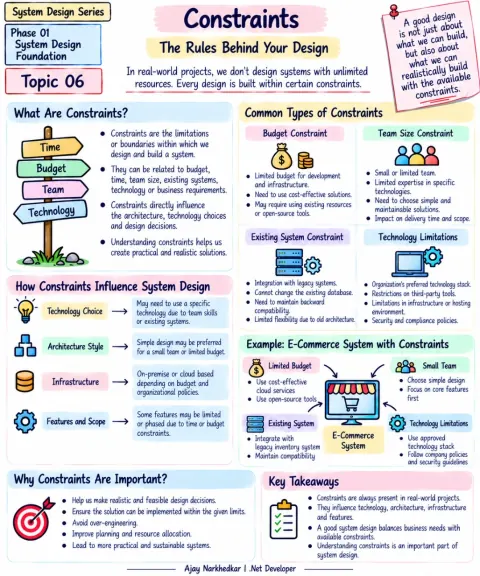
Learn how real-world constraints such as budget, team size, existing systems, technology limitations, and delivery timelines influence System Design. This practical guide explains how .NET developers can balance business requirements with real-world limitations to create simpler, maintainable, and realistic software architectures.
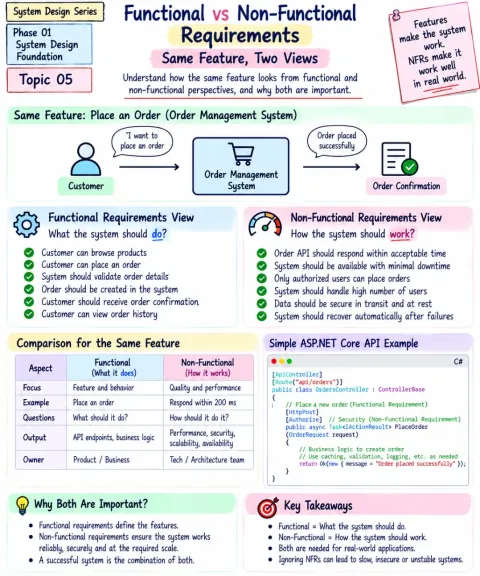
Understand the difference between Functional and Non-Functional Requirements using a practical Order Management System example. Learn how the same feature can be viewed from two perspectives and how performance, security, availability, and scalability requirements influence ASP.NET Core system design.
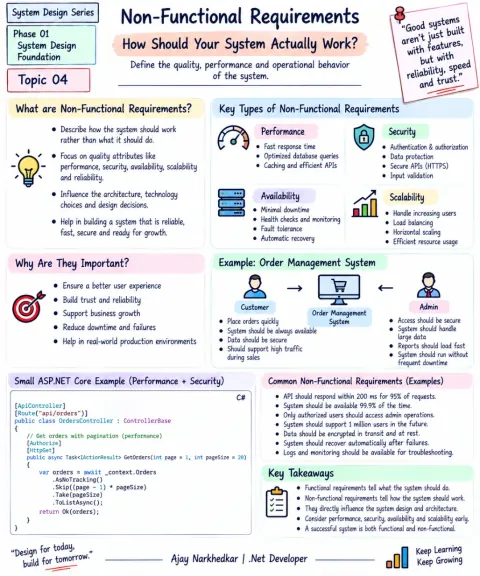
Understand Non-Functional Requirements from a practical .NET developer's perspective. Learn how performance, availability, security, and scalability requirements influence ASP.NET Core APIs, database design, architecture, and real-world System Design decisions.
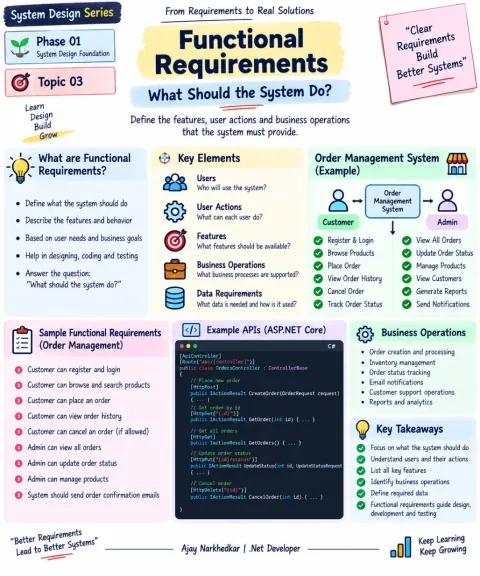
Learn what Functional Requirements really mean and how .NET developers can convert business requirements into users, actions, features, business operations, and APIs. This practical guide uses an Order Management System to explain how requirements become the foundation of effective System Design.
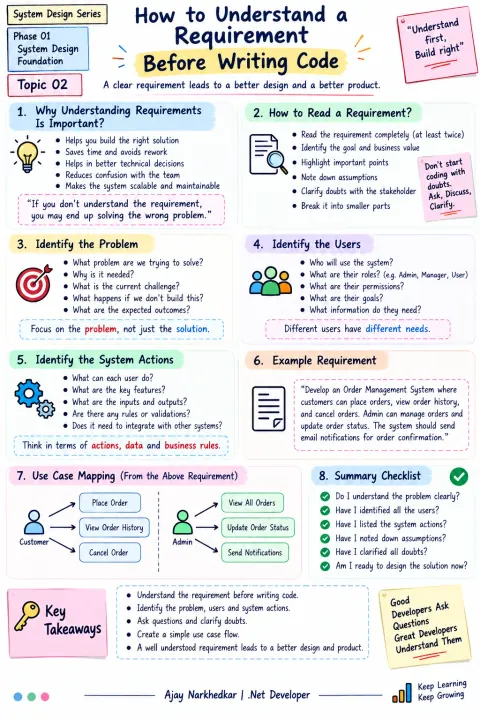
Learn how .NET developers can understand and break down software requirements before writing code. This practical guide explains how to identify the problem, users, system actions, use cases, business rules, data, and functional and non-functional requirements using a real-world Order Management System example.
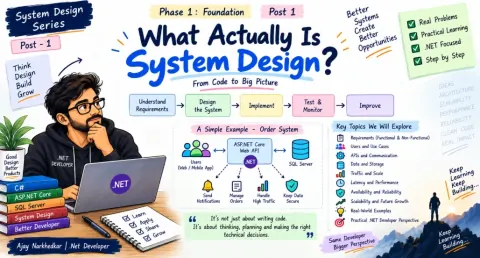
Learn what System Design really means from a .NET developer's perspective. Understand how requirements, APIs, data, traffic, performance, availability, and scalability come together to build reliable real-world applications.
A simple and practical look at .NET 11 Preview 7, covering the latest features, performance improvements, ASP.NET Core updates, C# development, EF Core, cloud tools, and what developers should know before the final .NET 11 release. Whether you're a beginner or an experienced .NET developer, this guide will help you understand what's new and how to get started.
Master C# interviews with 10 essential questions on classes, structs, async, DI, and more. Boost your .NET developer confidence!
Learn the technical and professional skills needed to become a .NET developer in 2026, including C#, ASP.NET Core, databases, Azure, DevOps, testing, and microservices.
This article provides a complete and easy-to-understand guide to classes and all types of classes in C#. It covers the fundamentals of what a class is, how objects work, and explains each class type—including concrete, abstract, sealed, static, partial, nested, anonymous, POCO, generic, and record classes—with clear examples and real-world applications.
This article provides a complete and easy-to-understand guide to Object-Oriented Programming (OOP) in C# .NET, covering core concepts such as classes, objects, variables, methods, constructors, access modifiers, encapsulation, inheritance, polymorphism, abstraction, and interfaces. With clear explanations and practical examples, it helps learners build a strong foundation for real-world .NET development and technical interview preparation. Ideal for beginners, students, and professionals looking to improve their understanding of OOP principles in C#.
This article explores five powerful yet often overlooked features in ASP.NET Core that can significantly improve application performance, reliability, and scalability. From background processing with IHostedService and built-in Health Checks to Endpoint Filters, HTTP/3 support, and Rate Limiting middleware, this guide helps developers understand and implement these hidden gems effectively. With practical explanations and real-world relevance, this article is ideal for developers looking to enhance their ASP.NET Core skills and build modern, production-ready applications.
Learn dependency injection in ASP.NET Core, including the IoC container, constructor, property and method injection, service lifetimes, and dependency inversion. See how DI improves testing and maintainability.
This article provides a highly detailed and comprehensive guide to Middlewares in ASP.NET Core, covering the complete request-processing pipeline, middleware architecture, built-in and custom middlewares, real-world use cases, microservices integration, performance tuning, and essential interview concepts. It is designed for beginners, intermediate developers, and professionals preparing for .NET interviews or building enterprise web applications.
In this article, you will learn about everything that every .NET developer needs to know about disposable types - properly implementing the idisposable interface.
DevSocialUpcoming · 3rd editionAI Agents ConferenceNov 23–27, 2026Live onlineMembers only17days leftRegisterPublish an article in this category and earn +1,000 SHARP when it is approved.
Write an article