Loading
Topic
dynamic pricing
9 posts about dynamic pricing by 4 contributors.
Know dynamic pricing? Share what you know with developers who are learning it.
+ Follow dynamic pricingBe the first to follow this
- Articles
- 9
- Contributors
- 4
Everything about dynamic pricing
- Article · AI Agents
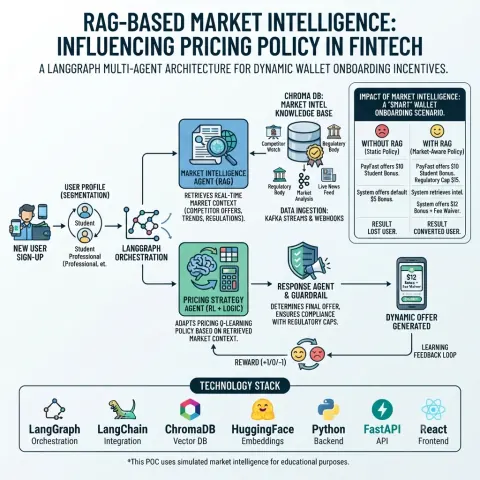
Context is King: How RAG-Based Market Intelligence Drives Dynamic Wallet Pricing
RAG-based market intelligence transforms a pricing engine from a reactive calculator into a proactive strategist. By grounding decisions in real-time external data, we ensure that wallet creation incentives are not just mathematically optimal, but competitively viable. This POC illustrates the power of combining LangGraph, RAG, and RL to build intelligent, context-aware financial systems.
- Article · AI Agents
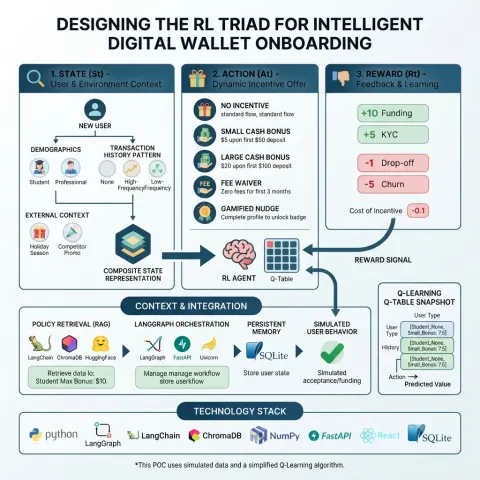
Designing the RL Loop: State, Action, and Reward in a Digital Wallet Onboarding Engine
Designing the State, Action, and Reward is the most critical step in building an RL-powered pricing or onboarding engine. By defining these clearly and wrapping them in a LangGraph multi-agent architecture, we can create systems that are not only intelligent but also compliant and context-aware. This POC demonstrates how to move from static marketing to dynamic, learning-driven user engagement.
- Article · AI Agents
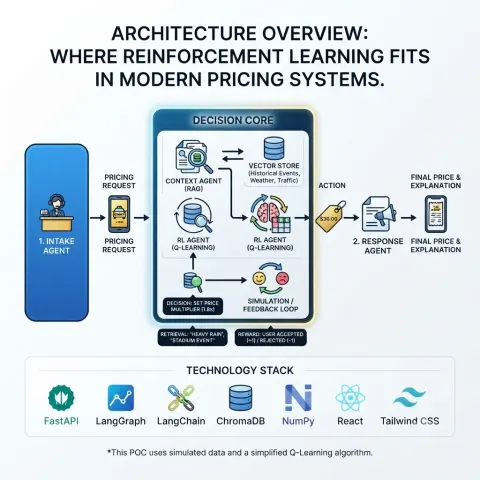
Orchestrating Intelligence: Integrating Reinforcement Learning into a Dynamic Pricing Engine with LangGraph
Reinforcement Learning fits into the architecture as the adaptive decision-maker. By wrapping it in a LangGraph workflow, we can combine its learning capabilities with the contextual awareness of RAG and the structural integrity of Multi-Agent Systems. This POC demonstrates how to build a pricing engine that doesn't just react to data, but learns from every transaction to optimize future revenue.
- Article · AI Agents
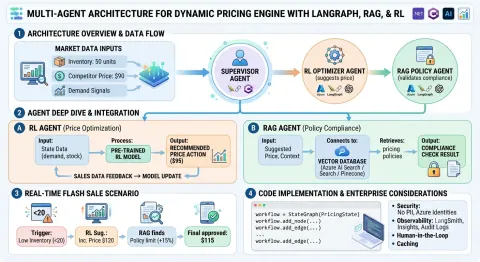
Building an Enterprise-Grade Dynamic Pricing Engine
By combining Reinforcement Learning for mathematical optimization, RAG for regulatory compliance, and LangGraph for orchestration, we create a pricing engine that is not only smart but also safe and auditable. This architecture moves beyond simple automation to true Agentic AI, where systems can reason, check constraints, and act autonomously within defined boundaries. For .NET developers, this logic can be exposed via FastAPI or ASP.NET Core Minimal APIs, allowing your existing enterprise frontends to consume these intelligent pricing decisions seamlessly.
- Article · Langchain
Enterprise Dynamic Pricing using Reinforcement Learning with Multi-Agent LangGraph and RAG
Enterprise dynamic pricing: RL for optimization, LangGraph for context, RAG for data. Drive profit safely.
- Article · Azure
AI for E-Commerce Platforms on Azure: Dynamic Pricing, Inventory Intelligence, and Conversion Optimisation
Learn how Azure AI supports e-commerce dynamic pricing, demand forecasting, inventory optimisation, personalisation, and conversion analysis in real time.
- Article · Python
How to Calculate Revenues Using Matrix Multiplication in Python
Unlock the power of matrix multiplication in Python to calculate revenue! This article demonstrates how to use Python lists (no NumPy needed!) to predict revenue across customer segments, enabling smarter pricing and inventory decisions. Learn from a real-world e-commerce scenario and get production-ready code with comprehensive test cases. Master this technique to transform raw sales data into strategic business insights and drive growth.
- Article · Prompt Engineering
Prompt Engineering in Retail Strategy: Optimizing Merchandising with Context-Aware AI Reasoning
Prompt-Oriented Development (POD) in retail transforms AI into a strategic merchandising advisor, delivering data-driven, context-aware recommendations for inventory, pricing, promotions, and multi-channel execution.
- Article · Algorithms in C#
Dynamic Pricing in E-Commerce: Maximizing Revenue with C# Algorithms
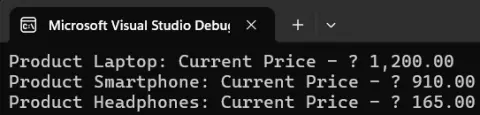
Dynamic pricing allows businesses to adjust product prices in real time based on factors like demand, competition, and inventory levels. This article explains dynamic pricing, its benefits, and a basic C# implementation of a pricing algorithm.