Loading
Topic
Gradio
6 posts about Gradio by 3 contributors.
Know Gradio? Share what you know with developers who are learning it.
+ Follow GradioBe the first to follow this
- Articles
- 6
- Contributors
- 3
Everything about Gradio
- Article · AI
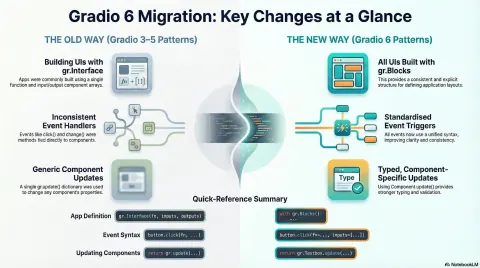
Gradio 6 Migration Guide: How to Upgrade from Gradio 3–5 with Code Examples
A detailed migration guide for Python developers moving from Gradio 3–5 to Gradio 6. Includes before/after code, UI changes, event system updates, schemas, comparison tables, diagrams, and best practices.
- Article · AI
Trackio by Gradio – Open-Source AI Experiment Tracking & Visualization Tool
Learn how Trackio by Gradio enables developers and researchers to track, visualize, and monitor AI model performance with ease. Explore setup, integrations, and best practices.
- Article · LLMs
Ray Serve and Gradio Integration Tutorial for AI Model Deployment
Learn how to integrate Ray Serve with Gradio to deploy scalable, interactive AI applications. Step-by-step guide with code and real-world examples.
- Article · AI
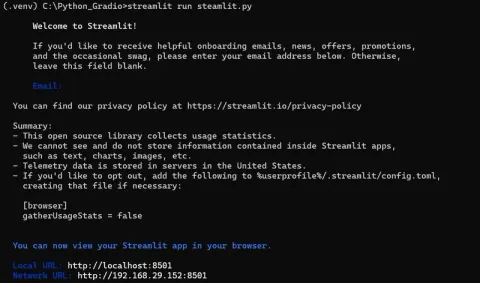
Gradio vs Streamlit: Which One Should You Use?
This article provides a clear comparison, highlighting the strengths of each tool. Gradio excels at quick ML model demos, especially within the Hugging Face ecosystem. Streamlit is better suited for building interactive data apps, dashboards, and full-fledged applications with rich UI components.
- Article · Python
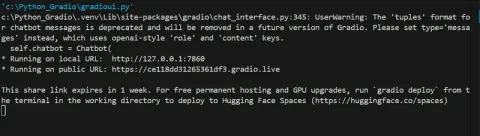
Python Gradio: An essential tool for AI/ML testing
Gradio simplifies AI/ML model testing by creating user-friendly web interfaces with minimal code. Skip complex front-end development and quickly build interactive demos for chatbots, image classifiers, and more. Prototype faster, gather feedback, and share results effortlessly, making AI deployment more accessible. Integrate with tools like Ollama for local LLM testing.
- Article · Python
How To Create Grammar Model Using Python?
Build a Python Gradio app that corrects grammar with LanguageTool and analyzes sentiment with NLTK. Learn how it returns corrected text, word counts, and suggested replacements.