IServiceCollection
6 posts6 contributors
Articles about IServiceCollection

How to Fix “Unable to Resolve Service for Type” Error in .NET Core?
Troubleshoot the "Unable to resolve service for type" error in .NET Core. Learn common causes, fixes, and best practices for dependency injection in ASP.NET Core.
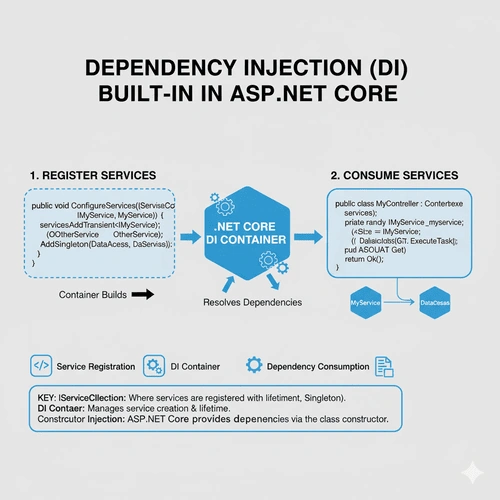
Dependency Injection (DI) Built-In in ASP.NET Core
Unlock the power of Dependency Injection (DI) in ASP.NET Core! This guide explores the built-in DI container, demonstrating how to register services (Transient, Scoped, Singleton), inject dependencies into controllers and middleware, and leverage DI for improved testability and maintainability. Learn to avoid common DI pitfalls and build cleaner, more scalable applications.

Dependency Injection in .NET Core Using IServiceCollection
Dependency Injection (DI) is a design pattern that enables the development of loosely coupled code. .NET Core has built-in support for DI, making it easy to manage dependencies in modern applications.
Understanding and Using Scope in .NET Core
In .NET Core, dependency injection (DI) manages service lifetimes with three scopes: Transient (new instance per request), Scoped (one instance per request), and Singleton (one instance shared across all requests). Proper use of these scopes optimizes resource management and application performance.
Dependency Injection in ASP.NET Core
Dependency Injection (DI) in ASP.NET Core enhances modularity, testability, and maintainability by providing class dependencies externally via the built-in Inversion of Control (IoC) container. Configure services in Startup.cs, utilize constructor injection in controllers, and choose appropriate lifetimes (Transient, Scoped, Singleton).
Implementing Model Binding, Handling Binding Failures, and Utilizing a Custom Model Binder in ASP.NET
In ASP.NET, model binding simplifies the process of mapping incoming HTTP request data to the parameters of controller actions or methods. This process ensures that the data provided by the user is appropriately converted and validated before being used by the application. However, there are cases when the default model binding behavior may not be sufficient. In such scenarios, custom model binders can be created to handle specific data types or complex binding logic.