Loading
Topic
Migrations
9 posts about Migrations by 9 contributors.
Know Migrations? Share what you know with developers who are learning it.
+ Follow MigrationsBe the first to follow this
- Articles
- 9
- Contributors
- 9
Everything about Migrations
- Article · Entity Framework
Understanding Migrations in Visual Studio: A Practical Guide for .NET Developers
Learn how to create, apply, roll back, and manage Entity Framework Core migrations in Visual Studio using Package Manager Console and the .NET CLI.
- Article · Entity Framework
Configuring EF Core Database Connections in ASP.NET Core
A complete guide to configuring database connections in ASP.NET Core using EF Core. Learn how to use IDesignTimeDbContextFactory, configure DbContext in Program.cs/Startup.cs, and use the OnConfiguring fallback method for design-time and runtime scenarios.
- Article · .NET
Understanding Entity Framework in .NET
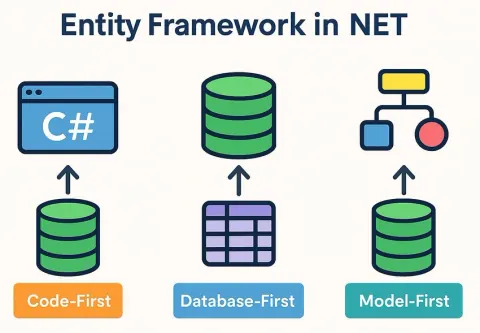
Entity Framework is an ORM tool for .NET that simplifies data access by mapping database tables to C# objects, supporting Code First, Database First, and Model First approaches for rapid development.
- Article · .NET Core
Dependency Injection & EF Migrations in ASP.NET MVC with Autofac
This article demonstrates how to implement Dependency Injection (DI) using Autofac in an ASP.NET MVC application and integrate Entity Framework for database operations, including migrations.
- Article · .NET Core
Create a Model with Database Table in .NET 8 using EF Core
This article guides you through creating a data-driven application using .NET 8 and Entity Framework Core. You'll learn to define a model, configure a DbContext, set up a SQL Server connection string, and use migrations to manage your database schema.
- Article · Entity Framework
Entity Framework: Code First Migrations With the Existing Database
Learn how to reverse engineer an existing database into an Entity Framework Code First model and manage schema changes with migrations.
- Article · .NET
Code First Migrations in Entity Framework
This article provides an overview of Code First Migrations in Entity Framework.
- Article · Entity Framework
Advanced Entity Framework Core: Extract data access layer with migrations to the library project and Execute migrations from the command line
See code examples in this article: Let's imagine you have a solution with many projects including a web application with the name "MiniService", which contains appsettings.json and a library project with DbContext and Migrations with any name f.e. "MiniService.Data". You most likely want to use the exact connection string in the appsettings.json used by the web app. May be different cases when you will need to run migrations from the command line, for example, there is no 'Package Manager Console' in VS for Mac.
- Article · Entity Framework
Code First Approach And Code First Migrations In Entity Framework
The intent of this article is to explain the code first approach and code first migrations that Microsoft’s Entity Framework provides. In my last article I explained the theory behind entity framework and the other two approaches i.e. database first and model first approach. We’ll go step by step to explore the code first approach via which we can access database and data using entity framework in our application.