Loading
Topic
Parallel.For
8 posts about Parallel.For by 8 contributors.
Know Parallel.For? Share what you know with developers who are learning it.
+ Follow Parallel.ForBe the first to follow this
- Articles
- 8
- Contributors
- 8
Articles about Parallel.For
- Article · Threading
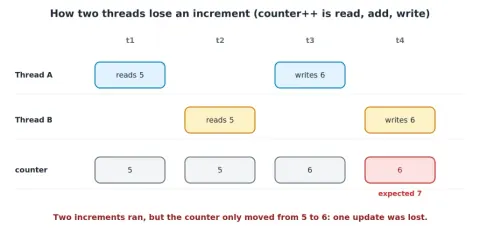
Why Parallel Code Loses Updates: lock, Interlocked, and Thread-Local State, Measured
Concurrency advice is usually delivered as rules: "use lock ", "prefer Interlocked ", "avoid shared state". Rules are easier to remember when you have watched them fail. So I built a deliberately small experiment, incrementing one counter 100,000 times with Parallel.For , and measured what happens w
- Article · Threading
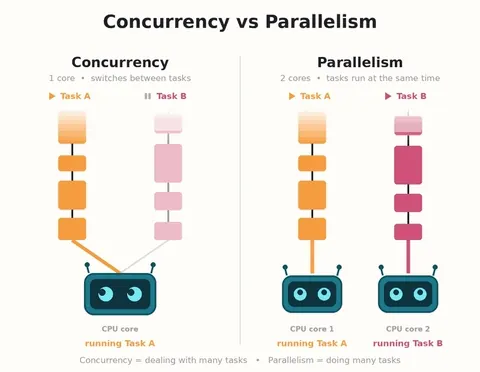
Concurrency vs Parallelism
Learn the difference between concurrency and parallelism in C#, when to use async/await for I/O-bound work, and when to use Parallel or PLINQ for CPU-bound work.
- Article · Threading
Parallel Processing in .NET with Task Parallel Library (TPL)
Unlock parallel processing in .NET using the Task Parallel Library (TPL). Learn how Parallel.For() boosts performance by leveraging multi-core processors efficiently. Optimize CPU-bound tasks!
- Article · Threading
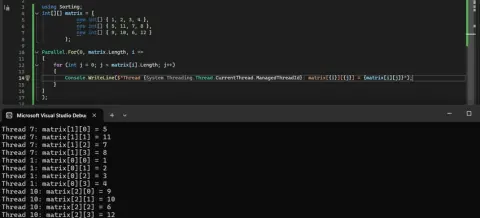
Understanding Parallel.For Method in c#
Parallel.For in C# allows executing loops in parallel, improving performance by utilizing multiple processors or cores. It enhances scalability but introduces overhead and requires thread safety for shared resources.
- Article · C#
CUDA integration with C#
This article will focus on how to create an unmanaged dll with CUDA code and use it in a C# program. The example will show some differences between execution times of managed, unmanaged and new .NET 4 parallel versions of for() loops used to do computations on arrays.
- Article · .NET Core
A Diagnosis Of Parallel.Foreach
In this article, you will learn about the diagnosis of Parallel.Foreach.
- Article · C#
Understanding Parallel Class (Parallel Loops) using C#
Learning the foundations of looping constructs in any language is a must and which are sequential in nature. However; once you have mastered it, learning parallel loops could be your next move. Learning it, is quite easy because it mimics the sequential loops that the C# language has. Furthermore; if you are into intensive algorithm computations learning parallel loops is highly recommended.
- Article · Threading
Parallel.Invoke in .Net Framework 4
In this article let's see about Parallel.Invoke method.