Loading
Topic
Streamlit
19 posts about Streamlit by 8 contributors.
Know Streamlit? Share what you know with developers who are learning it.
+ Follow StreamlitBe the first to follow this
- Articles
- 19
- Contributors
- 8
Everything about Streamlit
- Article · AI Agents
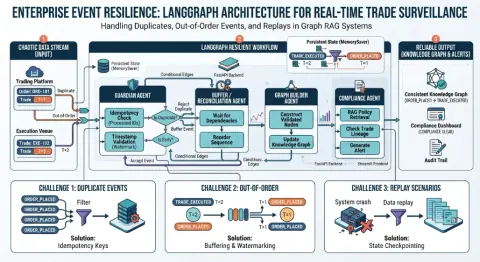
Resilience in Real-Time: Handling Duplicates, Reordering, and Replay in Enterprise Graph RAG
Handling the chaos of real-time data streams is not optional for enterprise Graph RAG systems it is a foundational requirement. By leveraging LangGraph’s persistent state, we can implement robust idempotency checks to kill duplicates, buffering logic to handle out-of-order events, and checkpointing to support safe replays.
- Article · AI Agents
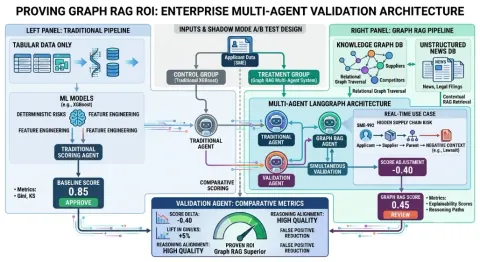
Quantifying Graph RAG Impact on Credit Risk Assessment
In our POC, the Graph RAG agent successfully identified a hidden supply chain risk that the traditional model missed, resulting in a significant score adjustment and a "Superior" verdict. This demonstrates that Graph RAG is not just a technological upgrade, but a risk-mitigation tool that provides tangible, measurable value to enterprise lending portfolios.
- Article · AI Agents
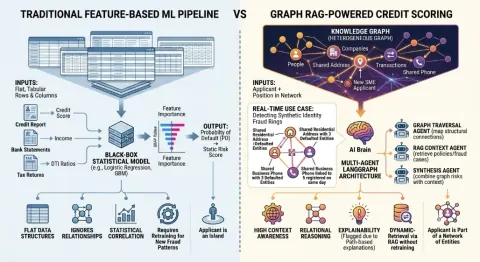
From Flat Features to Connected Insights: Graph RAG-Powered Credit Scoring vs. Traditional ML
By leveraging LangGraph, we created a system where the Graph Traversal Agent maps the structural landscape, the RAG Agent provides the regulatory and historical context, and the Synthesis Agent delivers a decision that is both mathematically grounded in graph theory and explainable through natural language. This architecture ensures that enterprises can detect sophisticated synthetic identity fraud rings that would otherwise slip through the cracks of flat, tabular data pipelines.
- Article · AI Agents
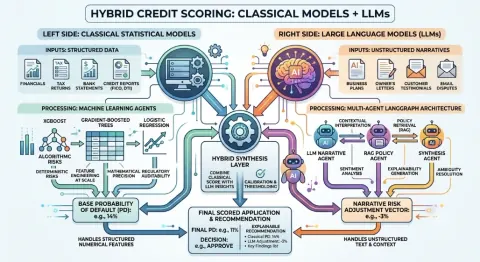
Hybrid Credit Scoring: Where Classical Models End and LLMs Begin in Enterprise Fintech
In our hybrid architecture, the classical XGBoost model produces a deterministic probability of default from tabular features. The LLM layer then analyzes business plans, owner letters, and other unstructured documents to identify qualitative risk signals that classical models cannot see. Through RAG, the system retrieves relevant underwriting policies to ensure the LLM's adjustments align with institutional guidelines. The synthesis agent combines these outputs into a final decision with full explainability.
- Article · AI Agents
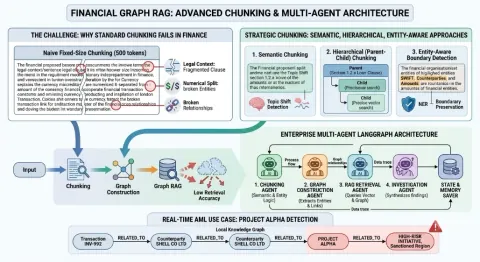
Advanced Chunking Strategies for Graph RAG in Transaction Narratives
Our Multi-Agent LangGraph POC demonstrates how specialized agents can handle the complexity of chunking, graph construction, and contextual retrieval, resulting in highly accurate and explainable AML investigations. This approach transforms raw, fragmented data into a coherent web of financial intelligence.
- Article · AI Agents
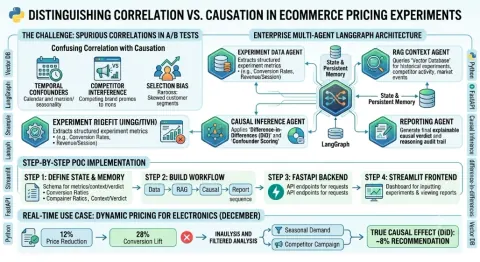
Distinguishing Correlation from Causation in Ecommerce Pricing Experiments: An Enterprise Multi-Agent LangGraph RAG Approach
By architecting a Multi-Agent LangGraph system with RAG, we empowered specialized agents to collaboratively investigate causality. The Data Agent extracts metrics, the RAG Agent surfaces critical historical and market context, the Causal Inference Agent applies rigorous Difference-in-Differences methodology, and the Reporting Agent delivers an explainable verdict.
- Article · AI Agents
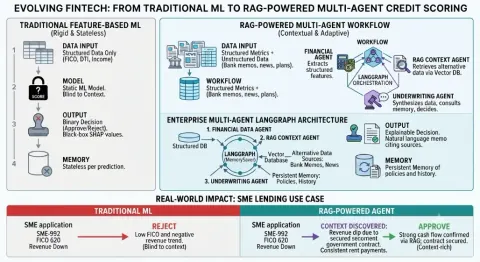
RAG-Powered Credit Scoring vs. Traditional ML
The transition from traditional feature-based ML pipelines to RAG-powered multi-agent workflows marks a critical evolution in Fintech credit scoring. While traditional models are fast and mathematically rigorous, they are inherently blind to context. By integrating LangGraph, we created a system where the Financial Agent handles the math, the RAG Agent provides the real-world context, and the Underwriting Agent synthesizes both.
- Article · AI Agents
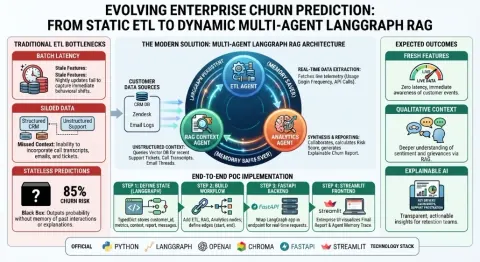
Overcoming ETL Bottlenecks in Churn Prediction: An Enterprise Multi-Agent LangGraph RAG Approach
The transition from traditional, batch-oriented ETL pipelines to dynamic, Multi-Agent LangGraph architectures represents a paradigm shift in enterprise data science. By addressing the core bottlenecks of latency, unstructured data silos, and stateless predictions, we can build churn prediction systems that are not only highly accurate but deeply explainable.
- Article · AI Agents
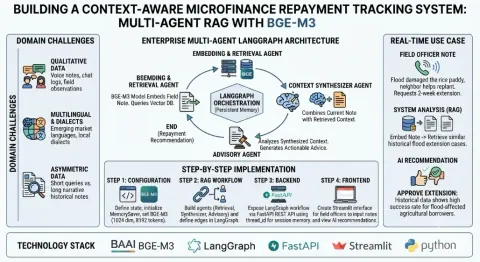
Selecting the Right Embedding Model for Microfinance: An Enterprise Multi-Agent RAG Approach to Repayment Tracking
Selecting the right embedding model is the most critical architectural decision when building RAG systems for specialized domains like microfinance. By choosing BGE-M3, we ensured our system could handle the multilingual, long-context, and asymmetric nature of field officer notes.
- Article · AI Agents
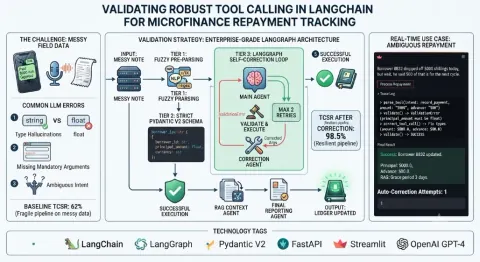
Validating Robust Tool Calling in LangChain for Microfinance Repayment Tracking
Validating tool calling in LangChain for enterprise microfinance required moving beyond simple prompt engineering. By implementing strict Pydantic schemas, we established a hard boundary for data types. More importantly, by integrating a self-correction loop within LangGraph, we transformed inevitable LLM hallucinations into manageable, auto-correctable events.
- Article · AI Agents
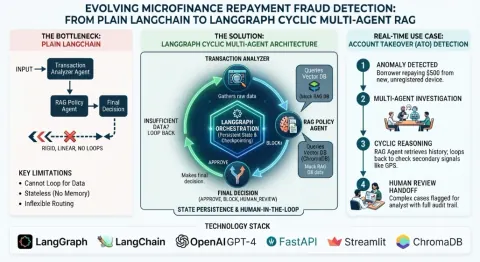
Beyond Linear Pipelines: Why LangGraph Powers Enterprise Fraud Detection in Microfinance Repayment Tracking
The transition from plain LangChain to LangGraph was not just a technical upgrade; it was a fundamental requirement for enterprise fraud detection in microfinance. Plain chains force a linear, rigid path that breaks down when faced with the ambiguity of real-world financial fraud.
- Article · Generative AI
How to Build a Local AI Chatbot Using Open Source LLMs Without OpenAI API
Build your own local AI chatbot using open-source LLMs! This guide provides a step-by-step approach, covering setup with Ollama, LangChain, and Streamlit. Enjoy privacy and cost savings!
- Article · LLMs
LLMs: Build an AI Healthcare App with Streamlit and GPT-5 (In-Depth)
Build a safe and auditable AI healthcare education app using Streamlit and GPT-5. This in-depth guide covers privacy, consent, redaction, curated knowledge bases, prompt contracts, red flag detection, and CI/CD. Learn to create a helpful tool that avoids diagnosis and prioritizes user safety with clear disclaimers and emergency routing. Includes code examples and architecture overview.
- Article · LLMs
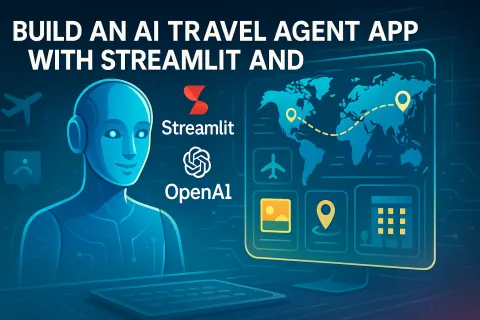
Build an AI Travel Agent App with Streamlit and OpenAI
Learn how to build a personalized AI travel planner using Streamlit, OpenAI GPT models, and LangChain. Includes architecture, setup guide, and code examples.
- Article · AI
Gradio vs Streamlit: Which One Should You Use?
This article provides a clear comparison, highlighting the strengths of each tool. Gradio excels at quick ML model demos, especially within the Hugging Face ecosystem. Streamlit is better suited for building interactive data apps, dashboards, and full-fledged applications with rich UI components.
- Article · AI Agents
Building a Local Action Agent with Streamlit + Ollama (Llama-3-Groq-8B-Tool-Use)
Build a local action agent using Streamlit, Ollama, and Llama-3-Groq-8B for tool use. This project demonstrates how to run a fully local agent without API keys, enabling tasks like weather checks, Wikipedia summaries, currency conversion, and calculations.
- Article · Python
Interactive UI using Streamlit: Python
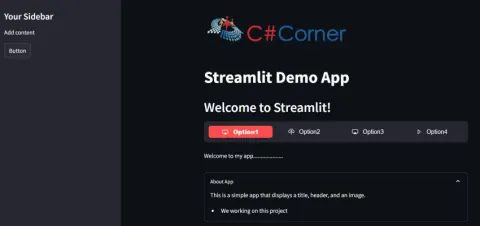
When you're building an app, one of the most important things is making sure it looks good and is easy to use. That's where an interactive user interface (UI) comes in. An interactive UI helps users understand how to use your app and makes it more enjoyable.
- Article · Python
Building Web Apps with Streamlit and Python
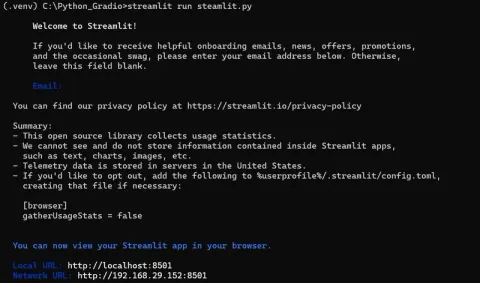
Streamlit is a powerful Python library for creating interactive web applications quickly and easily. It offers a simple API, fast prototyping, easy deployment, built-in widgets, and automatic reloading. This makes it an excellent choice for Python developers looking to build web apps without hassle.
- Article · Python
Unlocking Data Exploration and Machine Learning with Streamlit
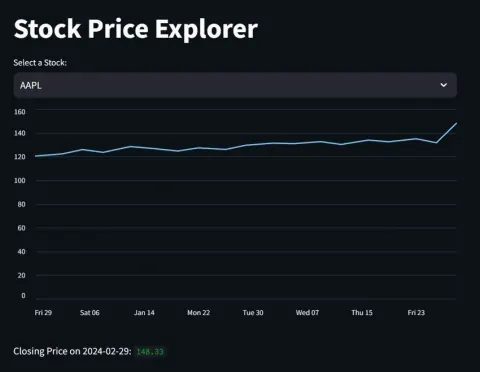
Streamlit turns data scripts into shareable web apps in minutes—all in pure Python. No front-end experience is required. Streamlit, a Python library, revolutionizes data science with user-friendly web app creation directly from Python code. Build interactive data experiences seamlessly.