
NVIDIA’s quarter was driven by demand for large-scale AI data center systems.
NVIDIA reported $115.8 billion in revenue for its third quarter of fiscal 2027, which ended October 25, 2026. That was 103% higher than the same quarter a year earlier, and its $107.6 billion Data Center business accounted for nearly all of that revenue. For developers, the report is a clear signal that AI infrastructure spending is still centered on large GPU-based data center systems, cloud capacity, networking, and the software stack around them.
The numbers matter because NVIDIA is no longer reporting growth mainly from PC graphics cards. Its business is now driven by organizations buying or renting large-scale accelerated computing for AI training, inference, science, enterprise workloads, and cloud services. NVIDIA also forecast $130.0 billion in revenue for the next quarter, though that forecast includes an additional week and assumes no Data Center compute revenue from China. NVIDIA’s November 17, 2026 earnings release has the full financial statements and outlook.
Key takeaways
- NVIDIA recorded $115.8 billion in Q3 fiscal 2027 revenue, up 20% from the prior quarter and 103% from a year earlier.
- Data Center revenue reached $107.6 billion, up 21% quarter over quarter and 110% year over year.
- GAAP net income was $65.3 billion, while GAAP gross margin was 74.8%.
- NVIDIA began shipping Vera Rubin NVL72 systems and called it the fastest product ramp in its history.
- The company expects $130.0 billion in Q4 fiscal 2027 revenue, plus or minus 3%, in a quarter with one extra week.
What NVIDIA reported in Q3 fiscal 2027
NVIDIA released these results on November 17, 2026. The company calls the period “third quarter fiscal 2027,” but the quarter itself ended on October 25, 2026. Public companies often name fiscal years differently from calendar years, so this is one of the first things a beginner should check when reading an earnings release.
Revenue is the money a company earned from sales before it subtracts expenses. NVIDIA reported $115.8 billion in revenue, compared with $96.2 billion in the previous quarter and $57.0 billion in the same quarter one year earlier. A 20% sequential increase means revenue increased from the immediately preceding quarter. A 103% year-over-year increase compares the result with the equivalent quarter in the prior fiscal year.
| GAAP measure | Q3 fiscal 2027 | Q2 fiscal 2027 | Q3 fiscal 2026 |
|---|---|---|---|
| Revenue | $115.8 billion | $96.2 billion | $57.0 billion |
| Gross margin | 74.8% | 75.0% | 73.4% |
| Operating income | $77.5 billion | $63.7 billion | $36.0 billion |
| Net income | $65.3 billion | $59.7 billion | $31.9 billion |
| Diluted earnings per share | $2.70 | $2.46 | $1.30 |
GAAP means Generally Accepted Accounting Principles, the standard accounting rules used for the company’s official financial reporting. NVIDIA also reports non-GAAP figures, which adjust some items to give management and investors another view of operations. In this quarter, non-GAAP diluted earnings per share were $2.68, compared with GAAP diluted earnings per share of $2.70.
You should not treat GAAP and non-GAAP measures as interchangeable. NVIDIA says its non-GAAP results exclude specified acquisition-related and other costs, legal settlement costs, gains or losses from equity securities, certain other income and expense items, and related tax effects. Beginning in the first quarter of fiscal 2027, its non-GAAP figures no longer exclude stock-based compensation expense.
How to read NVIDIA’s financial terms
An earnings release contains a lot of numbers, but you can start with five. Revenue tells you how much was sold. Gross margin tells you what percentage of revenue remains after the direct costs of producing the company’s products. Operating income subtracts research, sales, administration, and other operating expenses. Net income then includes taxes and other income or expense items. Earnings per share divides income attributable to shareholders across the weighted average number of shares.
Here is a simple way to read the Q3 report. NVIDIA had $115.8 billion in revenue and a GAAP gross margin of 74.8%. In plain English, after the direct costs of revenue, about 74.8 cents of every revenue dollar remained before operating expenses, taxes, and other items. Gross margin is not net profit, but it helps show how much room a company has to fund engineering, operations, and returns to shareholders.
NVIDIA reported $9.2 billion in GAAP operating expenses, up from $8.4 billion in Q2. That increase was much smaller than the increase in revenue, which is one reason operating income rose to $77.5 billion. But high margins do not remove business risk. Product mix, supply costs, pricing, export rules, customer demand, and competition can change future margins and revenue.
Why quarter-over-quarter and year-over-year both matter
Year-over-year comparisons can show whether a business is expanding against a comparable period. NVIDIA’s revenue went from $57.0 billion in Q3 fiscal 2026 to $115.8 billion in Q3 fiscal 2027. That is the reported 103% increase.
Quarter-over-quarter comparisons show more recent momentum. NVIDIA’s revenue increased from $96.2 billion in Q2 fiscal 2027 to $115.8 billion in Q3 fiscal 2027, a 20% increase. For a company selling large data center systems, timing of shipments can make quarterly results uneven, so it is useful to look at both comparisons rather than relying on one.
Why Data Center revenue is the main story
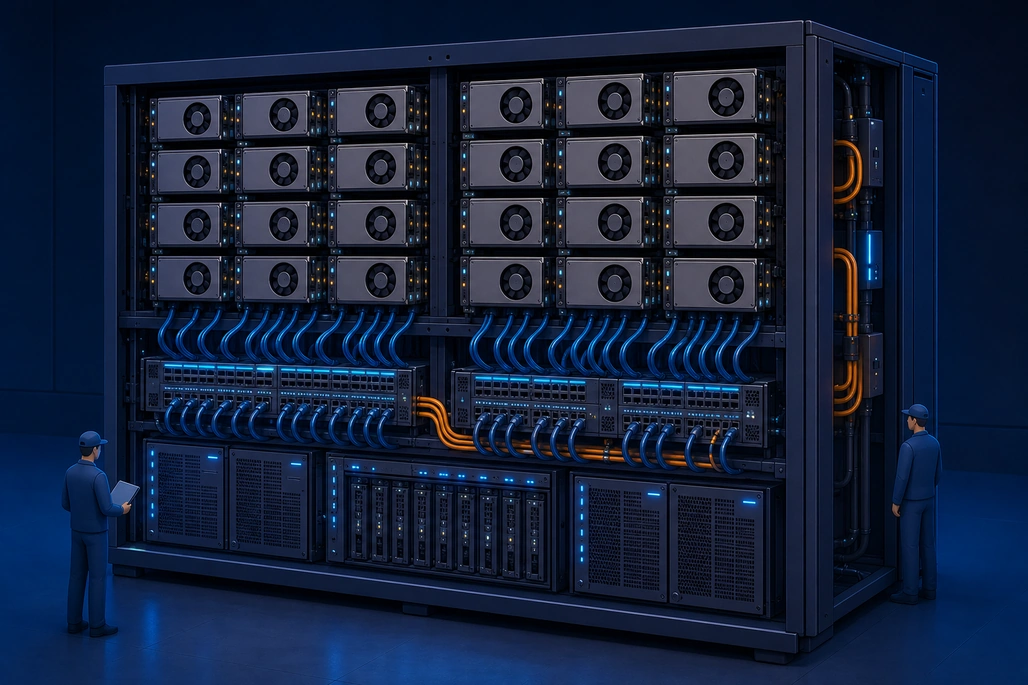
Large AI deployments depend on compute, networking, storage, power, and software working together.
Data Center revenue was $107.6 billion in Q3, up 21% from the previous quarter and 110% from one year earlier. That was about 93% of NVIDIA’s total quarterly revenue. Edge Computing, the company’s other reported platform in this release, produced $8.2 billion in revenue.
This split changes how developers should think about NVIDIA. Consumer graphics products still matter, but the financial report points to AI factories and cloud infrastructure as the dominant commercial engine. The customer is often a cloud provider, an AI company, an enterprise, or a service provider building capacity for many downstream users.
In a modern AI data center, a GPU is only one part of the system. A large deployment needs accelerated compute, CPUs, high-speed networking, storage, power, cooling, rack design, orchestration software, model frameworks, and developer tools. NVIDIA’s business covers more of that system over time, including GPU computing, networking, CPUs, CUDA software, and rack-scale platforms.
The release says NVIDIA ramped production and began shipping Vera Rubin NVL72. It also says racks were running with partners including CoreWeave, Google Cloud, Microsoft Azure, Oracle Cloud Infrastructure, and Nebius. This matters because a rack-scale platform is sold and deployed as a complete data center building block, rather than as a single component that the buyer must assemble into a large cluster alone.
What Vera Rubin NVL72 means for developers
Vera Rubin is NVIDIA’s next platform family after Blackwell. NVL72 refers to a rack-scale system design built around 72 GPUs. For many developers, that does not mean you will manage 72 GPUs directly. It means cloud providers and large AI platforms can offer more capable infrastructure for training and serving models.
The practical impact depends on where you work. If you use a managed AI service, you may eventually select an instance or endpoint backed by newer NVIDIA infrastructure without changing all of your application code. If you build infrastructure, you may deal with capacity planning, distributed training, inference throughput, network bandwidth, scheduling, observability, and cost controls.
Do not confuse an announcement of hardware shipments with immediate availability everywhere. NVIDIA said Vera Rubin NVL72 systems and Vera CPUs reached general availability on Oracle Cloud Infrastructure, while Google Cloud announced Vera Rubin-powered A5X instances. Availability, region coverage, price, quotas, and supported software can differ by provider.
AI infrastructure is more than model training
Training gets attention because it uses huge GPU clusters, but inference is also a major infrastructure workload. Inference is the work of running a trained model to generate an answer, classify an image, summarize a document, write code, or take another action. As more applications use models in production, latency, throughput, memory use, and cost per request become engineering concerns.
That is why infrastructure providers care about whole-system performance. A faster accelerator may help, but network topology, batching, model quantization, caching, data movement, and software optimization also affect the result your users see. NVIDIA’s revenue does not measure the quality of every AI application. It measures strong demand for the computing systems that support those applications.
How NVIDIA’s $130 billion outlook should be read
For Q4 fiscal 2027, NVIDIA forecast revenue of $130.0 billion, plus or minus 3%. That creates a guidance range of about $126.1 billion to $133.9 billion. Reuters reported that the midpoint was above the $125.25 billion average analyst estimate compiled by LSEG.
There are two qualifications beginners should keep in view. First, NVIDIA said the upcoming quarter includes an additional week. A longer quarter can add revenue simply because it contains more selling and shipping time. Second, NVIDIA said it is not assuming any Data Center compute revenue from China in this outlook.
NVIDIA expects GAAP and non-GAAP gross margin of 71.0% to 72.0% in Q4, below the 74.8% GAAP gross margin reported in Q3. A lower expected margin does not automatically mean the business is weakening. It can reflect product transitions, supply costs, the mix of products sold, or the cost of ramping new systems. It does mean margin is one number to watch in the next report.
| Q4 fiscal 2027 outlook item | NVIDIA forecast | Why it matters |
|---|---|---|
| Revenue | $130.0 billion, plus or minus 3% | Shows expected sales for the next quarter. |
| Gross margin | 71.0% to 72.0% | Shows the expected percentage left after direct costs. |
| GAAP operating expenses | About $11.0 billion | Shows expected spending to run and grow the business. |
| China Data Center compute revenue | Not included in outlook | Sets an explicit assumption behind the forecast. |
What the results do and do not tell developers
The report tells you that companies are spending heavily on AI computing capacity. It supports the view that cloud and enterprise demand for accelerated data center infrastructure remains large. It also confirms that NVIDIA is bringing Vera Rubin systems into production and partner environments.
It does not tell you that every AI project will succeed, that GPU capacity will be cheap, or that an application should use a large language model. Developers still need to solve a business problem, choose a model that fits it, protect customer data, evaluate output quality, track cost, and build reliable fallback behavior.
It also does not guarantee a stock market reaction. The Associated Press reported that NVIDIA initially rose after reporting stronger-than-expected revenue and profit plus an above-expectation forecast, then finished the November 18 trading session down 2.9%. Earnings reports describe business performance and forward-looking management estimates. Market prices also reflect expectations, interest rates, risk appetite, and many other factors.
How beginners can use this news
Start by learning the basic AI compute vocabulary: GPU, accelerator, training, inference, model serving, tokens, latency, throughput, and vector database. You do not need to buy hardware to learn. A cloud notebook, a managed model API, or a small local model can teach you the application side.
Then build one small application with measurable behavior. For example, create a document-question-answering app, record response time and cost per request, and compare answers against a small test set. This will teach you more than treating infrastructure announcements as a reason to add AI to every project.
If you work in .NET, focus on the parts you can control: application architecture, prompts, retrieval quality, token limits, retries, evaluation, telemetry, and data access rules. Use managed infrastructure at first. Move to specialized GPU hosting or self-managed inference only when your scale, data requirements, performance targets, or unit economics make that choice reasonable.
Frequently asked questions
What was NVIDIA’s Q3 fiscal 2027 revenue?
NVIDIA reported $115.8 billion in revenue for the quarter ended October 25, 2026. The figure was 20% higher than Q2 fiscal 2027 and 103% higher than Q3 fiscal 2026.
Why is NVIDIA’s fiscal 2027 quarter in calendar year 2026?
Companies can define fiscal years differently from calendar years. NVIDIA’s third quarter of fiscal 2027 ended on October 25, 2026, and the company reported the results on November 17, 2026.
How much of NVIDIA’s revenue came from Data Center?
Data Center revenue was $107.6 billion in Q3 fiscal 2027, up 21% from the prior quarter and 110% from one year earlier. It represented about 93% of NVIDIA’s $115.8 billion total revenue.
What is Vera Rubin NVL72?
Vera Rubin NVL72 is NVIDIA’s rack-scale AI computing platform design built around 72 GPUs. NVIDIA said it began shipping the system in Q3 fiscal 2027 and described it as the company’s fastest product ramp.
What is NVIDIA forecasting for Q4 fiscal 2027?
NVIDIA forecast Q4 fiscal 2027 revenue of $130.0 billion, plus or minus 3%, and GAAP and non-GAAP gross margins between 71.0% and 72.0%. The quarter includes an additional week, and the outlook assumes no Data Center compute revenue from China.
Based on reporting by NVIDIA Newsroom, NVIDIA Investor Relations, Reuters via Investing.com and Associated Press.

Join the conversation! Your thoughts help the community grow.