
Rubin HPC is designed to accelerate the simulation loop used in science and engineering.
NVIDIA Rubin HPC is a planned GPU for scientific computing, engineering simulation and data analytics, announced on November 16, 2026, at SC26 in Chicago. NVIDIA says it will combine more than 50,000 CUDA cores, hardware for sparse data movement and seventh-generation NVLink to help simulation-heavy workflows finish sooner. It is expected to be available in 2028, so developers cannot buy or benchmark it today, but they can start preparing code that uses CUDA and GPU-optimized libraries well.
Key takeaways
- NVIDIA announced Rubin HPC on November 16, 2026, as part of the NVIDIA Vera Rubin platform.
- The GPU is aimed at simulation and analytics workloads such as climate modeling, engineering, genomics and financial risk analysis.
- NVIDIA says Rubin HPC will have more than 50,000 CUDA cores on one GPU and a sparse data acceleration capability.
- Rubin HPC is expected in 2028, and NVIDIA has not published application benchmark results for the product announcement.
- Developers can prepare by profiling data movement, using sparse formats where appropriate and adopting CUDA-X libraries.
What NVIDIA Rubin HPC is
Rubin HPC is a new NVIDIA GPU designed for high-performance computing, often shortened to HPC. HPC is the kind of computing used when a normal server would take too long to run a large simulation, process an enormous dataset or repeatedly test many possible answers to a scientific problem.
NVIDIA announced Rubin HPC at SC26, the 2026 international conference for high-performance computing, networking, storage and analysis. SC26 runs from November 15 through November 20, 2026, at McCormick Place in Chicago. The conference program covers the same areas Rubin HPC targets, including algorithms, applications, architectures, networking, data analytics, AI and large-scale systems.
The name matters. Rubin HPC is a specialized member of the broader NVIDIA Vera Rubin platform. Earlier Vera Rubin announcements focused heavily on AI factories and agentic inference. Rubin HPC focuses on a related problem: using accelerated simulation and analytics as tools that AI agents can call while scientists and engineers evaluate ideas.
For a beginner, think of an AI agent as software that can plan a task, call tools and use results to decide what to do next. If an agent suggests a new battery material, it may need a chemistry or materials simulation to test that candidate. If it suggests a wing shape, it may need a fluid simulation. The quality of that next step depends on how quickly the simulation can return useful data.
Why agents for science need faster simulation
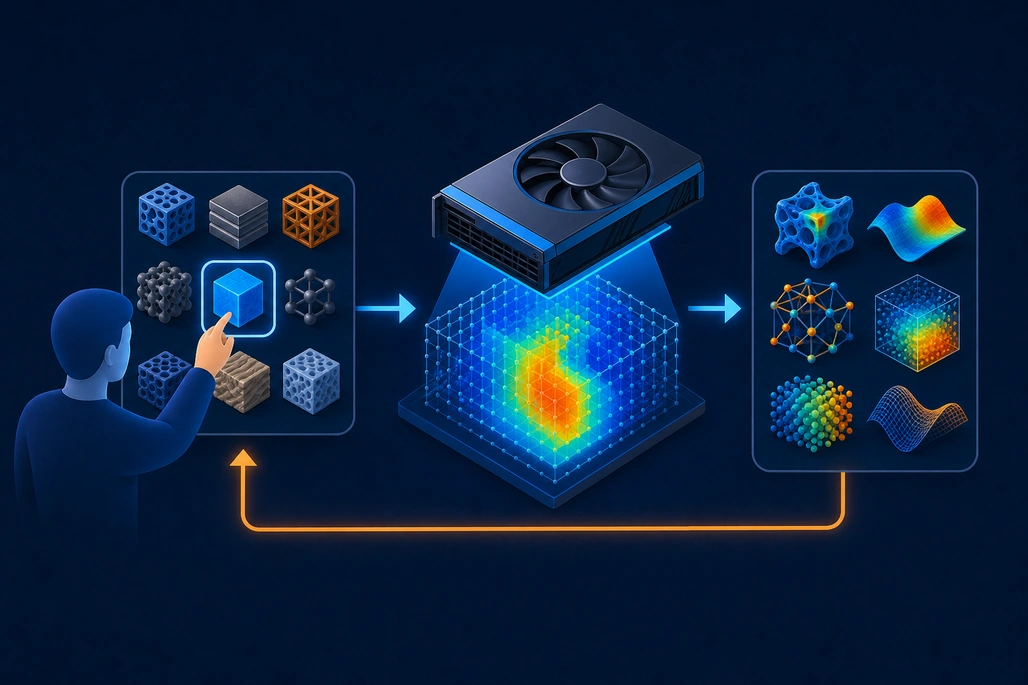
Faster simulations can shorten the cycle from an idea to a tested result.
Generative AI can produce a candidate molecule, design option or analysis plan quickly. That is only the first step. Scientists and engineers still need calculations, simulations, laboratory work or physical prototypes to determine whether an idea is useful.
NVIDIA describes this as a loop: hypothesis, simulation and refinement. An agent proposes possibilities, a simulation tests them, and the resulting data helps the agent or researcher choose the next set of possibilities. Faster simulation can shorten the wait between those stages.
This does not mean a GPU replaces scientific validation. A climate forecast still needs a sound model. A structural analysis still needs correct material properties and boundary conditions. A financial risk model still depends on its assumptions and its input data. Rubin HPC is hardware intended to make the compute portion of those workflows faster.
NVIDIA has already positioned the Vera Rubin platform for workloads that combine simulation, AI and analytics. Its June 2026 announcement identified climate modeling, computational fluid dynamics, quantum chemistry and energy exploration as target areas, and described native double-precision support for simulations that require FP64 arithmetic. That context helps explain why NVIDIA is now separating out a GPU with a more explicit focus on the common data access patterns in scientific applications.
How Rubin HPC is designed for simulation workloads

Multi-GPU workloads depend on compute, data movement and communication working together.
GPU specifications can become a list of big numbers very quickly. The useful beginner view is simpler: a fast GPU needs arithmetic hardware, fast access to data and fast communication with other GPUs. Rubin HPC is being presented as a balance of all three.
More than 50,000 CUDA cores
NVIDIA says Rubin HPC will include more than 50,000 CUDA cores on a single GPU. CUDA cores are processing units that can run many small operations in parallel. This fits workloads where the same calculation is repeated over huge grids, matrices, particle sets or datasets.
A large core count alone does not guarantee an application will run faster. If a kernel spends much of its time waiting for memory, loading data from storage or synchronizing with another GPU, many cores can sit idle. That is why data movement is a central part of the Rubin HPC announcement.
Sparse data acceleration
Many scientific datasets are sparse. In a sparse matrix, most values are zero, so storing and calculating every zero wastes memory bandwidth and compute time. Sparse matrices appear in finite element analysis, graph analytics, recommendation systems, scientific solvers and many other workloads.
NVIDIA says Rubin HPC has a sparse data acceleration capability intended to keep its CUDA cores supplied with useful data. The company specifically calls out sparse matrix operations, stencil computations, sorting and reductions as repeating patterns it wants to accelerate.
A stencil computation updates one point in a grid using nearby points. Weather and fluid simulations commonly work this way. A reduction combines many values into one result, such as a sum, minimum, maximum or average. These operations can look basic, but at massive scale they often decide whether a program is limited by math, memory access or communication.
Seventh-generation NVLink
Large HPC jobs often need more than one GPU. The GPUs must exchange boundary data, partial results or model state as the job runs. NVIDIA says Rubin HPC will use seventh-generation NVIDIA NVLink for GPU-to-GPU connectivity.
NVLink is NVIDIA's high-speed interconnect for connecting GPUs in a system. For developers, the important point is that multi-GPU performance depends on more than the speed of each GPU. The application must also divide work well, minimize unnecessary transfers and handle synchronization carefully.
What changed from the general Rubin GPU story
| Area | General Vera Rubin platform focus | Rubin HPC focus announced at SC26 |
|---|---|---|
| Primary workloads | AI infrastructure and agentic workloads | Simulation, data processing, science, engineering and analytics |
| Developer concern | Training and AI inference at scale | Keeping compute fed with data in recurring HPC patterns |
| Data patterns emphasized | Long-context and multi-agent processing | Sparse matrices, stencils, sorting and reductions |
| Scale-up connection | NVLink is part of the platform architecture | Seventh-generation NVLink is named in the Rubin HPC announcement |
| Availability | Vera Rubin products have been announced for 2026 platform deployments | Rubin HPC is expected to be available in 2028 |
The distinction is useful because “Rubin” is not one simple product name. NVIDIA uses it for a platform and for related components. If you are planning hardware, ask a vendor which exact GPU, rack architecture, memory configuration, interconnect and software stack is being offered. Do not assume that a benchmark for one Rubin system applies to Rubin HPC.
Also, do not treat projected specifications as shipping measurements. The November 16 announcement gives architecture direction and an expected availability year. It does not give a full public specification table, pricing, power requirements, memory capacity or benchmark results for specific simulation applications.
A small sparse matrix example in Python
You do not need Rubin HPC hardware to learn the programming model behind its announcement. Start with a CUDA-capable NVIDIA GPU and a GPU library. CuPy provides NumPy-like arrays and sparse matrix APIs for CUDA devices, while its cupyx.scipy.sparse module supports formats such as CSR matrices.
The example below creates a small sparse matrix in compressed sparse row, or CSR, format and multiplies it by a vector on the GPU. The matrix is deliberately tiny so you can read it. Real HPC workloads use much larger matrices, and performance must be measured with realistic data.
import cupy as cp
from cupyx.scipy import sparse

# Only seven non-zero values are stored.
rows = cp.array([0, 0, 1, 2, 2, 3, 3])
cols = cp.array([0, 3, 1, 0, 2, 1, 3])
values = cp.array([10.0, 2.0, 3.0, 4.0, 5.0, 6.0, 7.0], dtype=cp.float32)

A = sparse.csr_matrix((values, (rows, cols)), shape=(4, 4))
x = cp.array([1.0, 2.0, 3.0, 4.0], dtype=cp.float32)

y = A @ x

print(cp.asnumpy(y))
# [18.  6. 19. 40.]
This example does not prove anything about Rubin HPC performance. It shows the kind of sparse operation that NVIDIA has highlighted. In a real application, the first questions are: is the data actually sparse, is the chosen sparse format appropriate, and does the full workflow spend enough time in this operation to justify optimization?
NVIDIA's cuSPARSE library is part of the CUDA Toolkit and NVIDIA HPC SDK, and NVIDIA lists it among the libraries used for sparse linear algebra. CuPy's sparse APIs can be a practical way for Python developers to start before moving selected hotspots into C++ or Fortran.
How to prepare an application for Rubin HPC
Do not rewrite a working application because of a future GPU announcement. Start with evidence from your current workload. The same preparation improves performance on available NVIDIA GPUs and gives you a better path when later hardware arrives.
Profile before changing code
Find where execution time goes. Separate CPU work, GPU kernels, host-to-device copies, device-to-host copies, file I/O and GPU-to-GPU communication. A kernel that is only 2% of total run time is rarely your first optimization target.
Pay attention to memory access. A calculation can have plenty of parallel work and still run poorly because threads fetch scattered data or repeatedly move data between CPU and GPU memory. NVIDIA's Rubin HPC message is directly about this problem: compute needs a steady supply of data.
Use supported libraries before writing custom kernels
CUDA-X libraries contain optimized building blocks for areas including linear algebra, sparse computation, data processing and communication. A maintained library call is often easier to test and maintain than a custom kernel. It may also pick up improvements from future CUDA releases and GPUs without a large code rewrite.
For sparse workloads, choose formats based on access patterns. CSR is common for row-oriented sparse matrix operations. Other formats can work better for different structures and algorithms. Keep data sparse only when it really is sparse. Converting a dense problem into a sparse representation adds overhead without a benefit.
Design multi-GPU work around data locality
When one GPU is not enough, split data so each GPU can perform useful work locally for as long as possible. Exchange only the data other GPUs need. This is especially relevant for grids and domain decomposition, where each partition commonly needs boundary values from a neighbor.
NVLink can help accelerate the transfers that remain, but it cannot repair an application that sends large arrays back and forth unnecessarily. Good decomposition, fewer synchronization points and overlapping communication with computation are still the basic practices.
Trade-offs and limits to understand
Rubin HPC is aimed at data center and supercomputing environments. It is not a consumer graphics card announcement, and NVIDIA has not announced a retail price. Most individual developers will encounter it through a university cluster, national lab, cloud provider or enterprise data center rather than by installing one in a desktop PC.
GPU acceleration also has a learning cost. You need to understand data layout, precision requirements, parallel algorithms and performance measurement. Some code will benefit greatly. Some code is too small, too sequential or too dependent on irregular CPU-side work to gain much.
There is also a procurement limit: an announced 2028 availability target is not the same as hardware you can schedule jobs on today. Keep production plans based on hardware, cloud instances and software versions that are actually available. Treat Rubin HPC as a direction for software architecture, not as a current deployment dependency.
How to get started now
- Pick one real workload, such as a matrix solve, image-processing pipeline, simulation step or large data transformation.
- Measure its baseline runtime and identify the most expensive stages.
- Try a supported CUDA-X library or a high-level package such as CuPy where it fits your language and workflow.
- Validate numerical correctness against your CPU implementation, including acceptable error tolerance for floating-point results.
- Record data size, hardware, library versions and runtime so future comparisons are meaningful.
I would start with a small, repeatable benchmark that represents a real part of your work. That gives you a clean way to compare existing systems with future hardware. It also keeps your team focused on time to scientific result, which is the problem NVIDIA says Rubin HPC is intended to address.
Frequently asked questions
What is NVIDIA Rubin HPC?
NVIDIA Rubin HPC is a planned GPU in the NVIDIA Vera Rubin platform for scientific computing, engineering simulation and data analytics. NVIDIA announced it on November 16, 2026, and expects it to be available in 2028.
How many CUDA cores will Rubin HPC have?
NVIDIA says Rubin HPC will have more than 50,000 CUDA cores on a single GPU. The announcement does not provide a complete public specification sheet or application benchmark results.
What does sparse data acceleration mean?
Sparse data acceleration is hardware support intended to process datasets and matrices that contain many zero or absent values without wasting as much computation and data movement. NVIDIA says it will help keep Rubin HPC's CUDA cores supplied with data.
Will existing CUDA applications run on Rubin HPC?
NVIDIA has positioned Rubin HPC within its CUDA software ecosystem and points developers to CUDA-X libraries. Compatibility and performance for a specific application will still depend on its CUDA version, libraries, compiler settings, hardware configuration and validation results when Rubin HPC systems are available.
Can developers use NVIDIA Rubin HPC today?
No. NVIDIA announced on November 16, 2026, that Rubin HPC is expected to be available in 2028. Developers can prepare now by profiling workloads and using current CUDA-capable hardware and libraries.
Based on reporting by NVIDIA Blog, NVIDIA Newsroom, SC26 and TechRadar Pro.


Deepak TewatiaPosted Nov 23, 2026, 10:33 AM EST
Well explained
Deepak TewatiaPosted Nov 23, 2026, 10:25 AM EST
Well explained