
A governance-layer architecture for evidence-grounded, verifiable LLM execution

CONCEPTUAL ARCHITECTURE ANALYSIS • OCTOBER 2026
AbstractRetrieval-Augmented Generation (RAG), Cache-Augmented Generation (CAG), and Knowledge-Augmented Generation (KAG) address complementary problems in the acquisition and representation of information for large language models (LLMs). These techniques improve access to external documents, bounded long-context knowledge, and structured relationships, respectively. However, evidence availability alone does not establish operational correctness, policy compliance, or auditability. This article examines Gödel’s Scaffolded Cognitive Prompting (GSCP-15) as a proposed governance and execution architecture that coordinates context-acquisition strategies through requirements control, evidence provenance, and validation gates. It presents a four-phase operational abstraction of the broader 15-stage model, identifies measurable criteria for comparative evaluation, and distinguishes technically enforceable controls from unproven guarantees of factual accuracy or determinism. The resulting architectural position is that context augmentation and execution governance operate at different, complementary layers of an enterprise AI system.
Keywords RAG; CAG; KAG; GSCP-15; evidence provenance; LLM governance; validation orchestration; enterprise AI
1 Introduction: Grounding Is Not GovernanceContemporary enterprise AI architectures often frame retrieval-augmented generation, long-context processing, and knowledge-graph reasoning as competing solutions. This framing obscures a fundamental separation of concerns. Each approach influences which information is available to an LLM and how that information is represented; none, by itself, specifies the complete lifecycle of authorized execution, independently checked output, exception handling, and accountable release.
The distinction is consequential in systems that generate code, synthesize policies, answer regulated-domain questions, or invoke tools with external effects. A response may cite a relevant document yet violate an access rule; accurately describe a knowledge graph while making an unauthorized change; or produce syntactically valid code that fails its acceptance tests. Context quality is therefore a necessary but insufficient condition for system reliability.
GSCP-15 is positioned here as an execution-control plane rather than a new retrieval algorithm. Its published architectural description includes ScopeLock contracts, evidence routing, validation orchestration, halting conditions, and longer-horizon telemetry and governed memory [5]. The analysis below concerns this architectural proposition; it does not assume that GSCP-15 has already demonstrated superiority in controlled benchmark studies.
2 Functional Roles of RAG, CAG, and KAGRAG retrieves relevant external content at query time, classically through dense retrieval, and today frequently through hybrid lexical-semantic search. Its main benefit is reach into large or frequently changing corpora. Failure modes include retrieval omissions, stale indexes, ranking error, and poor passage granularity [1].
CAG is used in the research literature for cache-augmented generation: relevant knowledge is preloaded into an extended context and may be reused through a key–value cache, reducing repeat retrieval for bounded corpora [2]. The broader expression “context-augmented generation” is sometimes used informally, but is less precise for this mechanism. CAG can exchange retrieval overhead for context preparation, cache maintenance, and dependence on robust long-context attention. Relevant information may still be overlooked depending on its position [4].
KAG combines knowledge-oriented representations, including graph structure, semantic constraints, and, in published implementations, hybrid graph-and-text reasoning. It is suited to multihop questions, entity relationships, and domain rules. Its limitations arise from ontology design, graph construction, source alignment, update costs, and incomplete or incorrect relationships [3].
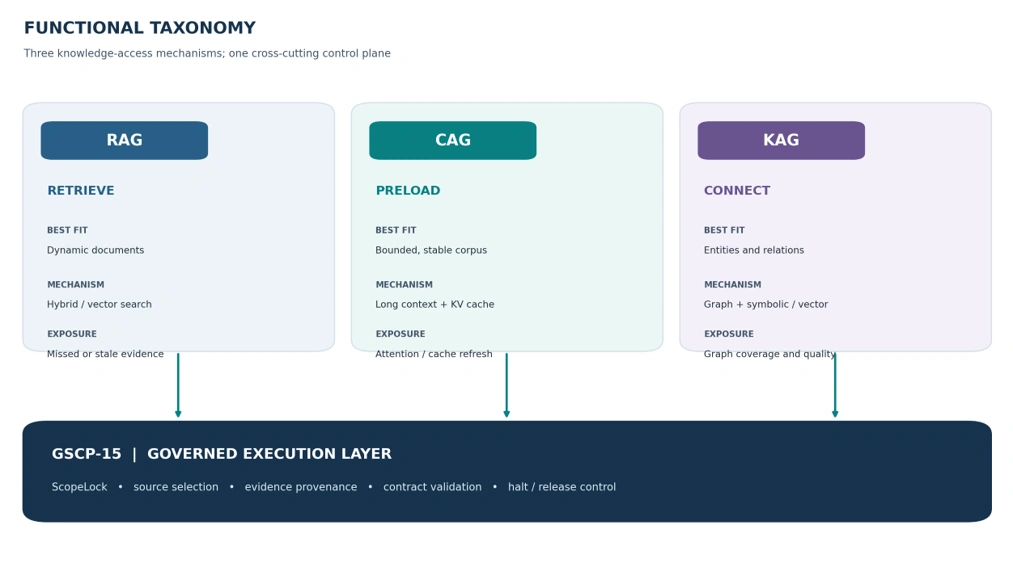
Figure 1. Qualitative functional taxonomy. The lower GSCP-15 band is an architectural control layer, not a fourth competing retrieval algorithm.
3 GSCP-15 as a Governed Orchestration LayerA useful implementation abstraction groups the relevant GSCP-15 responsibilities into four macro-phases. These phases illustrate the relationship among context acquisition, evidence control, and output validation; they should not be mistaken for the full set of 15 GSCP-15 lifecycle stages.
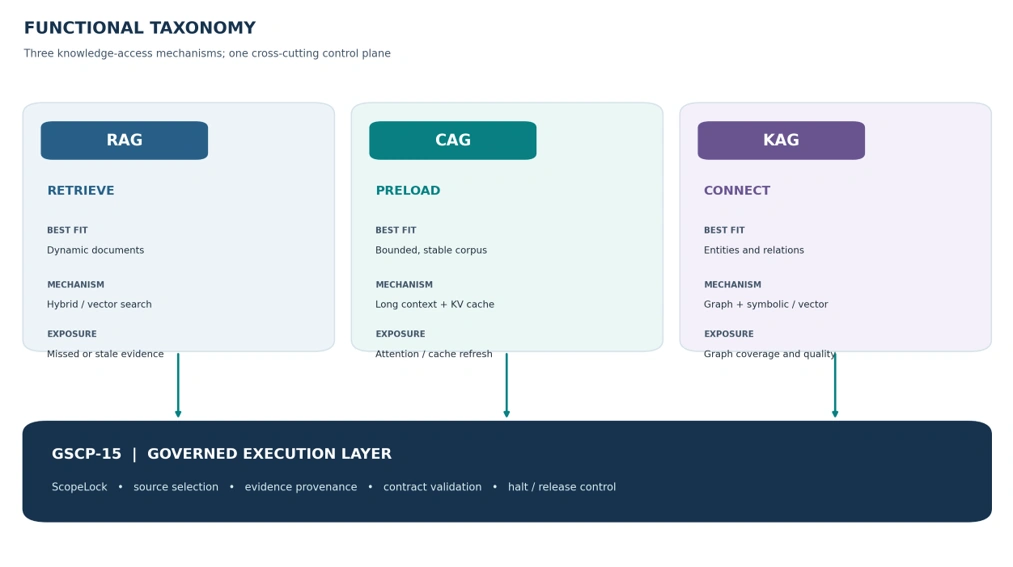
Figure 2. Conceptual four-phase control flow. RAG, CAG, and KAG can be selected independently or combined, while failed release criteria route to repair, escalation, or a controlled halt.
Phase I | ScopeLock and execution contracts
Before accessing external knowledge or invoking tools, the system defines the authorized task boundary: intended outputs, permitted data sources, available tools, nonfunctional requirements, explicit exclusions, and testable acceptance conditions. Contradictions and material missing inputs are represented as unresolved conditions rather than silently converted into assumptions. Machine-checkable contract fields provide stronger enforcement than prompt instructions alone.
Phase II | Selective context acquisition
Routing is determined by workload characteristics, not by a universal ranking among the three paradigms. Frequently updated document repositories favor RAG; bounded, relatively stable reference sets may favor CAG; highly relational or rule-intensive queries may favor KAG. Many enterprise tasks require combinations, such as retrieving a policy clause using RAG and traversing ownership relationships using KAG. The selection policy should also consider freshness, access permissions, retrieval cost, context budget, and fallback behavior.
Phase III | Evidence routing and provenance
The governing layer normalizes results into traceable evidence objects with source identifiers, timestamps where relevant, access scope, confidence or quality signals, and links to claims or actions. Evidence is distinguished from inferred conclusions. Conflicting sources trigger explicit resolution logic; material gaps produce an “evidence insufficient” outcome rather than an unsupported assertion. Cross-source corroboration is valuable, but agreement among dependent sources should not be mistaken for independent confirmation.
Phase IV | Validation, release, and halting
Validation depends on output type. Structured messages can be checked against schemas; generated code can be compiled and tested; policies can be evaluated with formal rules; citations can be inspected for entailment and source availability. Failing artifacts are rejected, repaired within controlled limits, or escalated. A valid schema does not prove a true claim, and a passing test suite cannot prove the absence of defects. The role of the gate is to enforce specified, observable criteria and record residual uncertainty.
4 From Architectural Claims to Testable HypothesesA scientifically defensible comparison must separate retrieval effectiveness from the marginal value of governance. A suitable experimental design evaluates RAG, CAG, and KAG as workload-dependent acquisition strategies, then measures each strategy with and without GSCP-15 controls under otherwise comparable models, datasets, task definitions, and tool permissions. This factorial view avoids drawing causal conclusions from incomparable stacks.
The principal hypothesis is that contract-driven evidence routing and independent validation reduce unsupported releases and unauthorized operations at the cost of additional latency, infrastructure, and occasional false rejection. The hypothesis requires measurement; it is not established simply by describing the architecture.
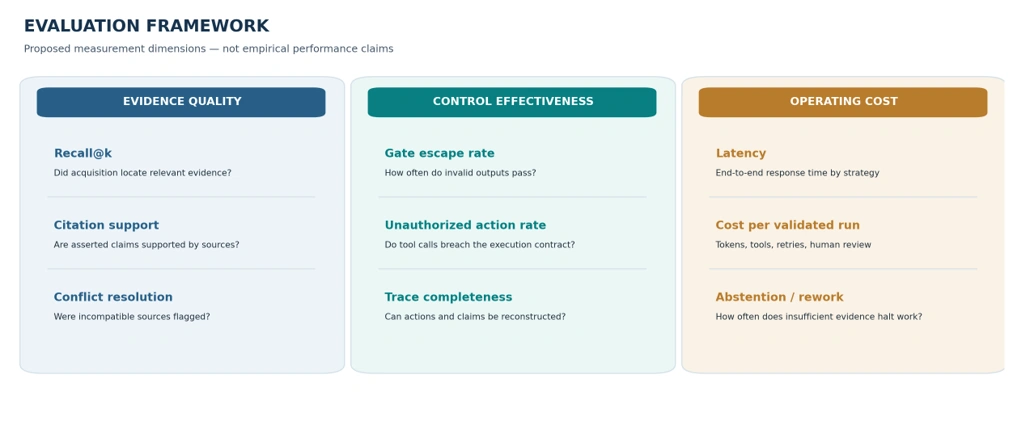
Figure 3. Proposed evaluation dashboard. The measures specify what to collect; the figure intentionally contains no invented benchmark results.
Recommended primary endpoints include claim-level citation support, rate of unsupported high-impact statements, unauthorized tool-action rate, invalid-output escape rate, and reconstruction completeness for audit traces. Secondary endpoints include retrieval recall, accuracy on multihop questions, human-review burden, latency, cost per accepted output, and false-positive halting. Stratified reporting is necessary because improvements on policy-heavy tasks may not generalize to low-risk summarization.
5 Limitations and Open Research QuestionsGovernance introduces trade-offs. ScopeLock contracts depend on the correctness of initial requirements, routing rules may select suboptimal context strategies, and validators can encode incomplete policies or share model-related failure modes. A system that relies solely on LLM self-critique does not obtain independent verification. Additional controls also increase cost, latency, maintenance requirements, and the number of potential operational failure points.
Further challenges include authorization-safe retrieval, prompt injection in external sources, provenance integrity, policy versioning, memory contamination, and adjudication when evidence conflicts. Consequently, “zero hallucination,” universally deterministic execution, and absence of architectural limitations are not defensible general claims. The more precise goal is to bound risks, constrain consequential actions through deterministic software where possible, detect a greater proportion of failures, and make residual uncertainty explicit.
These design goals are directionally compatible with NIST AI Risk Management Framework principles concerning governance, measurement, management, transparency, and reliability; alignment with a framework, however, does not itself constitute certification or an empirical performance result [6].
6 ConclusionRAG, CAG, and KAG address different facets of the enterprise context problem: scalable retrieval, efficient reuse of bounded reference material, and structured relational reasoning. GSCP-15 addresses a higher-order problem: governing how these information sources are authorized, combined, evaluated, and used to produce releasable artifacts. The paradigms are therefore better understood as complementary components than as direct substitutes.
The distinctive promise of GSCP-15 is not that it makes probabilistic models infallible. It is that a specified execution protocol can turn open-ended generation into an observable, testable, and interruptible workflow. That promise becomes an engineering claim only when its controls are implemented as enforceable mechanisms and evaluated against well-defined baselines. In enterprise AI, reliable context access supports correct answers; governed execution determines whether those answers and actions meet explicit operational standards.
References[1] Lewis, P., et al. (2020). Retrieval-Augmented Generation for Knowledge-Intensive NLP Tasks. NeurIPS. https://arxiv.org/abs/2005.11401
[2] Chan, B. J., Chen, C.-T., Cheng, J.-H., & Huang, H.-H. (2024). Don’t Do RAG: When Cache-Augmented Generation Is All You Need for Knowledge Tasks. arXiv:2412.15605. https://arxiv.org/abs/2412.15605
[3] Liang, L., et al. (2024). KAG: Boosting LLMs in Professional Domains via Knowledge Augmented Generation. arXiv:2409.13731. https://arxiv.org/abs/2409.13731
[4] Liu, N. F., et al. (2024). Lost in the Middle: How Language Models Use Long Contexts. Transactions of the Association for Computational Linguistics, 12, 157–173. https://doi.org/10.1162/tacl_a_00638
[5] Godel, J. (2026). GSCP-15 and Governed Agentic AI: A Technical Framework for Reliable LLM Execution. C# Corner. https://www.c-sharpcorner.com/article/gscp-15-and-governed-agentic-ai-a-technical-framework-for-reliable-llm-executio
[6] National Institute of Standards and Technology. (2023). Artificial Intelligence Risk Management Framework (AI RMF 1.0). NIST AI 100-1. https://doi.org/10.6028/NIST.AI.100-1

Join the conversation! Your thoughts help the community grow.