Loading
John Godel's contributions
- Article · AI
GSCP-15 and PT-SLM: Building Governed Agentic AI for Banking and Core Banking Modernization
Learn how GSCP-15 governance and private specialized models can support secure, auditable agentic AI workflows in core banking.
- Ebook · AI Agents
DESIGNING DATA-INTENSIVE APPLICATIONS
Designing Data-Intensive Applications with AgentFactory explores a new approach to architecting, engineering, and operating enterprise data-intensive systems through the power of intelligent, collaborative AI agents. The book demonstrates how AgentFactory’s specialized Digital FTEs, coordinated through Digital PODs and governed Work Orders, can transform complex data engineering challenges into structured, automated, and verifiable delivery processes. Covering data architecture, relational and distributed databases, data pipelines, real-time processing, scalability, reliability, analytics, security, and enterprise governance, it brings together established data engineering principles and AgentFactory’s agentic execution capabilities. Through practical architectural patterns, technical examples, and enterprise scenarios, readers discover how AI-driven collaboration can accelerate application development while maintaining engineering discipline, accountability, and operational contro
- Article · AI
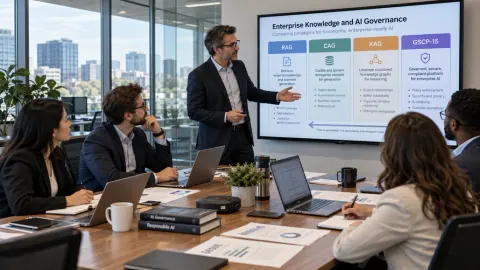
BEYOND RETRIEVAL How GSCP-15 Governs RAG, CAG, and KAG in Enterprise AI
Explains how GSCP-15 governs RAG, CAG, and KAG through execution contracts, evidence provenance, validation gates, and audit controls.
- Article · AI Agents
Beyond Generic Agents: GSCP-15, PT-SLM, and the Architecture of Organizational Digital Intelligence
Enterprise artificial intelligence is progressing from isolated conversational systems toward architectures in which specialized agents can maintain context, apply professional capabilities, use tools, collaborate with other agents, and participate directly in organizational work. This development changes the central architectural question. The question is no longer simply: How capable is the underlying language model? It increasingly becomes: How should model intelligence be structured, specialized, governed, organized, and operationalized inside an enterprise? Gate2ASI AI’s AgentFactory, originally developed as AlpineGate AI’s AgentFactory, addresses this question through two related concepts developed by John Godel: GSCP-15 — Gödel’s Scaffolded Cognitive Prompting and PT-SLM — Private Tailored Small Language Model.
- Article · AI Agents
From Noesis Noeseos to Governed Intelligence: The Metacognitive Paradigm in Gate2ASI AI’s AgentFactory
Explores how AgentFactory applies metacognitive monitoring, evidence, validation, and governance to build accountable autonomous AI agents.
- Article · AI Agents
The Agent Clone Era: From OpenClaw to Dots—and Why Enterprise AI Needs Governance Before Autonomy
OpenAI’s Dots, Meta’s Muse, xAI’s Grok Bot, Google’s Gemini Spark, and a rapidly growing class of persistent AI systems are being presented as the beginning of a new era in computing. Unlike the chatbots that defined the first phase of generative AI, these systems are designed to remain available ov
- Article · AI
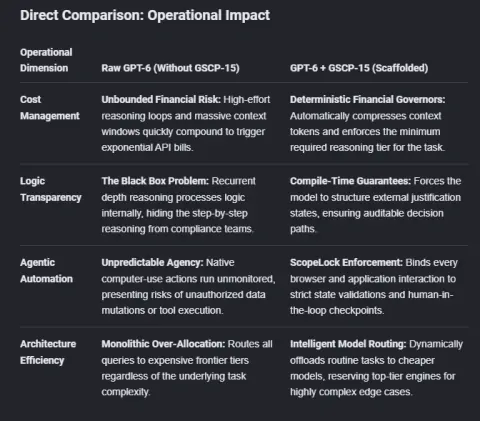
GPT-6 With and Without GSCP-15
The arrival of OpenAI’s GPT-6 architecture—spearheaded by the flagship GPT-6 Astra and its streamlined counterpart GPT-6 Sol [1, 2]—marks a massive leap in raw artificial intelligence capabilities. With a 1.05-million token context window, native computer-use automation, and advanced recurrent depth reasoning, the technology presents an unprecedented opportunity for enterprise automation.
- Article · Prompt Engineering
GSCP-15: Advancing Cognitive Intelligence Through Adaptive Reasoning, Deterministic Governance, and Continuous Learning
Artificial intelligence has reached a point where generating sophisticated responses is no longer sufficient. Enterprise systems increasingly require AI to interpret complex objectives, maintain contextual consistency, reason across multiple domains, execute multi-step tasks, verify results, recover from failures, and retain useful knowledge across interactions. Large language models have demonstrated remarkable capabilities in natural language understanding, code generation, mathematical reasoning, and problem-solving. Nevertheless, these capabilities do not inherently guarantee reliable execution, factual correctness, consistent decision-making, or operational continuity. A model may generate a convincing solution without verifying its correctness. It may repeat an unsuccessful strategy, overlook an authoritative constraint, lose essential context during a long-running task, or declare completion without sufficient evidence.
- Article · C#
C# Is Not Dead: Why It Still Plays a Major Role in the AI World
Artificial Intelligence is transforming the software industry, but the rise of Python and AI-powered development does not mean that established programming languages are becoming obsolete. C# remains highly relevant, and the increasing demand for intelligent enterprise applications is creating new opportunities for C# and the .NET ecosystem.
- Article · AI
Beyond Incompleteness: How John Gödel’s GSCP Architecture Tames Kurt Gödel’s Logical Wall
In 1931, logician Kurt Gödel shattered the foundational assumptions of modern mathematics with his First Incompleteness Theorem. He demonstrated a fundamental truth about formal systems: any consistent axiomatic system powerful enough to describe basic arithmetic cannot prove its own internal consistency from within itself. A system operating strictly within its own boundaries is inherently limited—eventually encountering truths it cannot prove or logic it cannot validate without stepping outside of itself. Nearly a century later, this classic problem has resurfaced in artificial intelligence. Modern Large Language Models (LLMs), when left to reason linearly within a single context execution path, frequently encounter systemic logical failures, hallucinations, and recursive loops. They attempt to validate their own reasoning using the very system that generated it. Enter Godel’s Scaffolded Cognitive Prompting (GSCP), engineered by John Gödel (President and CEO of AlpineGate AI and CEO of Gate2Asi AI). Designed as a direct, structural answer to mathematical incompleteness, GSCP establishes what is formally known as the "Gödelian meta-cognitive loop."
- Article · AI Agents
How AgentFactory Was Actually Built: From a Multidisciplinary Engineering Team to Self-Directed Development
How AgentFactory Was Actually Built: From a Multidisciplinary Engineering Team to Self-Directed Development The development story of Gate2Asi AI's AgentFactory is not the story of a single developer building an enterprise AI platform with the help of a chatbot. It is also not the story of a conventional software organization simply adding AI tools to an existing development process. AgentFactory evolved through a more unusual sequence: a multidisciplinary engineering team built the foundation, AI-assisted development accelerated that team, the platform gradually became capable of participating in its own development, and eventually AgentFactory itself became one of the primary engineering mechanisms used to extend AgentFactory.
- Article · AI Agents
The ROI of Governed Autonomy: Human FTE vs. Digital FTE
For decades, enterprise capacity has been constrained by a simple equation: More work requires more people. If a business needs twice the output, it usually needs more employees, more contractors, more management overhead, more onboarding, more coordination, and more operating cost. Artificial intelligence is beginning to change that equation. But the real transformation is not simply about giving employees AI assistants.
- Article · AI Agents
When AI Becomes Labor, Governance Becomes the Operating System
Why Gate2ASI AI’s AgentFactory (Formerly AlpineGate AI's AgentFactory) Challenges Microsoft, Salesforce, ServiceNow, Google and AWS at the Architecture Level Gate2ASI AI’s AgentFactory — formerly AlpineGate AI’s AgentFactory — is not trying to win the enterprise agent race by building another chatbot, another workflow canvas, or another wrapper around a frontier model. It is pursuing a more ambitious architectural objective: creating the governed operating environment in which Digital Intelligence can function as an accountable enterprise workforce. That distinction is becoming more important by the month.
- Article · AI Agents
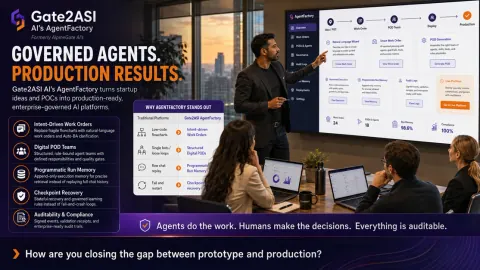
The Trillion-Dollar AI Industry Is Building Agents. Gate2ASI AI Is Building the Enterprise They Work For. by John Godel
The artificial-intelligence industry is racing toward agents. OpenAI is building increasingly capable agent runtimes and model-native execution environments. Microsoft is expanding Copilot Studio into autonomous enterprise agents with permissions, governance, audit logging and human supervision. Google is giving agents identities, security boundaries and production observability. AWS is turning AgentCore into a managed runtime for identity, memory, policy, tools, evaluation and telemetry. Salesforce is surrounding Agentforce with observability and operational controls. LangGraph has made durable execution, checkpointing and human intervention first-class runtime concepts.
- Article · AI
The Blueprint for Democratic Techno-Socialism: Beyond the Digital Panopticon by John Gödel
Humanity stands at a critical historical crossroads. The rapid acceleration of artificial intelligence (AI), automation, and decentralized data networks has granted us an unprecedented capacity to reorganize society. For the first time in history, the logistical tools required to transition from a centralized, coercive state apparatus to a decentralized, self-governing commune are within our reach.
- Article · AI Agents
Governed Autonomy: Why Enterprise AI Needs an Accountable Execution Architecture, Not Just a Smarter Chatbot
Enterprise AI needs accountable execution, not just RAG. AgentFactory offers governed autonomy, verification, and stateful recovery for AI.
- Article · AI Agents
The Illusion of Enterprise AI Governance: Why Tech Giants Are Selling a Black-Box Fantasy—And the Only Real Solution
Unmasking the illusion of enterprise AI governance. Discover why tech giants' 'black-box' solutions fail and the only real path to AI accountability.
- Article · AI Agents
Why the Tech Giants Struggle to Compete with Gate2Asi AI's AgentFactory?
Gate2ASI AI's AgentFactory outpaces tech giants with its governed digital workforce, built from scratch for structured AI operations.
- Article · AI Agents
Gate2Asi AI’s AgentFactory (Formerly AlpineGate AI's): The Governed Digital Workforce Layer for Enterprise AI
Gate2Asi AI's AgentFactory builds a governed digital workforce for enterprise AI, moving beyond agents to accountable work orders and auditable outcomes.
- Article · AI Agents
Vertical, Parallel, and Council-Based Agent Architecture of Gate2ASI AI’s AgentFactory
Gate2ASI AgentFactory: Vertical, parallel, and council-based AI architecture for a governed digital enterprise workforce.
- Article · AI Agents
Beyond Chatbots and Flowcharts: Why Gate2ASI AI’s AgentFactory Is a New Enterprise Execution Model
Gate2ASI AI's AgentFactory redefines enterprise AI execution with a governed digital workforce, moving beyond chatbots for dependable business outcomes.
- Article · AI Agents
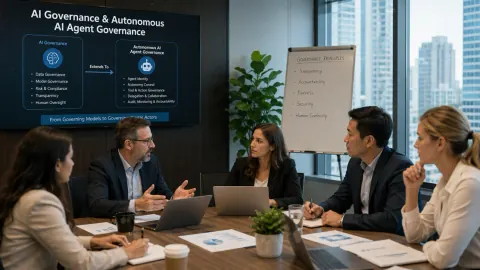
AI Governance and Autonomous AI Agent Governance: From Controlling Models to Governing Digital Actors - Human-in-the-Loop Is Not Enough
AI governance evolves from model control to governing autonomous digital actors, emphasizing identity, authorization, and accountability for responsible operations.
- Article · AI Agents
Gate2ASI AI’s AgentFactory: From Agent Memory to Governed Operational Intelligence
Gate2ASI AI's AgentFactory builds governed digital teams with persistent memory, operational intelligence, and human oversight for reliable enterprise AI.
- Article · AI Agents
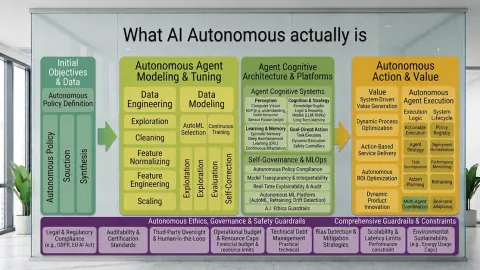
What AI Autonomous Actually Is: Deconstructing the Enterprise Reality by John Gödel
Deconstruct enterprise AI autonomy: explore its four-stage pipeline, essential guardrails, and how platforms streamline complex deployments.
- Article · AI Agents
The No-Code Revolution in Enterprise AI: Designing Without Overhead in Gate2ASI AI’s AgentFactory
Gate2ASI AI's AgentFactory revolutionizes enterprise AI with no-code design, empowering non-technical users to build intelligent agents effortlessly.