
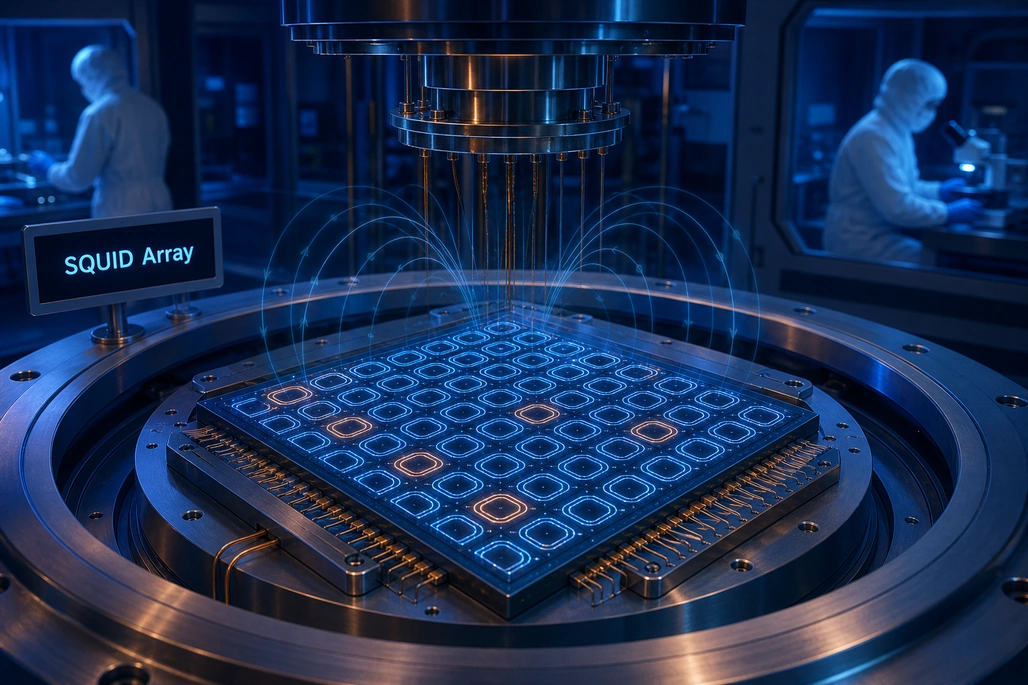
The research changes the layout of a superconducting sensor array rather than its physical loop sizes.
Adelaide University researchers have demonstrated a new design for superconducting quantum interference filter (SQIF) arrays that can identify an absolute magnetic field without physically making every sensing loop a different size. Published in Physical Review Applied on October 26, 2026, the work replaces selected active SQUID loops with junction-free “bare loops,” producing a “synthetic area spread” that preserves a uniform physical geometry while delivering the distinctive response needed for absolute magnetic sensing.
For beginners, the important point is simple: the researchers found a circuit-design alternative to a longstanding hardware trade-off. The result is an experimentally verified sensor-array principle, not yet a commercial medical scanner or communications product, but it could help future cryogenic quantum sensors retain high performance while becoming easier to fabricate.
Key takeaways
- A SQUID is a superconducting circuit that converts extremely small changes in magnetic flux into an electrical signal.
- Traditional two-dimensional SQUID arrays use differently sized loops to distinguish an absolute field value, but that geometry can compromise optimized loop performance.
- The Adelaide design uses selected bare superconducting loops with no Josephson junctions to create an equivalent, synthetic distribution of loop areas.
- The authors derived the theory and tested fabricated SQIF arrays, reporting behavior that aligned with their predictions.
- The study remains at the cryogenic circuit research stage; it does not demonstrate a deployed clinical, industrial, or communications device.
What did Adelaide University announce?
On October 27, 2026, Adelaide University announced research from its Quantum and Nano Technology Group, or QuaNTeG, led by Associate Professor Giuseppe C. Tettamanzi with Ross D. Monaghan and Jonathan L. Marenkovic. The team’s paper, “Synthetic area spread in two-dimensional arrays of superconducting quantum interference filters”, appeared in Physical Review Applied the previous day.
The research focuses on two-dimensional arrays of superconducting quantum interference devices, commonly called SQUIDs. More precisely, the paper studies SQIF arrays: networks of SQUID loops designed to turn magnetic flux into a voltage response suitable for highly sensitive radio-frequency and magnetic-field measurements.
The reported advance is not a newly discovered superconducting material or a quantum-computing processor. It is a circuit-architecture result. The researchers showed that a carefully chosen pattern of conventional SQUID loops and bare superconducting loops can give an array the response of an unequal-area design even when the physical loops have equal areas.
This matters because an absolute magnetometer needs more than the ability to notice that a field changed. It must also be able to associate its output with a unique field value, including the zero-field point, over its intended operating range.
What is a SQUID and why is it so sensitive?
A superconducting quantum interference device is a magnetic sensor built from a loop of superconducting material interrupted by one or more Josephson junctions. A Josephson junction is a thin barrier between superconductors through which quantum mechanical current can pass. At sufficiently low temperatures, superconductors carry electric current with no electrical resistance.
When magnetic flux passes through a SQUID loop, it changes the phase relationship of the superconducting current traveling around the loop. The currents that meet at the junctions interfere with one another. That interference changes the circuit’s electrical output, enabling very small variations in magnetic field to be measured.
The National Institute of Standards and Technology describes SQUIDs as quantum magnetometers in which a superconducting loop and insulating barriers convert magnetic-field changes into oscillations in current. In practical terms, the loop acts like an exceptionally sensitive antenna for magnetic flux.
SQUID sensitivity explains their use in specialized scientific instruments. It also explains their relevance to magnetoencephalography, or MEG, which measures magnetic fields generated by brain activity. The National Institute of Mental Health’s MEG Core states that its 275-sensor MEG system uses SQUID sensors to passively detect brain magnetic fields around 10-14 tesla.
Why is measuring an absolute magnetic field difficult?
The electrical response of a SQUID is periodic: as magnetic flux increases, a similar response pattern repeats. A single output value can therefore correspond to more than one possible magnetic-field value. The sensor may be excellent at detecting a change in flux while still lacking enough information to identify the absolute field unambiguously.
Consider a clock face. If a reader sees only that the minute hand points at 12, it cannot determine whether the time is 12:00, 1:00, or 2:00 without another clue. Similarly, a periodic SQUID response needs additional circuit information to identify where it is within repeated cycles.
Existing SQIF designs address this issue by using loops with incommensurate areas: their areas are deliberately different in a way that prevents their periodic responses from lining up repeatedly. When the many signals are combined, the array can create a distinctive feature around zero applied magnetic field.
The cost is a design compromise. According to the paper, imposing an area spread conflicts with optimizing each individual SQUID loop for the array’s highest performance. Fabricating large arrays with many loop sizes can also add manufacturing complexity.
| Design approach | Physical loop areas | How it supports absolute sensing | Main trade-off |
|---|---|---|---|
| Conventional equal-area SQUID array | Uniform | Its periodic response can leave field values ambiguous. | Does not inherently provide the desired absolute-field signature. |
| Conventional unequal-area SQIF array | Deliberately different | Different periodicities combine into a distinctive voltage-versus-flux response. | Area variation can conflict with optimizing individual loops and complicates fabrication. |
| Adelaide mixed-SQUID array | Uniform physical areas | Selected bare loops create a synthetic area spread. | Requires further performance, packaging, and application-specific validation. |
How does the synthetic area spread work?
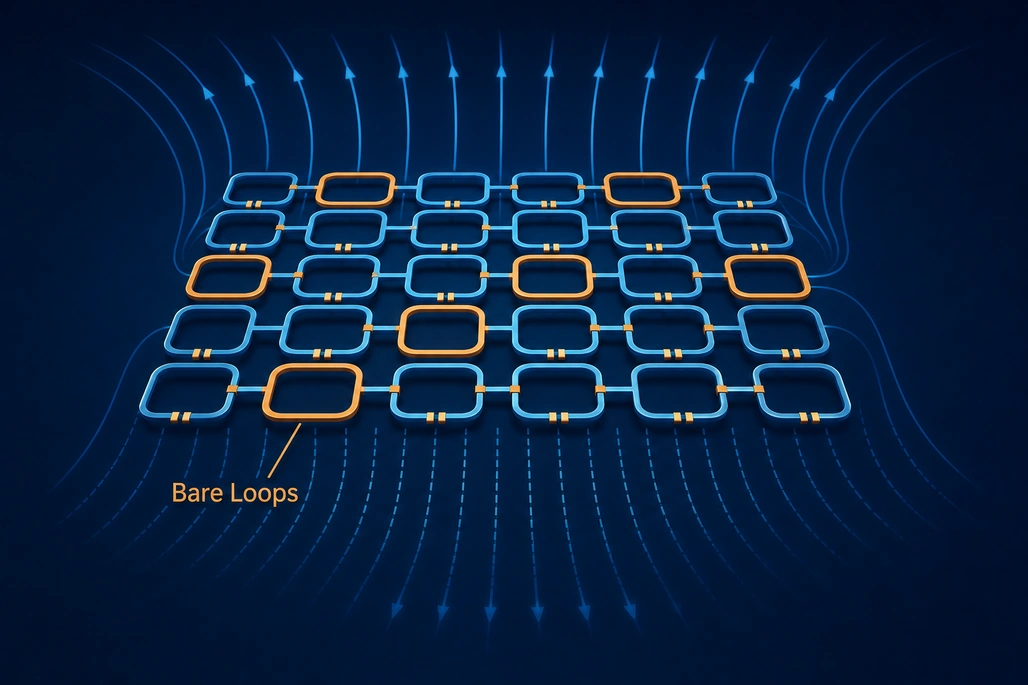
Selected bare loops create the array-level behavior called a synthetic area spread.
The Adelaide team’s central idea is to preserve same-sized superconducting loops but make some loops active SQUIDs and others bare loops. A bare loop is still superconducting, but it contains no Josephson junctions. It does not operate as a conventional SQUID sensing cell.
That absence is purposeful. In a connected two-dimensional circuit, bare loops alter how the magnetic-flux response is distributed through the network. Their location changes the collective electrical behavior of the active SQUID loops around them.
The authors call the resulting effect a synthetic area spread. The word synthetic does not mean simulated or artificial data. It means the circuit produces the electrical effect that a physical distribution of unequal SQUID loop areas would normally provide, without physically fabricating such a distribution.
The paper presents an analytical one-to-one correspondence between the distribution of bare loops and an equivalent distribution of physical SQUID loop areas. In other words, the placement pattern can be treated mathematically as if it generated a particular area spread in a conventional all-SQUID array.
What is the beginner-friendly circuit walkthrough?
- Start with a regular array. Imagine a grid of identical superconducting loops, each equipped with Josephson junctions. Every active cell is designed around the same optimized geometry.
- Identify the ambiguity. Because equal active loops respond periodically in the same way, the combined voltage response lacks a unique signature that reliably identifies zero or another absolute field point.
- Replace selected active cells. Keep the physical loop dimensions the same, but remove the Josephson junctions from carefully selected positions. Those cells become bare loops.
- Change the network response. The bare loops influence the flux and current relationships across neighboring active SQUID loops, so the array no longer behaves like a simple set of identical periodic sensors.
- Obtain an equivalent area-spread effect. The active SQUID portion of the circuit responds as though it had a suitable range of loop areas. This can generate the absolute-magnetometer response without physically varying every loop.
This is a collective effect. It does not mean a bare loop magically changes its measured physical area. Instead, the complete connected circuit changes the effective relationship between applied magnetic flux and output voltage.
What did the researchers test?
The paper reports both theory and fabrication experiments. The authors fabricated several two-dimensional SQIF arrays that incorporated bare superconducting loops, then measured their voltage-to-magnetic-flux behavior at very low temperatures.
The article’s abstract states that the experimental devices behaved in alignment with the theory. That experimental agreement is important because the result is not only a proposed layout or numerical model. It is a demonstrated circuit behavior in fabricated superconducting devices.
The associated international patent application describes examples including 16-by-16 mixed-SQUID devices measured at temperatures including 4.2 kelvin, 4.5 kelvin, and 5.1 kelvin. These temperatures underscore a practical limitation: the reported devices are cryogenic superconducting circuits, not room-temperature magnetic sensors.
The study does not report a clinical trial, an installed MEG system, a packaged commercial receiver, or a head-to-head system-level comparison against every established unequal-area SQIF design. Those distinctions are essential when interpreting potential applications.
Why could this matter for medicine and communications?
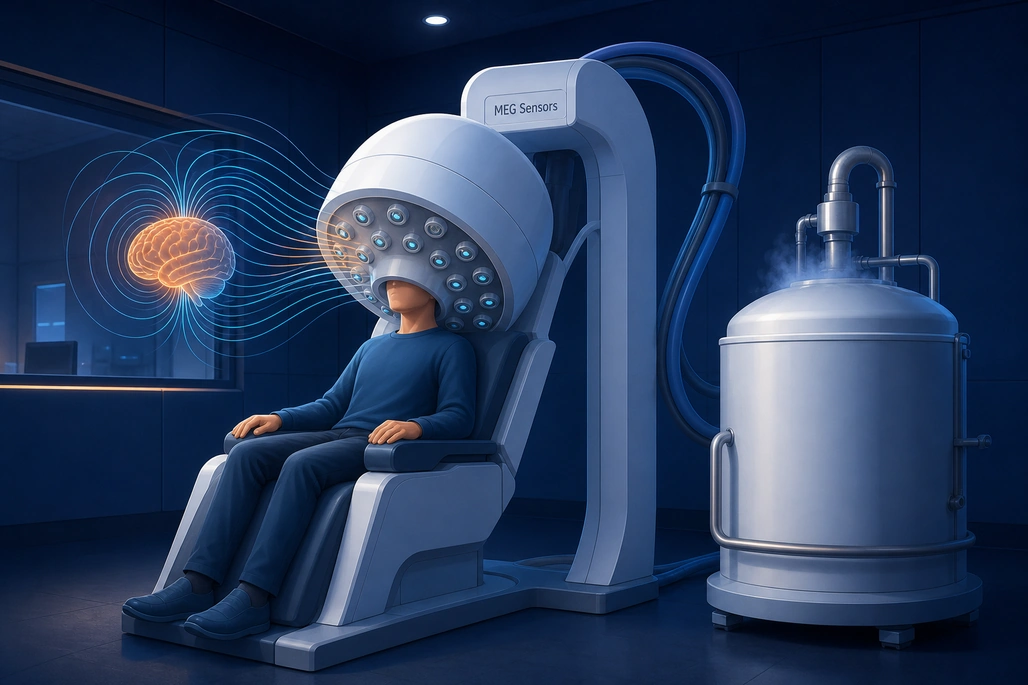
SQUID technology is already used in specialized systems that detect extremely weak magnetic signals.
SQUID-based sensing is relevant wherever an instrument must extract a weak magnetic or electromagnetic signal from substantial background noise. Brain imaging is a prominent example because neural magnetic signals are exceptionally faint. The NIMH MEG Core uses 275 SQUID sensors distributed around a helmet to record these signals noninvasively.
A sensor architecture that maintains an absolute-field response while retaining a uniform physical loop design could be useful in future sensor arrays, provided subsequent experiments establish the needed noise, bandwidth, stability, fabrication yield, and system-integration performance. Adelaide University identified brain monitoring, medical diagnostics, radio-frequency receivers, low-noise communications, and electromagnetic sensing as possible future areas.
However, potential relevance is not proof of an application-level improvement. Medical imaging systems must also address magnetic shielding, cryogenic operation, patient-facing hardware, calibration, safety, data processing, and regulatory requirements. A radio-frequency platform must likewise be evaluated for operating frequency, linearity, dynamic range, noise, packaging, and readout electronics.
The clearest immediate contribution is at the device-design level: it offers a new way for engineers to reason about the trade-off between absolute measurement and optimized, repeatable loop geometry.
What are the trade-offs and limitations?
The new design removes one geometry problem, but it does not remove the fundamental engineering demands of superconducting sensing. SQUID systems require low-temperature operation, which can require substantial cryogenic equipment. NIST notes that the refrigerators needed for SQUID operation are a major reason such systems remain bulky and expensive.
Array-level behavior must also be reproducible. The eventual value of a mixed-SQUID layout will depend on fabrication tolerances, junction consistency, magnetic shielding, readout design, biasing, and the performance of the whole package rather than the circuit alone.
There is also a difference between a design principle and a sensor specification. The published abstract establishes a synthetic-area mechanism and experimental verification of the voltage-to-flux response. It does not provide a universal claim that every future mixed array will be more sensitive, cheaper, or better for every application.
The authors and Adelaide University are appropriately cautious: additional testing is required before commercialization. The patent application and continued studies indicate active development, not a product availability date.
How can beginners get started with SQUID quantum sensing?
Beginners do not need to fabricate a superconducting circuit to understand this research. Start by separating four ideas that are often blended together: superconductivity, Josephson junctions, magnetic flux, and interference. A SQUID is where these concepts become an electrical measurement tool.
Next, learn the difference between relative and absolute sensing. A relative sensor tells an instrument that something changed. An absolute sensor gives the instrument a reliable reference for the field value itself. The Adelaide work is fundamentally about adding that reference behavior without sacrificing a uniform physical loop design.
Then read the paper’s abstract alongside introductory material from NIST on quantum magnetic sensors. The research is easier to follow when viewed as an array-design problem: engineers are shaping the combined response of many loops, not merely improving one isolated sensor.
Finally, treat applications such as MEG, communications, and next-generation quantum devices as directions for validation rather than finished outcomes. That distinction is the best way to understand both the promise and the present limits of this bare-loop SQUID design.
Frequently asked questions
What is a bare loop in a SQUID array?
A bare loop is a superconducting loop with no Josephson junctions. In the Adelaide mixed-SQUID design, selected bare loops are placed among active SQUID loops to alter the array’s collective magnetic-flux response.
What is a synthetic area spread?
A synthetic area spread is the equivalent area-distribution effect created by the placement of bare loops in a uniform physical array. The active SQUID array behaves as though it contains differently sized loops even though the physical loop areas are not varied.
Does this discovery create a new medical brain scanner?
No. The published work demonstrates and experimentally tests a cryogenic superconducting circuit design. Brain imaging and medical diagnostics are potential future applications, not devices demonstrated in this study.
Why do SQUID arrays need an absolute magnetic-field response?
A SQUID’s response to magnetic flux is periodic, so the same output can correspond to more than one field value. An absolute response provides a distinctive reference that helps the system identify the actual field value, including zero field.
When will bare-loop SQUID sensors be commercially available?
No commercialization date has been announced. Adelaide University states that further testing is needed, while the research team continues work on performance improvements and applications.
Based on reporting by adelaide.edu.au, Physical Review Applied, National Institute of Standards and Technology, National Institute of Mental Health and Patsnap Eureka.

Join the conversation! Your thoughts help the community grow.