
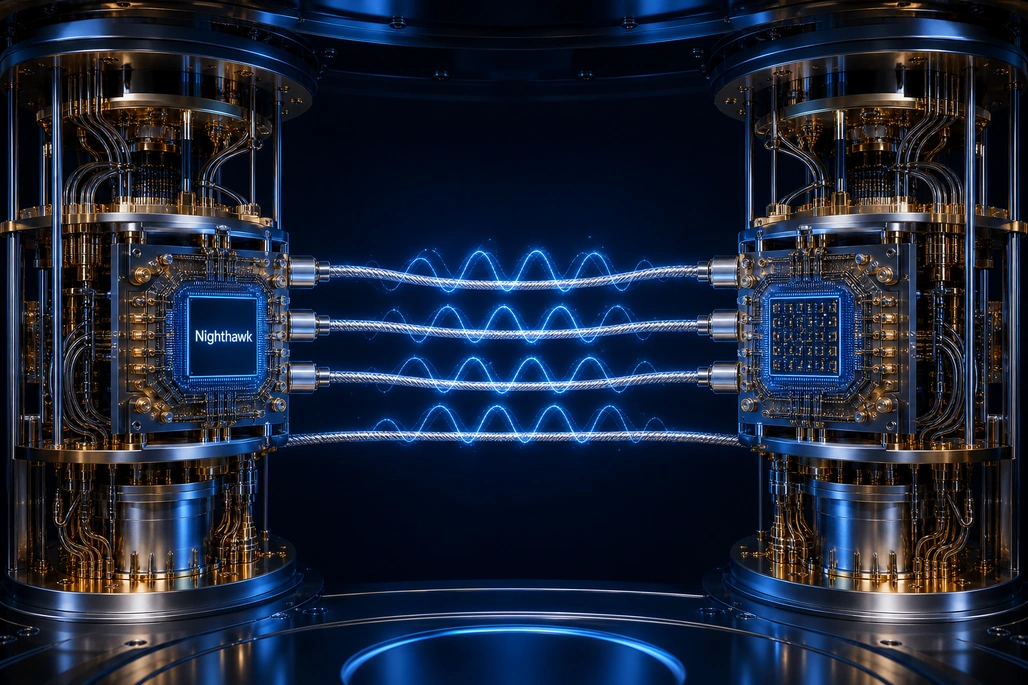
Four L-couplers connected two IBM Nighthawk R1 processor modules in the reported experiment.
IBM researchers have demonstrated four meter-scale quantum interconnects, called L-couplers, between two 120-qubit IBM Nighthawk R1 superconducting processors. In a paper submitted to arXiv on October 21, 2026, the team reported average quantum-state-transfer fidelity of 99.00% across 80-centimeter superconducting cables and average fidelity of 94.75% for CZ gates performed between qubits on different processor modules. The result is an important hardware demonstration for modular quantum computers, although the research is a preprint and has not yet been peer reviewed.
Key takeaways
- Each of the four L-couplers connects one qubit region on one IBM Nighthawk R1 processor to a counterpart region on a second processor through an 80-centimeter superconducting aluminum coaxial cable.
- The experiment achieved 99.00% mean state-transfer fidelity, with the best individual link measured at 99.29% plus or minus 0.07%.
- A complete cross-module CZ operation averaged 94.75% fidelity because it combines state transfers with several local quantum gates.
- The system generated entanglement across the processors, including simultaneous Bell pairs using two neighboring L-couplers.
- This is an engineering result toward modular systems, not a public 240-qubit processor or a general-purpose quantum network.
What did IBM demonstrate?
The researchers connected two separate 120-qubit IBM Nighthawk R1 processors using four independent L-couplers. An L-coupler is a long-distance, cryogenic connection designed to move quantum information between superconducting processor modules while preserving the fragile quantum state involved in the computation.
The core result is described in the primary arXiv paper, “Meter-scale quantum interconnects between large quantum processors”. Each link uses an approximately 80-centimeter aluminum coaxial cable, operates using modes near 5 GHz, and joins dedicated hardware at both ends of the cable. The cables were installed after the processor modules had already been mounted inside the cryogenic system.
It is useful to separate the chip count from the demonstrated workload. The experiment involved two full Nighthawk R1 chips, each with 120 qubits, but the paper states that only a subset of qubits around the L-couplers was wired and measured for this development experiment. It therefore does not mean that every qubit on both processors was used as one 240-qubit computational device.
Nighthawk R1 is the first revision of IBM’s 120-qubit Nighthawk processor family, introduced in December 2025. IBM describes the family as using a grid topology with increased connectivity relative to earlier processor designs.
Why do quantum computers need interconnects?
Adding more qubits to a single chip is not the only way to build a larger quantum computer. As systems grow, fabricating, controlling, wiring, cooling, testing, and repairing one ever-larger processor becomes harder. A modular architecture instead aims to connect multiple processor modules so that they can participate in one calculation.
The challenge is much harder than sending data over a normal cable. A classical network can copy bits, buffer them, retransmit corrupted packets, and inspect messages during debugging. Quantum states cannot be copied in the same way, and measuring a qubit generally destroys the superposition that the quantum computation needs. The interconnect must move or create useful shared quantum states without turning them into ordinary classical data.
In this work, the interconnect remains inside a cryogenic environment and uses superconducting microwave hardware. It is not an optical link between distant buildings, and it is not a quantum internet connection. IBM distinguishes this approximately one-meter scale from longer one-to-ten-meter connections and future kilometer-scale optical quantum-network research.
The modular approach matters because a large algorithm or an error-correction code may need qubits that reside on different chips to become entangled. If that connection is reliable enough, the separate modules can act as parts of a larger quantum system for selected operations.
How does an L-coupler move a quantum state?
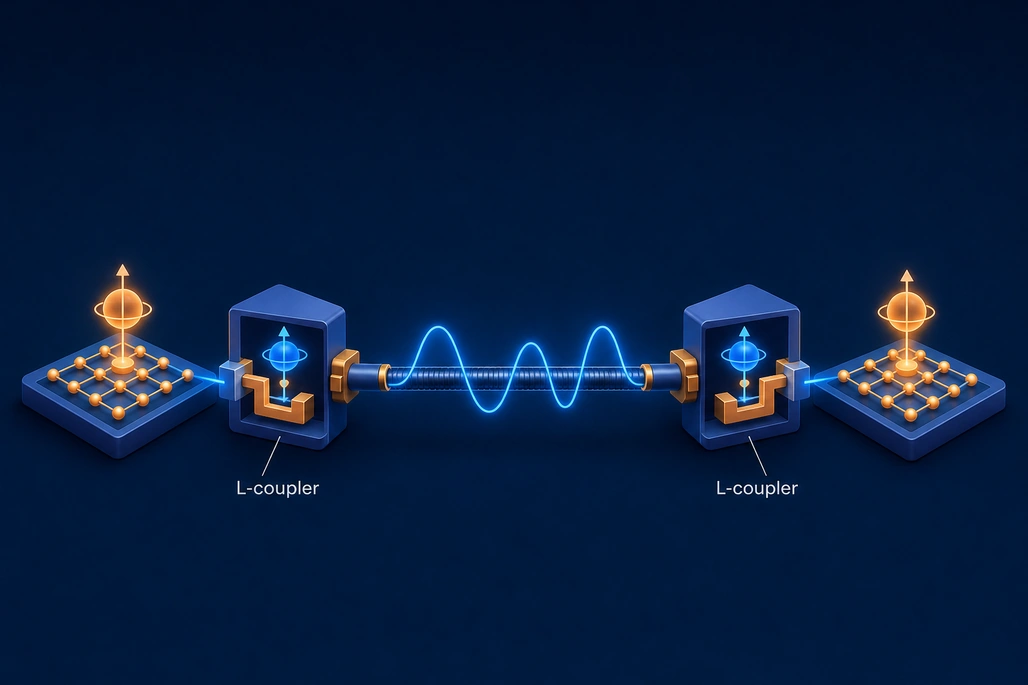
An L-coupler includes the dedicated transfer qubits, tunable couplers, cable attachment, and superconducting cable.
An L-coupler is not just the cable. It is the complete path between processor modules: the cable, the cable-to-chip attachment, dedicated frequency-tunable L-qubits, tunable couplers, and local connections to the Nighthawk processor’s lattice qubits.
At each end, a lattice qubit on the main processor connects to a dedicated L-qubit through a tunable coupler. The L-qubit connects to the aluminum cable through an RF-SQUID-based tunable component that the paper calls an i2m coupler. By tuning the components, the system can exchange a quantum excitation between an L-qubit and a selected standing-wave mode in the cable.
A simple beginner-friendly analogy is a relay rather than a continuous wire carrying an ordinary signal. The state moves from a working qubit to a local transfer qubit, occupies a selected mode in the superconducting cable, arrives at a transfer qubit in the other module, and can then be used by a qubit on that processor.
| Component | Role in the experiment | Why it matters |
|---|---|---|
| Nighthawk lattice qubit | A computational qubit on the main processor chip | It is where a cross-module operation ultimately begins or ends. |
| L-qubit | A dedicated, frequency-tunable transfer qubit | It interfaces between the processor lattice and the cable. |
| i2m coupler | A tunable qubit-to-cable coupler | It controls coupling between an L-qubit and the cable mode. |
| Aluminum coaxial cable | An approximately 80-centimeter superconducting path | It carries the microwave mode used for the relay transfer. |
| Indium pressure bond | The room-temperature cable-to-chip connection | It makes the physical connection after the modules are mounted. |
The researchers isolated one standing mode of the 80-centimeter cable near 5 GHz and used it for relay-based state transfer. The paper reports internal quality factors from 0.86 million to 1.09 million for the L-coupler modes, a measure related to how effectively a resonant system stores energy rather than losing it.
What do 99% state-transfer fidelity and 94.75% gate fidelity mean?
These two percentages measure different tasks, so they should not be treated as competing scores. State-transfer fidelity measures how accurately the system transfers a quantum state through an L-coupler. The reported mean was 99.00% across the four links, and every link measured at least 98.86%.
The team used network benchmarking for the transfer measurement. The paper explains that this method removes state-preparation and measurement error from the quoted transfer fidelity, making results more comparable across the four links. This does not mean every possible end-to-end application operation succeeds 99% of the time.
A distant CZ gate is a more demanding operation. A CZ, or controlled-Z, is a two-qubit gate commonly used to create entanglement and build quantum circuits. Here, the two lattice qubits were on different processor modules.
To create that distant CZ, the implementation combined three local CZ gates, two state transfers, four single-qubit gates, and one virtual phase correction. That extra sequence explains why the mean distant-CZ fidelity was lower, at 94.75%, even though the underlying state transfers averaged 99.00%.
The best distant CZ link reached 96.42% plus or minus 0.28%. The paper attributes a substantial portion of the remaining difference between its component-error estimate and the measured gate result to residual population left on L-qubits after incomplete state transfer.
What entanglement did the researchers create across the processors?
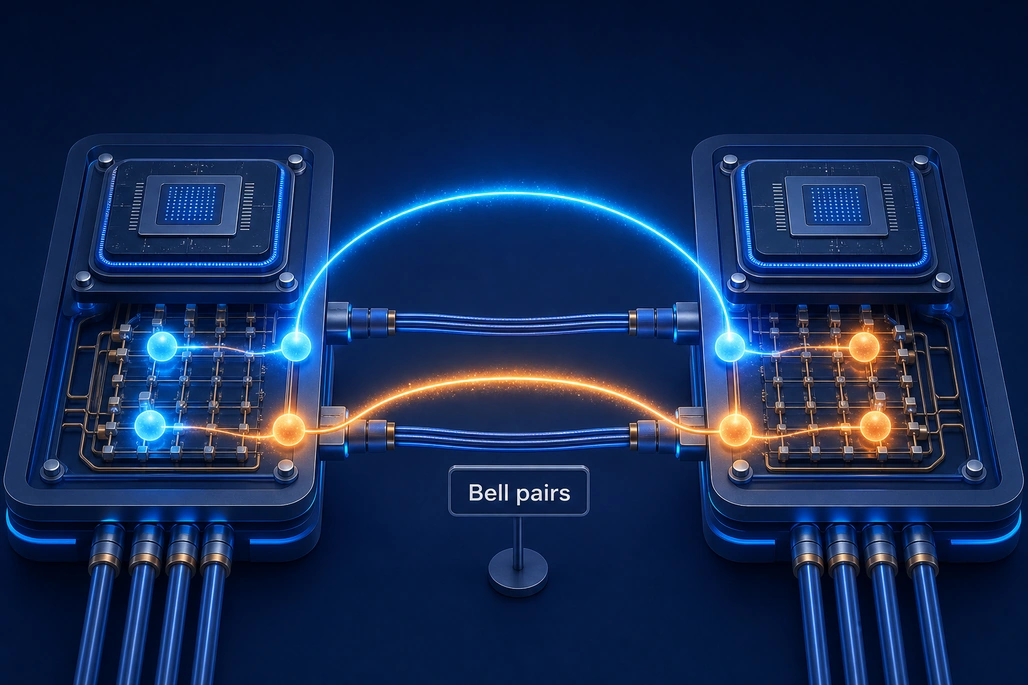
The experiment generated Bell pairs simultaneously across two neighboring L-couplers.
The team used the distant CZ operations to create entangled states spanning the two modules. A Bell pair is a two-qubit entangled state; measuring one qubit produces correlations with the other that cannot be explained as two independent classical bits. Bell pairs are a basic resource for quantum communication and distributed quantum computation.
One individually generated Bell pair had unmitigated fidelity of 85.91% plus or minus 0.40%, or 93.94% plus or minus 0.27% with readout mitigation. A second Bell-pair path measured 76.93% plus or minus 0.49% unmitigated and 86.98% plus or minus 0.41% with readout mitigation.
Importantly, the researchers also generated those two Bell pairs simultaneously over adjacent L-couplers. That test is significant because a modular system will need multiple links to work without one connection preventing another from operating independently.
The paper further reports four-qubit and six-qubit GHZ states distributed across the modules. A GHZ state extends entanglement beyond two qubits, making it a useful demonstration that the L-couplers can support operations beyond the qubits immediately adjacent to the cable interface.
What engineering problems did the experiment expose?
High fidelity is necessary, but hardware that cannot be assembled and maintained reliably will not scale into a useful modular computer. The experiment therefore examined physical packaging as well as quantum operations.
The cable enters perpendicular to the processor surface, rather than lying parallel to it. This layout is intended to support denser connections. The team used a spring-loaded holder that installs two cable connections at one time, with an indium-to-indium pressure bond made at room temperature after module mounting.
The connections also survived three thermal cycles without being touched. That result matters because large cryogenic systems must be warmed, serviced, modified, and cooled again during their working lives.
The study also identified magnetic field exposure during cool-down as a loss mechanism for aluminum cables. The researchers found that cable performance depended on the magnetic field present while the cable crossed into its superconducting state. This is a practical warning: modular quantum hardware requires careful control of shielding, cabling, packaging, and assembly conditions, not only good chip design.
How does this fit IBM’s modular quantum roadmap?
IBM announced its first connected modular cryogenic systems on August 19, 2026. The company said those two modules jointly cooled below 15 millikelvin and that each module provides up to 12 times more wiring space than widely used IBM systems. IBM’s stated 2027 roadmap goal is to use L-couplers to link multiple processors into a system with at least 1,000 programmable qubits.
The October 2026 L-coupler preprint supplies a more direct hardware demonstration of cross-module quantum operations than the earlier cryogenic-system announcement. It shows four links between Nighthawk R1 processors, state transfer, remote entangling gates, and simultaneous use of two links.
However, the result should be read as a milestone rather than an end state. The work is a preprint, it used a limited wired subset of the chips, and the distant-gate fidelity remains lower than the state-transfer fidelity because the present implementation adds transfer and local-gate overhead. Independent coverage has also noted that further improvements are needed before the interconnects are ready for broad operational use.
How should beginners interpret this result?
For beginners, the clearest interpretation is that IBM has tested a plausible way to connect substantial superconducting processors inside a shared ultra-cold system. The key advance is not merely that a cable exists; it is that four connections operated with high state-transfer fidelity, supported cross-chip CZ gates, and created entanglement across two 120-qubit modules.
It is not evidence that quantum computers have already reached fault tolerance, that a 240-qubit system is available to users, or that quantum messages can now be sent across the internet. It is a hardware-building-block demonstration for modular computing.
The next technical questions are whether the design can support many more links, maintain or improve fidelities under system-scale control conditions, and integrate effectively with quantum error correction. Those questions will determine whether modular architectures can turn separate quantum chips into practical large-scale machines.
Frequently asked questions
What is an IBM L-coupler?
An IBM L-coupler is a cryogenic, meter-scale quantum interconnect that combines dedicated L-qubits, tunable couplers, cable-to-chip joins, and a superconducting coaxial cable to connect separate superconducting processor modules.
How far did IBM transfer quantum information in this experiment?
Each demonstrated L-coupler used an approximately 80-centimeter superconducting aluminum coaxial cable between two IBM Nighthawk R1 processor modules.
Did IBM build a 240-qubit quantum computer?
No. The experiment connected two 120-qubit processors, but the paper says only a subset of qubits near the L-couplers was wired and measured. It demonstrated interconnect hardware and cross-module operations rather than a publicly available 240-qubit machine.
Why is the distant CZ gate fidelity lower than the state-transfer fidelity?
The distant CZ is a complete multi-step operation. In this implementation it combines two state transfers, three local CZ gates, four single-qubit gates, and a virtual phase correction, so errors from several operations contribute to its 94.75% mean fidelity.
Has the L-coupler research been peer reviewed?
No. The paper was submitted to arXiv on October 21, 2026, and is available as a preprint. Its results should be treated as reported research pending peer review.
Based on reporting by arXiv.org, IBM Newsroom, IBM Quantum Documentation, IBM Quantum Computing Blog, ScienceAlert and Live Science.

Join the conversation! Your thoughts help the community grow.