Loading
Ajay Kumar's contributions

Why Any() Outperforms Count() in Collection Checks
Efficiency in programming is vital, and choosing the right method for tasks is crucial. Explore why Any() often outperforms Count() in specific scenarios with illustrative examples in C#.

Understanding Directives in .NET
Explore the significance of directives in .NET development, understanding types like preprocessor, reference, warning suppression, and nullable context directives. Learn their syntax and implementation through practical examples for effective coding.
Mastering Object Creation in C#
Learn to create objects in C# step-by-step. Define classes, instantiate objects, access members, use constructors, and explore static constructors—master object creation for robust C# applications.
Learn about Data Structures in .NET
Explore key .NET data structures—Lists, Queues, Stacks, and Dictionaries. Learn their practical applications through examples for efficient and scalable software development in the .NET ecosystem.

SQL Tuning - Effective Strategies with Practical Examples
SQL Tuning — Effective Strategies with Practical Examples
Repository Pattern with Multiple Databases in C# and .NET
Implementing the Repository Pattern with multiple databases in C# and .NET requires strategic abstraction, database-specific implementations, entity mapping, and transaction management. Explore challenges and best practices for efficient data access.
Understanding Caching in .NET With Example
Caching is a cornerstone in .NET development, enhancing application performance and scalability. This article explores its significance, and diverse caching techniques, and offers a practical example for efficient implementation in .NET applications.

Service Lifetimes in .NET Core Applications
In .NET Core, understanding service lifetimes is crucial for efficient dependency management. This article explores transient, scoped, and singleton lifetimes with practical examples in ASP.NET Core applications.

ASP.NET Core with Hosted Service & Lifecycle Events
ASP.NET Core with Hosted Service & Lifecycle Events explores the integration of background tasks in ASP.NET Core applications. Learn how to implement long-running processes efficiently, manage service lifetimes, and leverage lifecycle events for graceful initialization and shutdown.
Distributed Tracing with OpenTelemetry in .NET Core
OpenTelemetry revolutionizes observability in software development, offering a unified approach to collecting telemetry data across distributed systems. With its standardized APIs and SDKs, developers can effortlessly instrument their .NET Core applications for distributed tracing,
Fortifying your .NET Project
This article explores essential strategies to enhance the security of .NET projects, addressing common threats like SQL injection and XSS. It covers input validation, parameterized queries, authentication, secure communication, XSS prevention, and dependency management for robust application security.
Learn about Sealed Classes in C#
In C# programming, sealed classes offer control over inheritance but can be restrictive. This article delves into unlocking their potential using extension methods and the decorator pattern. These techniques enable extending sealed classes' functionality without compromising code integrity,
Mastering Middleware in .NET
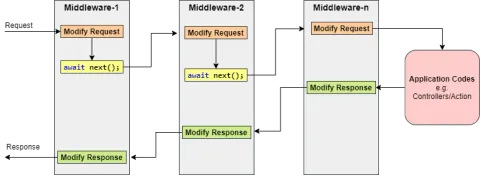
Discover the role and importance of middleware in .NET development. Explore its implementation, patterns, and integration within the ASP.NET request processing pipeline for enhanced application functionality and flexibility.
What is Memento Pattern in C#?
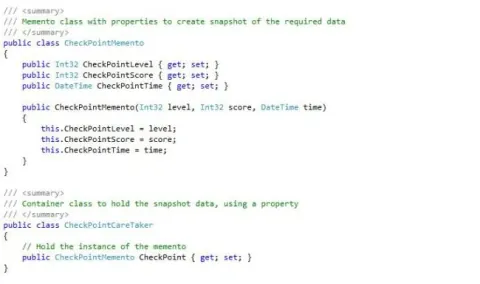
Learn how to implement the Memento pattern in C# to capture and restore object state for checkpoints, undo operations, and state recovery.
Difference Between Raw SQL and Dapper
Explore the trade-offs between using raw SQL queries and leveraging Dapper, a micro-ORM for database access in C# development. Delve into performance, code maintainability, and efficiency to make informed decisions in your data retrieval strategies.
Common Implementation Mistakes of Work Pattern in C#
Exploring common mistakes in implementing the Unit of Work pattern in C# development. Examples include overcomplicating the class, incorrect transaction management, and lacking exception handling.
Understanding and Implementing the Builder Pattern in C# .NET
The Builder Pattern in C# .NET empowers developers to construct complex objects step by step, enhancing configurability and code maintainability. Learn its components, implementation, and benefits for effective software development.
Building a URL Shortener with .NET
Create a powerful URL shortener using the versatile .NET framework, specifically ASP.NET Core. This guide walks you through setting up a database, implementing URL shortening logic, and configuring controllers and views.
HTTP Requests in .NET Core with HttpClient and HttpClientFactory
In this article, we explore efficient HTTP request handling in .NET Core using HttpClient and harness the power of HttpClientFactory. Learn best practices for scalability, dependency injection, and optimal configuration.
Understanding Event Sourcing Pattern in .NET
Event Sourcing, a potent architectural pattern in .NET, captures state changes through events, promoting auditability, time travel, and scalability. Learn its implementation and best practices for resilient applications.
What is Command Pattern in C#?
The Command Pattern, a behavioral design pattern in C#, transforms requests into stand-alone objects, promoting decoupling between sender and receiver. It enhances flexibility, undo/redo capabilities, and ease of command integration.
Optimizing Performance in C# Entity Framework
Optimize the performance of your C# Entity Framework application with these strategic best practices. From lazy loading and eager loading to caching and database tuning, ensure efficient data access.
What is Adapter Pattern in C#?
Explore the Adapter Pattern in C#, a crucial design pattern for integrating incompatible interfaces. Learn its components, implementation, and benefits, making code reusability and interoperability seamless in software development.
TaskCompletionSource and CancellationTokenSource in .NET
Explore the functionalities and use cases of TaskCompletionSource and CancellationTokenSource in the .NET framework for managing asynchronous operations, providing flexibility, and control, and building responsive applications efficiently.
Extending HttpClient With Delegating Handlers in ASP.NET Core
Explore the power of the HttpClient class in ASP.NET Core through Delegating Handlers. Learn to create a custom handler for logging HTTP requests and responses, enhancing HttpClient functionality with extensibility and modularity.