Loading
Ajay Narkhedkar's contributions
- Article · ASP.NET Core
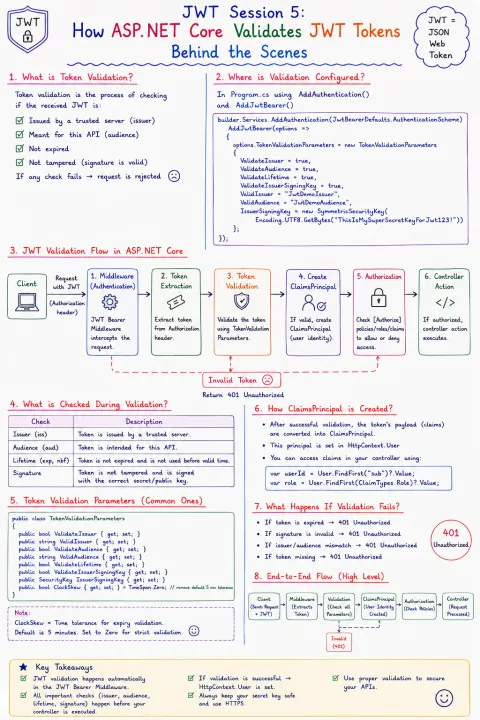
JWT Session 5: How ASP.NET Core Validates JWT Tokens Behind the Scenes
Learn how ASP.NET Core validates JWT tokens behind the scenes, ensuring API security by checking signatures, expiration, issuer, and audience.
- Article · ASP.NET Core
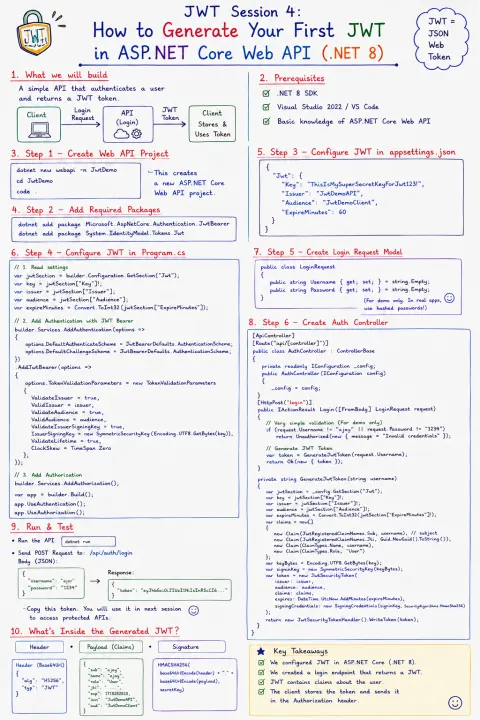
JWT Session 4: How to Generate Your First JWT in ASP.NET Core Web API (.NET 8)
Learn to generate your first JWT in ASP.NET Core Web API (.NET 8) by creating a dedicated token service and configuring JWT settings for secure authentication.
- Article · ASP.NET Core
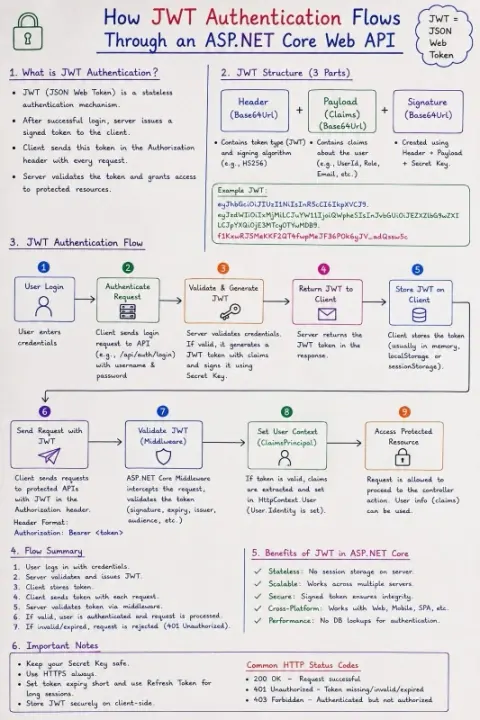
JWT Session 3: How JWT Authentication Flows Through an ASP.NET Core Web API
Understand the JWT authentication flow in ASP.NET Core Web APIs, from login to protected resource access, ensuring secure and efficient user identification.
- Article · .NET Core
JWT Session 2: How JWT Works Internally- Understanding Header, Payload, Signature, and Claims
Unlock JWT secrets! Understand Header, Payload (claims), and Signature for secure authentication in ASP.NET Core Web APIs.
- Article · ASP.NET Core
JWT Session 1: Why Modern ASP.NET Core Web APIs Use JWT Instead of Sessions
Explore why modern ASP.NET Core Web APIs favor JWT over sessions for flexible, scalable authentication across diverse applications.
- Article · C#
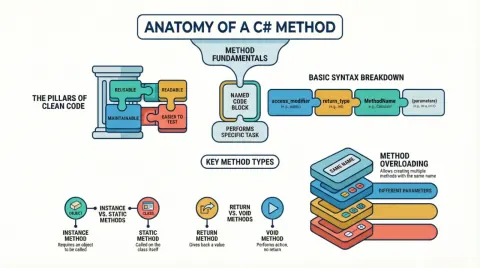
Methods in C# – A Complete and Practical Guide
Master C# methods! This guide covers syntax, parameters, return values, overloading, static/instance methods, ref/out, and best practices for clean, scalable code.
- Article · C#
Loops in C# – A Complete Guide with break and continue
Master C# loops! This guide covers for, while, do-while, and foreach loops, plus break and continue statements. Learn to control program flow effectively.
- Article · C#
Conditional Statements in C#
Master C# conditional statements! Learn to use if, if-else, switch, and the ternary operator for decision-making in your code. Includes practical examples and tips.
- Article · C#
Type Casting and Comments in C#
Master C# type casting (implicit, explicit, Convert, Parse, TryParse) and comments (single-line, multi-line, XML). Write safe, readable, and maintainable code!
- Article · C#
What Is C#?
Discover C#, a powerful language by Microsoft for .NET development. Build web, desktop, cloud apps & more! Explore its features, uses, and career scope. Perfect for beginners!
- Article · C#
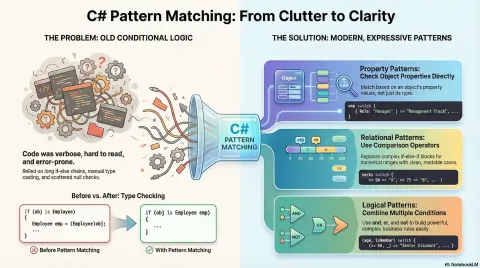
Introduction to Pattern Matching in C#
Unlock the power of C# pattern matching! Learn how to simplify complex logic, improve code readability, and avoid errors with this essential feature. Master modern C#!
- Blog · How do I
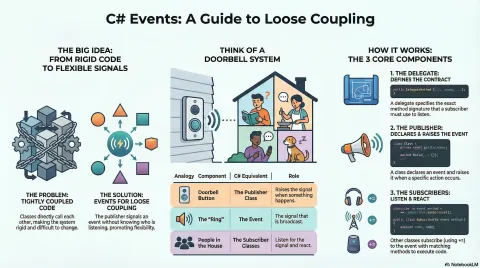
Events in C#
Master C# events! Learn how to build loosely coupled, event-driven applications. Explore delegates, event handlers, subscription, and real-world examples for scalable systems.
- Article · C#
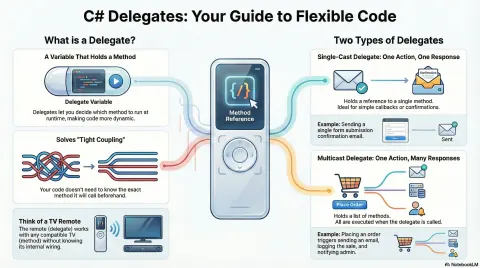
Introduction to Delegates in C#
Unlock C# delegates: Learn how to declare, use, and master single-cast, multicast, and built-in delegates (Func, Action, Predicate) for flexible code!
- Article · C#
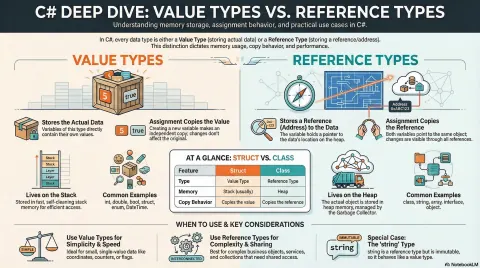
Value Types and Reference Types in C#
Unlock C# mastery! This guide clarifies value vs. reference types, impacting memory, performance, and bug prevention. Essential for efficient .NET development.
- Article · Entity Framework
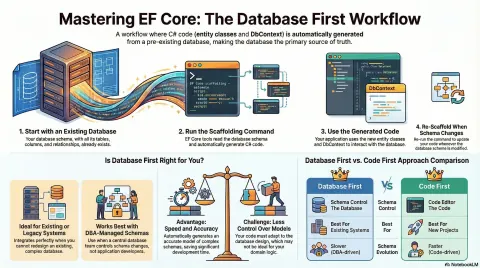
Entity Framework Core – Database First Approach
This article provides a complete and descriptive explanation of the Entity Framework Core Database First approach. It explains how EF Core generates entity classes and DbContext from an existing database, how scaffolding works, how relationships, views, and stored procedures are handled, and how to safely manage schema changes using re-scaffolding and partial classes. Written in simple language, this guide is ideal for beginners and professional .NET developers working with legacy or enterprise databases using Entity Framework Core.
- Article · Entity Framework
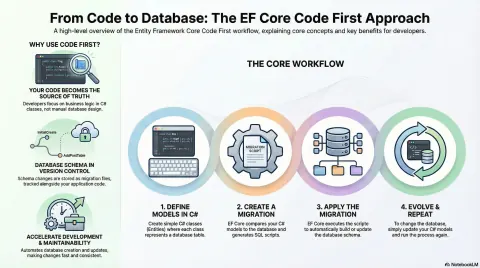
Entity Framework Core – Code First Approach
This article provides a complete and descriptive explanation of the Entity Framework Core Code First approach. It explains how databases are created and managed using C# classes, how DbContext and entities work together, how migrations handle schema changes, and how relationships, configuration, and change tracking are managed in Code First development. Written in simple language, this guide is ideal for beginners and professional .NET developers building modern, scalable applications using Entity Framework Core and SQL Server.
- Article · C#
Learn Operators in C#
This article provides a complete and highly descriptive guide to Operators in C#. It explains all categories of operators—arithmetic, assignment, comparison, logical, unary, bitwise, conditional, null-coalescing, type checking, member access, indexers, lambda, range, pattern matching, and operator overloading—with 3–4 detailed points for each. The article helps beginners and professional .NET developers understand how operators work, how expressions are evaluated, and how to write clean, expressive, and efficient C# code.
- Article · C#
Learn Data Types in C#
This article provides a complete and descriptive guide to data types in C#. It explains value types, reference types, nullable types, numeric types, boolean, character types, strings, records, arrays, enums, structs, dynamic types, object types, pointer types, and memory behavior in C#. The article also covers stack vs heap storage, best practices, and clear examples, making it ideal for beginners and professional .NET developers who want to understand C# fundamentals in depth.
- Article · Entity Framework
Entity Framework Core – A Complete and Deep Explanation
This article provides a complete, descriptive, and beginner-to-advanced explanation of Entity Framework Core (EF Core). It covers how EF Core works internally, its core components, change tracking, relationship handling, migrations, DbContext, DbSet, performance features, advanced capabilities, concurrency handling, shadow properties, value conversions, global filters, interceptors, and when EF Core is suitable for real-world .NET applications. Written in a simple, clear style, this guide helps developers understand EF Core deeply without focusing on LINQ or specific approaches.
- Article · Design Patterns & Practices
Building Maintainable Applications Using the Repository Pattern in ASP.NET Core
This article provides a complete and descriptive guide to the Repository Pattern in C# and ASP.NET Core. It explains what the repository pattern is, why it is used, and how it helps achieve clean architecture, separation of concerns, and maintainability. With detailed explanations, step-by-step implementation, generic and specific repositories, code examples, dependency injection usage, best practices, and real-world scenarios, this guide is ideal for beginners and advanced developers building scalable and testable .NET applications.
- Article · C#
Asynchronous Programming (Async / Await) in C# and .NET Core
This article provides a complete, easy-to-understand guide to asynchronous programming in C# and .NET Core. It explains the differences between synchronous and asynchronous execution, how the async and await keywords work, the role of Task and Task<T>, I/O-bound vs CPU-bound operations, and how async improves performance in ASP.NET Core applications. With practical examples, repository patterns, controller samples, and best practices, this guide is ideal for beginners and professionals who want to build scalable, responsive, and high-performance applications using modern asynchronous programming techniques.
- Article · C#
Access Modifiers and Access Specifiers in C#
This article provides a comprehensive and easy-to-understand guide to Access Modifiers and Access Specifiers in C#. It explains how accessibility works in classes and class members, covering public, private, protected, internal, protected internal, and private protected modifiers with clear examples, descriptive explanations, and real-world scenarios. This guide is written for beginners and professional .NET developers who want to master encapsulation, improve application structure, and follow best practices in C# object-oriented programming.
- Article · C#
Understanding Classes and Types of Classes in C# – A Complete Guide
This article provides a complete and easy-to-understand guide to classes and all types of classes in C#. It covers the fundamentals of what a class is, how objects work, and explains each class type—including concrete, abstract, sealed, static, partial, nested, anonymous, POCO, generic, and record classes—with clear examples and real-world applications.
- Article · Exception Handling
Exception Handling in ASP.NET Core
This article provides a complete, easy-to-understand, and professional guide to Exception Handling in ASP.NET Core. It explains what exceptions are, why proper error handling is important, and how to implement try–catch, global exception middleware, built-in error handling, custom exception filters, structured ProblemDetails responses, validation errors, and logging using best practices. Ideal for beginners and experienced .NET developers, this article teaches how to build stable, secure, and production-ready applications with proper exception handling techniques.
- Article · C#
C# .NET Object-Oriented Programming – A Complete Guide (Beginner to Advanced)
This article provides a complete and easy-to-understand guide to Object-Oriented Programming (OOP) in C# .NET, covering core concepts such as classes, objects, variables, methods, constructors, access modifiers, encapsulation, inheritance, polymorphism, abstraction, and interfaces. With clear explanations and practical examples, it helps learners build a strong foundation for real-world .NET development and technical interview preparation. Ideal for beginners, students, and professionals looking to improve their understanding of OOP principles in C#.