Loading
Articles by John Godel
⚙️ Generative AI: How to Combine ChatGPT and Codex for More Efficient Code
Unlock faster, more efficient coding by combining ChatGPT and Codex! This article explores how to integrate these powerful AI models into a seamless workflow. Learn to leverage ChatGPT for planning and refinement, while Codex handles code generation, resulting in 30-60% faster development cycles, fewer errors, and better documentation. Discover real-world use cases and advanced techniques for maximum efficiency.
🧭 Vibe Coding: The Professional Prompt Engineering Approach to Emotional Precision in AI
Vibe Coding is a prompt engineering methodology that focuses on encoding emotional and tonal intent into AI prompts for precise, contextually aligned, and human-centric outputs. It treats tone, style, and energy as structured variables, enabling enterprises to maintain brand voice, improve empathy, and reduce hallucination. Learn how to engineer prompts that resonate!
Artificial Intelligence: A Leader’s True Promise in the AI Century - Standing Beside the Team When Change Feels Uncertain
Navigate the AI revolution with leadership that prioritizes empathy and trust. Discover how to redefine failure, build psychological safety, and foster a culture where humans and AI thrive together. Learn to lead with compassion, turning uncertainty into opportunity and fear into focus, ensuring your team's success in the age of artificial intelligence. This article provides insights on how to support teams through technological change.
LLMs: How to Combine NoSQL Data with LLMs Effectively
Unlock enterprise AI potential by integrating NoSQL databases with Large Language Models (LLMs). This article explores how to build a Retrieval-Augmented Generation (RAG 2.0) pipeline for contextual cognition. Learn key design patterns, practical use cases, governance strategies, and performance optimizations to transform raw data into a living knowledge graph. Discover the future of cognitive data fabrics!
From Generative AI to Generative Systems Intelligence (GSI):
Generative Systems Intelligence (GSI) is presented as a framework for building governed, self-reflective AI systems that could bridge Generative AI and AGI.
Prompt Engineering: How GSCP Stays Fast - Eliminating Runtime Overhead While Preserving Multi-Step Validation
Gödel's Scaffolded Cognitive Prompting (GSCP) optimizes generative AI by intelligently integrating governance without sacrificing speed. It avoids runtime overhead through risk-adaptive validation, structured contracts, parallelism, memoization, and deterministic micro-validators. GSCP ensures fast, safe, and auditable AI experiences by planning governance, prioritizing structured validation, and amortizing work.
Generative AI: Chat-Native Software, Not Home-Screen Icons - Why ChatGPT Apps Aren’t an App Store
ChatGPT Apps are redefining software. They're not traditional apps with icons, but chat-native experiences living inside conversations. This article explores the platform model, UX, permissions, distribution, developer experience, strengths, and limitations of this emerging paradigm. Discover how to design great chat apps and understand their trade-offs compared to native apps. It's about action, not icons.
Artificial Intelligence: OpenAI Lines Up $100B+ in AI Compute - NVIDIA to Power 10 GW Buildout as AMD Partnership Targets Additional 6 GW
OpenAI plans major AI compute buildouts with NVIDIA and AMD, targeting 16 GW of capacity. The expansion highlights power, supply chains, data centers, and multi-vendor AI infrastructure.
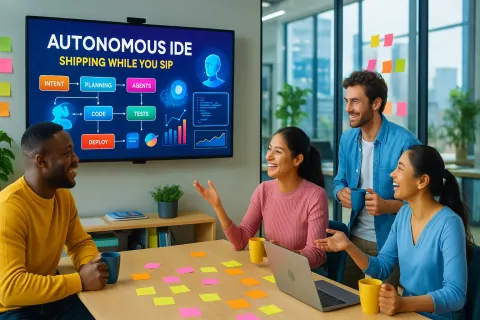
Vibe Coding: Your IDE Should Ship While You Sip - From Assistance to Autonomy
Tired of IDEs that just autocomplete? Discover Autonomous IDEs: the future of software development. This article explores how these intelligent platforms interpret intent, design architectures, generate full-stack applications, and automate testing and deployment – all while you enjoy your coffee. Learn how to adopt this transformative technology and ship faster, safer, and with less effort. Embrace the shift from assistance to true autonomy in coding!
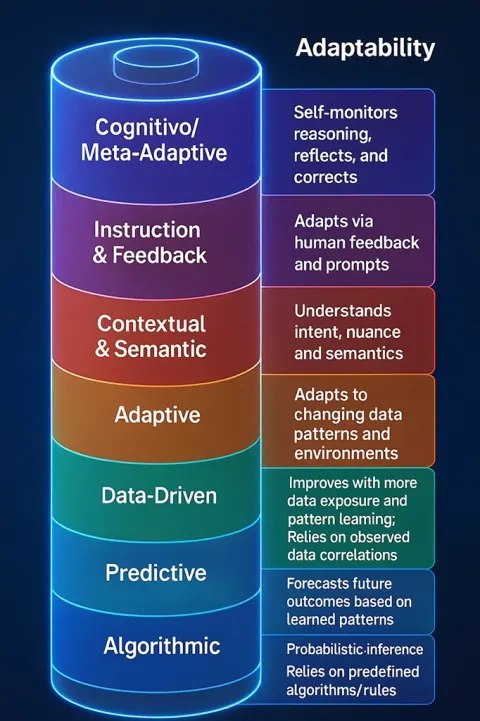
Artificial Intelligence: From Rules to Self-Monitoring Cognition: The Seven Levels of AI Adaptability
Explore the Seven Levels of AI Adaptability, a framework charting AI's evolution from rigid algorithms to self-monitoring cognition. Understand how AI progresses through predictive modeling, data-driven learning, contextual understanding, instruction following, and ultimately, cognitive self-awareness. This model provides a practical guide for building responsible and adaptable AI systems, crucial for enterprises, researchers, and policymakers navigating the future of AI.
The Top 10 Large Language Models (LLMs) of 2025: The Age of Cognitive Giants
A comparative overview of leading 2025 LLMs, including GPT-5, Claude, Gemini, LLaMA, DeepSeek, and Mistral, covering architecture, reasoning, multimodal capabilities, safety, and enterprise use.
Large Language Models (LLMs): The Top 10 Models of 2025 - The Age of Cognitive Giants
Explore the top 10 Large Language Models of 2025, including GPT-5, Claude, LLaMA, and AlbertAGPT. This analysis delves into their architectures, capabilities, and impact across industries. Discover how these cognitive giants are revolutionizing AI assistants, scientific discovery, and enterprise systems, emphasizing the shift towards specialized, governed, and adaptive AI ecosystems. Uncover the future of AI where awareness and ethical considerations are paramount.
Generative AI: Gödel’s AgentOS - The Cognitive Revolution on the Path to Awareness and Conscious Control in AI
Gödel’s AgentOS is presented as an agentic AI architecture that combines meta-reflection, governance, memory, and validation to support accountable reasoning and decision-making.
Artificial Intelligence: Gödel’s AgentOS - The Governance Operating System for Smart AI Agents
Gödel's AgentOS is a governance operating system for AI agents, addressing the limitations of raw LLMs by embedding compliance, transparency, and safety into the reasoning architecture. It transforms AI into reliable, auditable agents for enterprise use, ensuring responsible autonomy and regulatory adherence. AgentOS offers hierarchical planning, multi-agent orchestration, awareness, probabilistic governance, validator integrations, and domain-specific compliance modules.
Large Language Models: How to Become Smart Agents:
Explore the evolution of Large Language Models (LLMs) into smart agents through architectural shifts and the integration of GSCP-12. Learn how GSCP-12 provides a governance-driven framework for task decomposition, alignment, and tool use, enabling safe, auditable, and enterprise-grade AI agents. Discover the key architectural layers required to transform LLMs into goal-directed, auditable systems.
Everything About Large Language Models—and How They Differ From GPT
Explore the world of Large Language Models (LLMs) and understand how they differ from GPT. This article clarifies the distinction between LLMs as a broad AI category and GPT as a specific, influential implementation by OpenAI. Learn about their architectures, training, uses, and cultural impact, and discover the future of AI beyond GPT.
Artificial Intelligence: Illusions, Agents, and Rights - The Next Chapter of Humanoids
Explore the evolving landscape of AI, examining the illusion of consciousness in machines, the rise of autonomous agents, and the potential for AI rights. This article delves into the future of human-AI partnerships, emphasizing the importance of ethical governance, transparency, and safeguards to ensure a beneficial and responsible coexistence. Discover how AI will reshape work, ethics, and society.
Generative AI: Breaking the Gen-AI Paradox with GSCP-12: From Scattered Pilots to Industrialized Agentic Systems
Break the Gen-AI paradox! GSCP-12 offers a structured framework to transform scattered AI pilots into industrialized agentic systems. Achieve measurable EBIT uplift by shifting from horizontal convenience to vertical value, ensuring governance, auditability, and sustainable impact. Implement in 90 days!

C# 14 Extension Members: A Deep Dive Into Power, Patterns, and Pitfalls
C# 14 introduces extension members, expanding the capabilities of extension methods to include properties, indexers, operators, and events. This feature enhances API design by allowing developers to enrich existing types without modification, leading to cleaner code, improved modularity, and better interoperability. Learn how to leverage extension members for more expressive and maintainable code.

Visual Studio 2026 vs. Visual Studio 2022: A Practitioner’s Upgrade Analysis
Visual Studio 2026 vs. 2022: An in-depth upgrade analysis for practitioners. Explore AI integration, performance enhancements, and cloud development features. Discover whether the move to Visual Studio 2026's AI-native environment, improved .NET support, and enhanced governance is right for your team, or if Visual Studio 2022 remains the better choice.
Large Language Models (LLMs) Under the Hood: A Technical Deep Dive
Dive into the technical depths of Large Language Models (LLMs). Explore tokenization, transformer architecture, training pipelines, instruction tuning, inference optimization, quantization, and long-context methods. Learn practical engineering details for building, deploying, and evaluating LLM systems, including tool use, security, and serving architectures. Discover tips for optimizing performance and ensuring reliability.
Large Language Models (LLMs) With Guardrails: How GSCP Turns Raw Capability Into Reliable Systems
Unlock reliable LLM systems with Gödel’s Scaffolded Cognitive Prompting (GSCP). This governance-first approach transforms raw LLM power into dependable solutions by enforcing verifiable subgoals, policy gates, and auditable workflows. GSCP addresses hallucinations, inconsistent reasoning, and security risks, ensuring grounded, explainable, and compliant outputs for enterprise-grade applications.
Large Language Models (LLMs), Explained: Foundations, Capabilities, Limits, and What Comes Next
Explore the world of Large Language Models (LLMs): their architecture (Transformers, attention), training (scaling, alignment), limitations (hallucination), and future (RAG, agents, efficiency). Understand how LLMs are built, why scaling works, and how to build with them robustly. Discover the key components for reliable composition and enterprise integration.
Generative AI in Software Development: What’s Real, What’s Next, and How to Put It to Work
Explore the transformative impact of generative AI on software development. Learn how AI boosts developer productivity by 55%, automates tasks like code generation, documentation, and refactoring. Discover practical workflows, risk management strategies, and future trends like reasoning-centric models and deeper IDE integration. Unlock the potential of AI while maintaining quality and security in your software development lifecycle.
The Age of Prompt Architects
The rise of Prompt Architects marks a pivotal shift in the AI era. These professionals design, orchestrate, and govern human-AI collaboration, ensuring reliable, ethical, and contextual AI outcomes. From business to healthcare to governance, they are shaping how society interacts with AI, building a future where AI aligns with human values and fosters trust.