Loading
Articles by John Godel
LLMs: How You Can Keep Your Job Next 5 Years by Mastering Them
Future-proof your career! Master LLMs to automate tasks, improve reliability, and prove your value. Learn a 90-day plan and role-specific playbooks now.
GSCP-12, The Enterprise Standard for Responsible Prompting
GSCP-12: The enterprise standard for responsible AI prompting. Govern AI with a repeatable, auditable methodology for verifiable, compliant outcomes.
Artificial Intelligence: How You Can Keep Your Job Next 5 Years by Learning AI
Learn a 90-day plan for building reliable AI workflows using clear specifications, grounded sources, validation checks, automation, and measurable results.
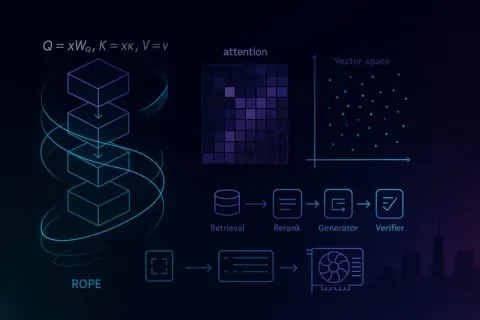
AI in Practice: LLMs, Transformers, Weights, and Embeddings/Vectors — An In-Depth Builder’s Guide
A builder's guide to AI in practice: LLMs, Transformers, weights, and embeddings. Learn to optimize performance, memory, and reliability for real-world AI.
Artificial Intelligence: The People’s Power Tool Artificial Intelligence
AI is transforming work & life, not replacing humans. Learn how to use it for productivity, creativity, and small business success. A practical guide to AI!
Artificial Intelligence: Using It Properly, Creates an “Unfair” Advantage — Powered by Gödel's Scaffolded Cognitive Prompting
GSCP (Gödel’s Scaffolded Cognitive Prompting) transforms AI demonstrations into dependable systems. With contracts, grounding, verifiers, and feedback loops, it delivers reliable, auditable, and scalable outcomes.
Generative Artificial Intelligence: A Practical Playbook to Earn Real Money with Generative AI
Monetize GenAI: Practical guide to building profitable AI services/products in 30-60 days. Includes business models, niches, offers, and pricing strategies.
Contract-Driven Prompt Engineering: Spec-Verified LLM Pipelines That Actually Ship
Ship reliable GenAI! Contract-driven prompt engineering combines specs, verifiers, & tools for production-ready LLM pipelines that meet SLAs & regulations.
From Prompt Engineering to PromptOps: The Rise of AI-Native Development Workflows
From Prompt Engineering to PromptOps: Discover how to scale AI with robust workflows. Learn about versioning, testing, and governance for reliable AI deployments.
Software at the Speed of Spec: AI Code-Generator IDEs Are the Next $100B+ Platform
AI code-generator IDEs mark a platform shift, transforming specs into software with governance, automation, and scalability. By 2030, millions of builders will create production-ready applications, reshaping development and enterprise value.
From Reflection to Production: How GSCP Transcends Research-Grade Prompting Techniques
Gödel’s Scaffolded Cognitive Prompting (GSCP) evolves beyond Reflection Agents, embedding self-improvement within governance, guardrails, and observability to deliver safe, cost-controlled, auditable, and enterprise-ready AI reasoning frameworks for real-world deployment.
GSCP, From Governance to Self-Improvement: A Practical Guide
Gödel’s Scaffolded Cognitive Prompting (GSCP) combines governance, retrieval, reasoning, guardrails, and auditability with a self-improving prompting framework, enabling generative AI systems that are safe, adaptable, cost-aware, and continuously learning without retraining.
Market Research: Prompt Engineering Jobs—Salaries, Hiring Paths, and the 5-Year Outlook
Prompt engineering has evolved into a core AI skill across diverse roles. This article explores job trends, salaries, titles, hiring practices, regional insights, and future outlook shaping the prompt engineering career landscape.
Beyond Buzzwords: Clear Thinking in the Age of AI
This article cuts through AI hype, offering mental models, decision flows, adoption blueprints, and governance strategies to build practical, safe, and scalable AI products that deliver measurable business impact and sustained value.
Prompt Engineering in Depth: From Tricks to Structured Reasoning
This article explores the evolution of prompt engineering into system design, highlighting reasoning paradigms like CoT, ToT, GoT, and GSCP, with practical examples, production guidance, governance, safety, and scalability insights.
Decode the AI Noise: A Survival Guide for Smart Skeptics
Generative AI adoption requires evidence over hype. By staying skeptical, running experiments, measuring outcomes, enforcing decision gates, and ensuring ownership, organizations achieve durable, measurable AI impact.
AI Without the Hype: What to Know, What to Ignore, What to Do
This guide helps organizations cut AI hype and focus on impact, emphasizing retrieval over memory, cost and latency discipline, human-in-the-loop, measurable metrics, and disciplined workflows for real-world results.
Stop Guessing About Prompts: The No-BS Playbook
Prompt engineering is a disciplined approach to designing AI prompts as production assets—measurable, reliable, and workflow-driven, ensuring clarity, accountability, and real business impact beyond quick demo tricks.
Prompt Engineering + Context Engineering: Building Reliable GenAI with GSCP
This article introduces Prompt Engineering, Context Engineering, and Gödel’s Scaffolded Cognitive Prompting (GSCP), showing how to unify them into reliable, auditable pipelines that deliver production-grade GenAI systems with governance, scalability, and adaptability.
The Next 5 Years of Prompt Engineering: Benefits, Career Paths, and How to Stay Layoff-Proof
A practical guide to AI prompt engineering, covering workflows, evaluation, governance, risks, and cost optimization. Learn how to design reliable, efficient AI systems aligned with business goals.
Why the Next AI Coding Cycle Will Create Clear Winners—and How to Spot One
AI coding platforms are evolving beyond demos. The next wave demands repo-aware context, agentic workflows, evaluation, and cost efficiency—making software delivery measurable, reliable, and enterprise-ready. Discover SharpCoder.ai’s breakthrough showcase.
When “Prompt Engineer” Becomes a Button: Pivot to Prompt Tool Architect/Designer/Engineer
The future of prompting lies in platform ownership. Instead of crafting text, professionals must design prompt compilers, guardrails, evaluators, and governance systems to ensure scalability, efficiency, safety, and lasting career impact.
Why Prompt Engineering Won’t Die in the Next 5 Years — and How to Get Ready for the Next Wave
Why Prompt Engineering Won’t Die in the Next 5 Years — Prompt engineering isn’t disappearing—it’s evolving into system design, governance, and orchestration. Enterprises will need experts to create structured, testable, and compliant prompt contracts, ensuring efficiency, accountability, and long-term career resilience.How to Get Ready for the Next Wave
Prompt Engineering in the New AI World: From Craft to Discipline
Prompt engineering has evolved into systems design. By modularizing prompts, enforcing schemas, embedding governance, and treating them as production code, organizations achieve predictable, auditable, and safe AI outcomes across models and domains.