Loading
John Godel's contributions
Vibe Coding for Healthcare AI: From Symptom Narratives to Structured Diagnostics
Vibe Coding uses multi-agent AI to transform unstructured medical data into precise, explainable diagnoses. It acts like a digital clinical team, enhancing healthcare with trust, transparency, and collaborative reasoning.
Vibe Coding in Retail & eCommerce: Dynamic AI Merchandising Engines
Discover how Vibe Coding transforms retail merchandising into a real-time, AI-driven process, using multi-agent systems to detect trends, sync inventory, adjust pricing, and personalize experiences at market speed.
Building Enterprise-Grade GenAI: From Prompt Experiments to Cognitive-Scale LLM Systems
Explore how Prompt-Oriented Development, PromptOps, and GSCP enable scalable, reliable GenAI products. Learn to transform prototypes into enterprise-grade LLM systems with governance, reasoning, and continuous delivery.
Scaling AI Products: Integrating Prompt-Oriented Development with GSCP for Advanced Reasoning at Scale
Learn how combining Prompt-Oriented Development (POD) with Gödel’s Scaffolded Cognitive Prompting (GSCP) creates scalable, governed AI systems capable of advanced reasoning, adaptive workflows, audit-ready transparency, and enterprise-grade performance.
PromptOps: The DevOps Mindset for AI Prompt Engineering
Discover PromptOps, the DevOps approach to AI prompt engineering. Learn how to version, test, deploy, and monitor prompts with precision, ensuring scalability, compliance, and performance for enterprise-grade AI systems.
From Playground to Production: Migrating Vibe Coding Projects into Prompt-Oriented Development
Learn how to migrate from Vibe Coding to Prompt-Oriented Development (POD) for scalable, governed AI systems. Discover a step-by-step framework ensuring reliability, version control, testing, and observability for enterprise-ready AI solutions.
Why GSCP Can Make a GPT-5-Class Model Smarter — Step by Step
OpenAI’s GPT-5, paired with Gödel’s Scaffolded Cognitive Prompting, delivers adaptive, transparent, and verifiable reasoning—transforming raw AI power into governed enterprise cognition for accuracy, auditability, compliance, and continuous improvement in high-stakes tasks.
The AI Maturity Curve: Leading Teams from Experimentation to Cognitive-Scale Production
Sharp Token stands out in the volatile crypto market with real utility, steady growth, transparent communication, and a committed team, offering investors long-term potential beyond hype and speculation.
Prompt-Oriented Development vs. Vibe Coding: Choosing the Right Approach Across the AI Product Lifecycle
Prompt-Oriented Development (POD) brings structure to AI development, replacing casual "vibe coding" with scalable, repeatable workflows like prompt versioning, evaluation, CI/CD, and observability.
How Does GSCP Handle Conflicting Information from Different Sources?
Gödel’s Scaffolded Cognitive Prompting (GSCP) introduces a multi-path reasoning framework that enables AI to intelligently detect, evaluate, and resolve conflicting information with transparency, improving factual accuracy and user trust.
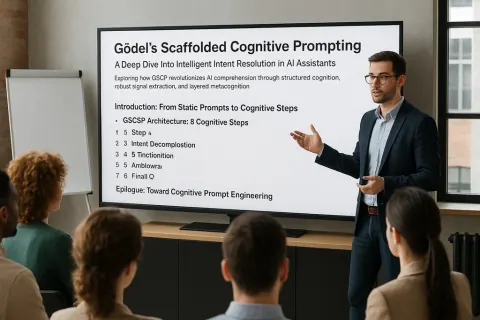
GSCP: A Framework for Structured, Multi-Path Cognitive Prompting in Language Models
GSCP is a structured prompting framework for LLMs that enhances reasoning, accuracy, and tool integration using modular templates, self-verification, and multi-path strategies for enterprise-grade AI solutions.
Cascading Private Tailored Small Language Models (PT-SLM) Using GSCP Framework: A Cost-Efficient Architecture for Accura
AI cascade using PT-SLM and GSCP offers a modular approach to NLP by combining small, accurate models for complex tasks like document parsing and reasoning, improving scalability, accuracy, and control.
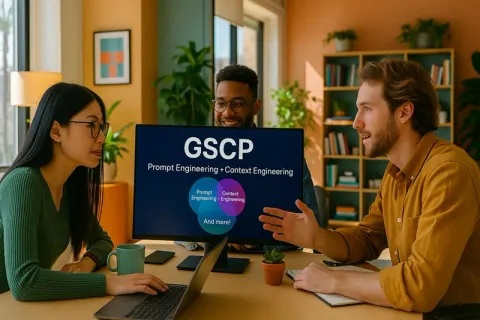
💡 GSCP: Prompt Engineering + Context Engineering — And More!
GSCP (Gödel’s Scaffolded Cognitive Prompting) combines Neuro-Symbolic reasoning and Retrieval-Augmented Generation to build AI systems that not only generate outputs but also reason, verify, and adapt contextually.
Toward a Post-Predictive Paradigm in Language Modeling: Integrating GSCP with Neuro-Symbolic and Retrieval-Augmented Architectures
This article explores a hybrid AI framework combining GSCP, neuro-symbolic reasoning, and RAG to overcome LLM limitations, enabling deeper understanding, transparency, and reliable reasoning in high-stakes applications.
AI Will Not Make Us Stupid — It Will Redefine Intelligence
AI won’t replace human intelligence — it will enhance it. By offloading routine tasks, AI empowers creativity, critical thinking, and innovation, reshaping how we define and apply intelligence in the modern age.
The Data-Driven Intelligence Era: How Clean Data and Tailored SLMs Power Next‑Gen AI
Learn how data cleaning, integration, enrichment, transformation, validation, and consistency prepare trustworthy data for private, domain-specific small language models.
Integrating GSCP with Vision RAG: A Cognitive Framework for Context-Aware Multimodal AI
Discover how GSCP and Vision RAG combine to deliver scalable, interpretable AI reasoning across text and visuals—advancing prompt engineering for healthcare, legal, education, and enterprise automation use cases.
Why AI Code Generators Like Cursor and WindSurf Are Desktop Apps—Not Web-Based
AI code tools like Cursor and WindSurf are desktop apps because they offer deep system access, faster performance, stronger privacy, and richer project context—capabilities web-based tools still struggle to match.
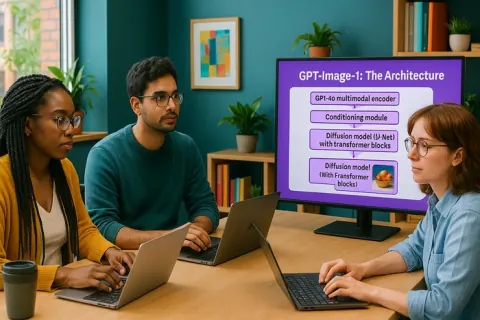
GPT-Image-1: The Next Evolution of Diffusion-Based Image Generation
Explore GPT-Image-1, OpenAI’s next-gen image model that fuses diffusion with transformer-based conditioning. It delivers high fidelity, prompt consistency, and advanced multimodal capabilities for creation, editing, and visualization.
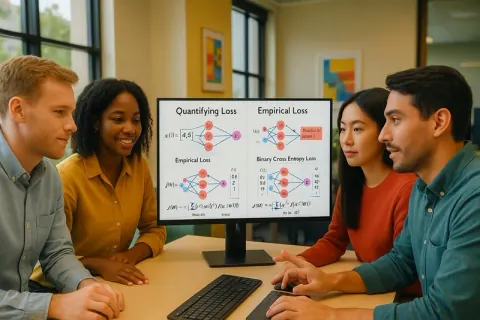
Understanding Loss in Neural Networks: From Individual Predictions to Specific Loss Functions
Explore how loss functions guide neural network learning—from individual prediction errors to advanced techniques in classification, regression, and reinforcement learning—highlighting Binary Cross Entropy, MSE, Huber, and more.
The Truth About “Vibe Coding”: Why AI Isn’t Destroying Junior Developers’ Careers
AI-assisted coding is transforming how junior developers learn and work. Tools like GitHub Copilot and ChatGPT boost productivity, aid debugging, and support real-world skill-building for faster career growth.
Why Your Favorite AI Is Just Guessing
This article explores the illusion of intelligence in Large Language Models, revealing how they predict text without true understanding, raising concerns about trust, safety, and the limits of AI cognition.
Vibe Coding Is Actually Prompt-Oriented Development (POD)
Prompt-Oriented Development (POD) is a disciplined approach to AI-assisted coding. Unlike "vibe coding," POD emphasizes structured prompting, critical thinking, and collaborative software development.