Loading
Mariem Moalla's contributions
- Article · .NET Core
Beginner's Guide: Authentication & Authorization in Modern Applications
Unlock the secrets of secure apps! This beginner's guide demystifies authentication and authorization, explaining how your data is protected when you log in and use modern applications. Learn the fundamentals of privacy and security online.
- Article · .NET
Observability in .NET with OpenTelemetry
Explore .NET observability with OpenTelemetry! Learn how to monitor distributed applications using logs, metrics, and traces. Plus, a basic setup example included!
- Article · C#
Abstract vs Virtual in C#
Confused about abstract vs. virtual in C#? This guide clarifies their differences, usage scenarios, and common pitfalls. Learn when to use each for robust code design.
- Article · Threading
Using Cache in C# with Concurrency
Explore C# caching with concurrency! Learn how to use ConcurrentDictionary, handle cache expiration, and prevent duplicated work using SemaphoreSlim for thread safety.
- Article · Redis
Cache, Local Storage, and Modern Caching Techniques
Boost web app performance! Learn the differences between cache, local storage, session storage, and cookies. Explore caching techniques like Write-Through, Write-Behind, and eviction strategies for optimal efficiency.
- Article · Design Patterns & Practices
Understand SOLID Design Principles in 5 Minutes
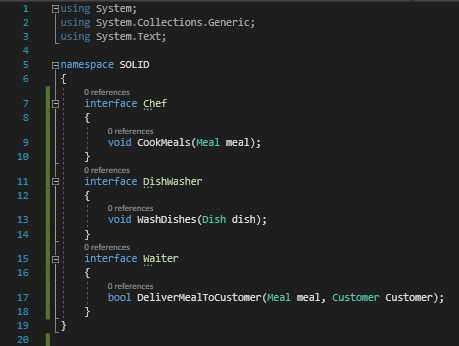
Grasp the core of SOLID design principles quickly! This guide breaks down the Single Responsibility, Open/Closed, Liskov Substitution, Interface Segregation, and Dependency Inversion principles into easily digestible concepts. Learn how to write more maintainable, scalable, and robust code in just 5 minutes. Improve your software architecture and development skills now!
- Article · C#
Record, Record Struct, and Structural Equality in C#
Understand structural equality in C# records and record structs, and learn when to use them or classes for DDD value objects and domain models.
- Article · Software Architecture/Engineering
Domain Driven Design (DDD) for Beginners
Domain Driven Design (DDD) helps teams build software that meets real needs. To start, focus on understanding the problem your software solves. Talk to users to learn their needs. Use simple language to describe your ideas. Create a shared vision with your team. This way, everyone works towards the same goal.
- Article · LINQ
Understanding Any() vs Count()
Unlock C# performance! Discover when to use Any() vs. Count() for checking collection emptiness. Learn the O(1) vs. O(n) complexities and crucial exceptions for Lists & arrays.
- Article · .NET
.NET 10 Breaking Changes: The New field Keyword
Discover the .NET 10 'field' keyword: a powerful C# 14 feature for concise property validation. Learn how it simplifies code but may introduce breaking changes & how to fix them.
- Article · C#
Null Conditional Assignment in C#
Learn how to use the null conditional assignment operator (?.) in C# to simplify null checks and prevent.
- Article · C#
Understanding Span<T> in C#
Learn how it provides a zero-allocation view over memory for arrays, strings, and more, boosting efficiency and reducing GC overhead
- Article · C#
What you need to know about Extension Members in C#
Learn how to extend existing types without modification, adding functionality and improving code readability.
- Article · Data Structures and Algorithms (DSA)
Binary Search From Basics
Master binary search! This guide breaks down the core concepts, and real-world applications with C# examples.
- Article · Threading
Why not use Dictionaries in Multi-Thread Apps
Explore safer alternatives like ConcurrentDictionary for thread-safe mutable access with fine-grained locking, and ImmutableDictionary for guaranteed thread safety through immutability. Understand the performance trade-offs between speed and safety when choosing the right collection type for concurrent operations.
- Article · C# Strings
C# tips: string.IsNullOrEmpty vs string.IsNullOrWhiteSpace
Understand the crucial difference between string.IsNullOrEmpty and string.IsNullOrWhiteSpace in C#. This article clarifies when to use each method for effective string validation. Learn how IsNullOrWhiteSpace handles whitespace-only strings, preventing potential bugs. We also cover performance considerations, highlighting that while IsNullOrEmpty is slightly faster, the difference is often negligible in real-world applications. Choose the right tool for robust and reliable C# code.
- Article · Data Structures and Algorithms (DSA)
C# Tip: Use Stack<T>, Not List<T>
Unlock performance gains in your C# applications! Discover why Stack<T> often outperforms List<T> when implementing LIFO (Last-In, First-Out) data structures. This tip explores the underlying reasons for the efficiency difference, focusing on memory allocation and access patterns. Learn when and how to leverage Stack<T> for optimized code and improved application responsiveness. Avoid common pitfalls and write cleaner, faster C#!
- Article · C#
All you need to know about switch expression and Modern Pattern Matching
Explore the evolution of the C# switch statement from its traditional constant-based form to the powerful pattern matching capabilities of modern C#. This article covers type patterns, relational patterns, positional patterns, and switch expressions introduced in C# 7.0 and later. Learn how to leverage these features for cleaner, more expressive code and improved conditional logic.
- Article · C#
C# Performance Hack: Use record struct for Small, Immutable Models
This optimization avoids heap allocation and provides value-based equality, unlike classes. See how record struct dramatically improves efficiency when comparing immutable objects, offering a significant advantage over traditional classes in specific scenarios.
- Article · C#
How Async/Await Really Works in C# : A Beginner-Friendly Guide
Learn how C# async and await work with Task-based asynchronous programming, why they do not automatically create threads, and how they keep apps responsive during I/O operations.
- Article · C#
Why ValueTask Can Save You from Async Overhead
Discover how ValueTask in C# can dramatically reduce the performance overhead associated with asynchronous operations. Learn when and why to use ValueTask instead of Task to optimize your async code, minimizing allocations and improving responsiveness. Explore practical examples and best practices for leveraging ValueTask to achieve significant performance gains in your applications, especially in high-throughput scenarios. Understand the nuances of using ValueTask effectively.
- Article · C#
When To Use ToList() and ToArray()?
Choosing between .ToList() and .ToArray() in C# depends on usage: use .ToList() for collections needing modification; use .ToArray() for fixed-size, read-only collections—optimized in .NET 9 for performance.
- Article · SQL Server
SQL Server Index Fragmentation: What It Is and How to Fix
Index fragmentation slows SQL Server queries by disrupting data order. This article explains its causes, types, and impact, while offering practical steps to detect, fix, and prevent fragmentation for optimal database performance.
- Article · C#
When to Use Generic vs Non-Generic Collections in C#
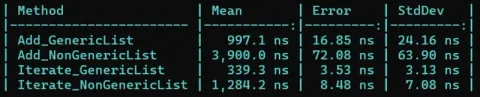
Discover the differences between generic and non-generic collections in C#. Learn their impact on performance, type safety, and usability with examples, helping you choose the right collection for efficient development.
- Article · C#
Structured Logging in .NET: Why You Should Avoid String Interpolation
Structured Logging in .NET: Why You Should Avoid String Interpolation, and string concatenation and use structured logging instead.