Loading
Blogs by Mike Gold

How To Make Sure the Silverlight App Gets Keyboard focus
After playing with silverlight for a while, I found that the Focus method did not work very well to give the silverlight app focus for keyboard input. You can use a trick in javascript to make sure that the silverlight control has focus to begin with. Then later use the Focus method inside your XAML code behind.

How To: Speeding up adding nodes to a Treeview
Not sure if others have experienced this, but if you try to add a lot of nodes to a treeview, the program will progessively slow down with the addition of each node. Here is how to solve the problem.
How To: Getting strings from the resx file of your form
resx files are useful for creating window forms that can be multilingual. This blog tells you how to use the resourcemanager to get strings from your form's resx file using managed C++.

Doing OO in F# : Defining an F# Class
Although very much a functional language, F# provides us with object-oriented mechanisms such as classes, inheritance, and encapsulation. The sample below illustrates all three

Problem with DataBinding and Custom Formatters
Has anyone else been able to get this to work properly? It seems the only way is to implement custom formatting in a databound control is to use the Format event. Here is my sample code and how to overcome the problem.
Language-Oriented Programming: Inventing your own languages in F#
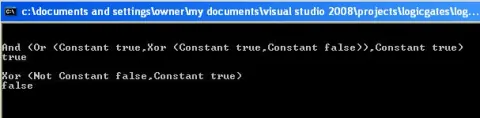
Using cool features like discriminating unions, you can pretty much invent your own language structures in F#.
Getting Prime Numbers up to 1,000,000 using F#
A while ago, I wrote a blog on using C# and LINQ to obtain all prime numbers up to 1,000,000. In this blog we'll show you the equivalent code in C# without using LINQ.

Setup and Deployment: How to create a Launch Option in the Finished Dialog
Aaron Stebner gives us the solution in the link below on how to modify the finished dialog using javascript to allow us to launch our app in a postbuildevent.
Using GDI+ with F#
This Blog illustrates how to create a Windows Form in F# and Draw a Rectangle that Positions itself based on a Left Mouse Click.
Using F# to compute roots from the Quadratic equation
One of many things F# is great for is for implementing algorithms and equations. This sample demonstrates using F# to compute quadratic roots.
My First F# Experience
After talking to Matt at the MVP Summit and reading his articles, I got interested in experimenting with F# and my conclusion...F# is like C# on steroids. Below is a sample comparing C# recursion to F# recursion.
Writing Articles on C# Corner
Lately I've seen articles on C# Corner that have great titles, but no substance. This blog is an attempt to guide those people wishing to share their ideas here without turning off our large reader base.

Google Chart API
Although not as fancy as some of the commercial API's available for ASP.NET. Google's chart API is free and allows you to add charts to your web page. Follow the link in this blog to a great article on using the google chart api in .NET
How To: Binding a Property to a Label Control in a Windows Form
This Blog Describes the code for binding a property to a label control, a not so intuitive process.
How to: Rotating text 90 degrees in GDI+
One of the issues I ran into when using GDI+ is how to rotate a string and place it on the Y Axis of a Graph. Here is how I solved it.

Even More Fun with LINQ - Finding Perfect Numbers
From WikiPedia - "A Perfect number is defined as a positive integer which is the sum of its proper positive divisors (not including the number itself)". For example, 6 is a perfect number because its divisors are 1,2, and 3. 1+2+3 = 6. In this C# Corner BLOG, we show you how to use LINQ to search for all perfect numbers up to 10000.
Using AJAX to put up a MessageBox in the Browser in ASP.NET 2.0
AJAX is a powerful technology that increases your ability to do some cool stuff on the Client. You can use the AJAX tools in ASP.NET 2.0 to create JavaScript from the server and execute it on the client. This blog tells you how to put up a message box.
How to freeze the Top Row Dynamically of a Table Server Control in ASP.NET
Did you know that you could make the top row of a table frozen dynamically in the browser and have the other rows scroll in IE? Here's how...
Accessing Data From a selected row in a Hidden GridView Column
You can't easily access the text from a hidden column in a grid view, but you can access the data in the datasource that it is bound to. Recently I ran into the problem of getting data from a hidden GridView column. I gave up trying to get it from the GridView and focused on the data. Here is how I did it:
Dynamically sizing a DIV tag in C# and ASP.NET
Recently I ran across the requirement of needing to size a div tag around a table in order to have it scroll. You can actually make the DIV tag act as a server side control! Here's How:

LINQ and Prime Numbers
LINQ can be used to find complex mathematical sets. Here is a LINQ Program I created that will find all the prime numbers from 1 - 1,000,000
How To: Persisting scroll position in a User Control in ASP.NET and AJAX
Recently I ran into the problem of persisting the scroll position of a control which takes advantage of the div tag. Here is the solution.
Retrieving the Directory of the Current Application
I often find myself getting the current directory of the executable to use it as a base reference path. This is a tidbit on using reflection to obtain the directory.
How To: Hiding a Column in a DataBound GridView
As obvious as you would think this would be, it turns out that in order to hide column in a GridView, you need to go through a pretty unintuitive step. (The Windows Form Version is much more flexible). Here I'll show you how.
How to find and launch the application associated with a file type
Ever wonder how to find the application associated with a particular file type? The FindExecutable SDK call in Windows allows you to do this. Not sure if there is a .NET solution to this, but here is an example of using FindExecutable in managed C++.