Loading
Sardar Mudassar Ali Khan's contributions
- Article · .NET Core
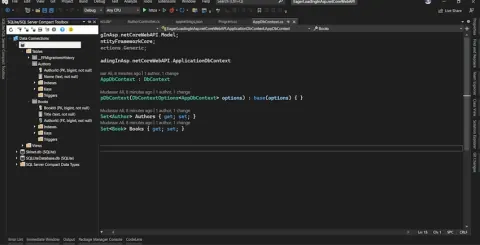
Eager Loading In ASP.NET Core Web API Complete Example
In ASP.NET Core, eager loading is a technique used to load related data along with the main entity in a single database query. This helps to optimize performance by reducing the number of database calls. Let's implement an example of eager loading in an ASP.NET Core Web API using Entity Framework Core.
- Article · .NET Core
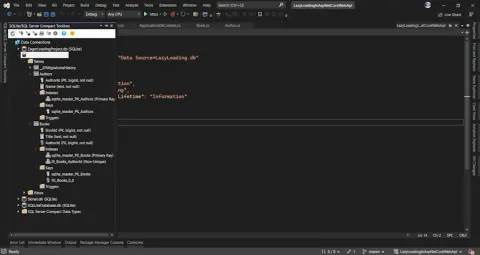
Lazy Loading In ASP.NET Core 7 Web API
ASP.NET Core 7 Web API. Lazy loading is a technique where related data is only loaded from the database when it is explicitly requested. In Entity Framework Core, lazy loading can be achieved by marking navigation properties as virtual.
- Article · .NET Core
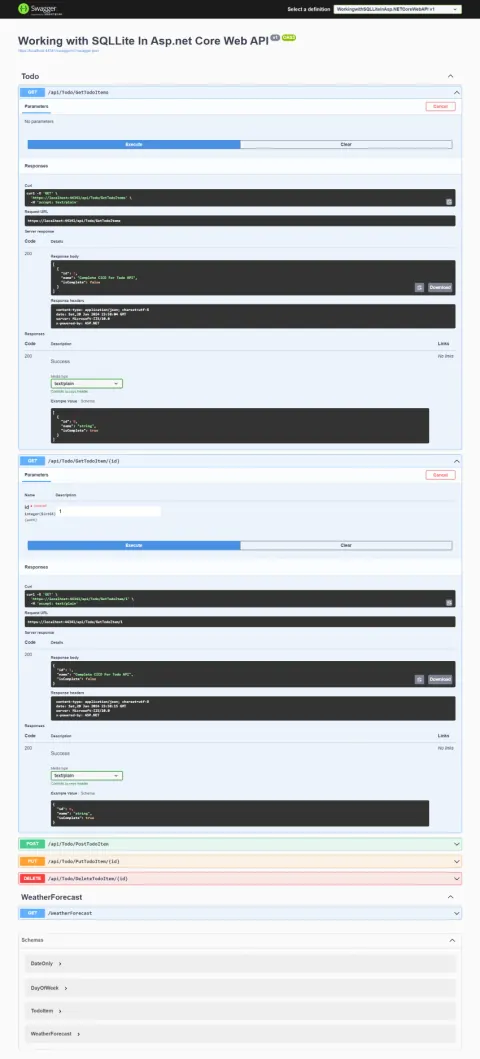
Working with SQL Lite Database in Asp.NET Core Web API
SQLite is a self-contained, serverless, and zero-configuration relational database management system (RDBMS). It is a lightweight, open-source, and embedded database engine that does not require a separate server process and operates directly on the client's device
- Article · .NET Core
Synchronous vs Asynchronous Programming in ASP.NET Core Web API
Synchronous Programming: In synchronous programming, tasks are executed one after the other, in a sequential manner. When a request is made to a synchronous API, the server processes the request and waits for it to be completed before moving on to the next task. This means that if one operation takes a long time to finish, it can block the execution of subsequent operations, potentially leading to slower response times for clients. Asynchronous Programming: On the other hand, asynchronous programming allows tasks to be executed concurrently. When a request is made to an asynchronous API, the server can initiate tasks and continue processing other requests without waiting for the previous tasks to be completed. This can lead to better scalability and responsiveness, especially in scenarios where certain operations, such as I/O operations, may take some time. ASP.NET Core Web API: In ASP.NET Core Web API, you have the flexibility to choose between synchronous and asynchronous programming models. The framework supports both approaches. Asynchronous programming is particularly useful when dealing with I/O-bound operations, such as accessing a database or making external API calls, where the application can continue processing other tasks while waiting for the I/O operation to complete. To implement asynchronous programming in ASP.NET Core Web API, you can use the `async` and `await` keywords in your controller methods, allowing you to write non-blocking code. This helps improve the overall performance and responsiveness of your API, especially in scenarios with high concurrency.
- Article · .NET Core
Implementing IP Rate Limiting in ASP.NET Core MVC
IP rate limiting is a crucial aspect of web application security that helps prevent abuse, protect against brute force attacks, and ensure fair resource usage. In this article, we will walk through the process of implementing IP rate limiting in an ASP.NET Core MVC application using middleware.
- Article · .NET Core
Handling CORS (Cross-Origin Resource Sharing) in ASP.NET Core Web API
Demystify CORS in ASP.NET Core! Learn how to seamlessly handle Cross-Origin Resource Sharing and overcome origin-related errors in your Web API with this concise guide.
- Blog · .NET Core
Debugging IIS Websites with Visual Studio
This blog provides a concise guide on how to debug IIS websites using Visual Studio, offering step-by-step instructions for efficient troubleshooting and code inspection.
- Article · .NET Core
Azure Functions in ASP.NET Core Web API
Azure Functions, a component of Microsoft's serverless computing offerings in Azure, enable developers to create and deploy small, event-driven code without managing infrastructure. These functions, supporting languages like C# and JavaScript, automatically scale and integrate with Azure services, streamlining the development of serverless applications and microservices.
- Article · .NET Core
Microservices Development with 3-Tier Architecture and Circuit Breaker Design Pattern Using Microsoft ASP.NET Core Web API
The Circuit Breaker pattern, analogous to its electrical counterpart, monitors for failures and helps prevent cascading failures in distributed systems. It acts as a barrier between a potentially failing service or resource and the rest of the system. When a service is working as expected, the Circuit Breaker allows requests to pass through. However, if the service encounters an issue or starts to fail, the Circuit Breaker "opens" and prevents further requests from being sent to the failing service for a defined period. This helps to preserve system resources and prevent overload or degradation.
- Article · .NET Core
Microservices Development Using CQRS Architectural Design Pattern in Microsoft Asp.net Core Web API
The Command Query Responsibility Segregation (CQRS) pattern is an architectural principle that separates the responsibility for handling commands (write operations that change state) from queries (read operations that retrieve state). It advocates having separate models for reading and writing data. Components of CQRS: Command: Represents an action that mutates the system's state. Query: Represents a request for data retrieval without changing the system's state. Command Handler: Responsible for executing commands and updating the system's state. Query Handler: Responsible for handling read requests and returning data in response to queries. Command Model: Contains the logic and rules necessary to process commands and update the data store. Query Model: Optimized for querying and presenting data to users, often involving denormalized or optimized data structures tailored for specific queries. Key Principles: Separation of Concerns: Splitting the responsibilities of reading and writing data helps in maintaining simpler, more focused models for each task. Performance Optimization: Enables independent scaling of read and write operations. The read model can be optimized for query performance without affecting the write model. Flexibility: Allows for different models to be used for reading and writing, which can cater to specific requirements and optimizations for each use case. Complex Domain Logic: Particularly beneficial in domains where read and write logic significantly differ, allowing tailored models for each type of operation. Benefits: Scalability: CQRS enables scaling read and write operations independently, optimizing performance. Flexibility and Optimization: Tailoring models for specific tasks allows for better optimization of the system. Complexity Management: Separating concerns can make the system easier to understand and maintain.
- Article · .NET Core
Efficient API Development Database Operations in ASP.NET Core Web Using Dapper and Stored Procedures
Employing Dapper in ASP.NET Core for database operations brings a streamlined approach to handling data, ensuring efficient and straightforward interactions. When complemented with stored procedures, this combination elevates the API development process, enhancing performance and maintainability. Leveraging these tools empowers developers to create robust, high-performing applications while simplifying database access and management.
- Article · .NET Core
API Development Using Dapper and Microsoft Asp.NET Core Web API
ASP.NET Core is a powerful framework for building web applications, and "Dapper" is a popular micro ORM (Object-Relational Mapping) that works well with ASP.NET Core for database operations. Dapper provides a simple way to interact with databases using raw SQL queries while mapping the results to objects.
- Article · .NET Core
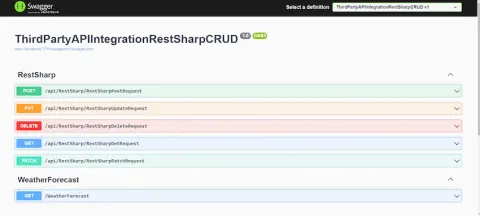
Using RESTSharp for CRUD Operations in ASP.NET Core Web API
Utilizing RESTSharp for CRUD operations in ASP.NET Core Web API offers a streamlined approach to interacting with APIs. This library simplifies HTTP requests and responses, allowing developers to focus on implementing functionality rather than managing low-level HTTP communication. By breaking down each operation—POST, PUT, DELETE, GET, PATCH—and providing corresponding code snippets, the process of creating, retrieving, updating, and deleting resources becomes more accessible. The RestClientHelper class encapsulates RESTSharp configuration, promoting code reusability and maintainability.
- Article · .NET Core
ValidateAntiForgeryToken in ASP.NET Core
In web development, security is a crucial aspect that demands meticulous attention. Cross-Site Request Forgery (CSRF) is a type of attack where unauthorized commands are transmitted from a user trusted by a web application. ASP.NET Core provides a built-in defense mechanism against CSRF attacks called ValidateAntiForgeryToken.
- Article · .NET Core
Creating Consistent ASP.NET Core Web API Responses with AutoMapper and DTOs
Developing a robust ASP.NET Core Web API hinges on the subtle yet pivotal details of response structuring. Leveraging AutoMapper in tandem with well-designed Data Transfer Objects (DTOs) not only ensures the separation of concerns but also orchestrates a symphony of consistent and predictable API responses. These intricacies extend beyond mere data mapping; they epitomize a strategic approach in harmonizing the internal model intricacies with the API's outward-facing facade. Unveiling the elegance of these detailed mappings and the orchestration of a uniform response structure not only enhances the developer's workflow but also augments client-side integration, presenting an intuitive and standardized communication channel. Addressing these finer points not only establishes a foundation for resilient error handling but also fuels the API's scalability and ease of maintenance, fostering an environment where agility meets reliability.
- Article · .NET Core
Implementing the Visitor Pattern in ASP.NET Core Web API Using 3-Tier Architecture
In an ASP.NET Core Web API employing a 3-tier architecture, the Visitor Pattern is utilized for efficient data manipulation in the C# Article model. The model, CSharpArticle, includes essential properties. The architecture involves a Data Access Layer with a repository managing database interactions, a Business Layer housing the Visitor interface and Article Service, and a Presentation Layer containing the API controllers. The Visitor Pattern is employed in the Business Layer to perform operations on articles, allowing for clean separation of concerns and enabling reusable, structured, and scalable code. This design ensures that CRUD operations benefit from the Visitor Pattern's flexibility while maintaining a clear division of responsibilities across the layers of the application.
- Article · ASP.NET Core
ASP.NET Core Web API Development with Template Method Pattern and 3-Tier Architecture
Build an ASP.NET Core Web API using a three-tier architecture, repository pattern, and service layer to organize CRUD operations for article data.
- Article · .NET Core
API Development Using Strategy Design Pattern with 3-Tier Architecture
In today's fast-paced software development landscape, creating well-structured and maintainable applications is crucial. One popular design pattern that can greatly enhance the organization and flexibility of your ASP.NET Core Web API projects is the Strategy Design Pattern. This pattern allows you to encapsulate and swap out algorithms or behaviors at runtime, making it an ideal choice for handling various CRUD (Create, Read, Update, Delete) operations on your data models. In this article, we'll explore how to implement the Strategy Design Pattern within a 3-Tier Architecture in an ASP.NET Core Web API. You'll learn how to create a robust business logic layer, define concrete strategies for each CRUD operation, and seamlessly integrate them into your API controllers. By the end of this guide, you'll have a comprehensive understanding of how to leverage this pattern for a more maintainable and scalable API.
- Article · .NET Core
Implementing State Design Pattern in ASP.NET Core Web API with 3-Tier Architecture
In this ASP.NET Core Web API project utilizing a 3-Tier Architecture with the State Design Pattern, we've created a News management system that encapsulates the state of news items, allowing for a clear and structured way to handle state transitions. The architecture consists of three distinct layers: Presentation, Business Logic, and Data Access. The Business Logic layer is where the State Design Pattern is applied, with different states such as Draft, Published, and Archived, each represented by concrete state classes. The NewsService class is responsible for managing these states and their transitions. Controllers in the Presentation layer handle HTTP requests and delegate the state-related operations to the NewsService, enabling CRUD functionality for news items. By setting the appropriate state and invoking state-specific methods, such as Publish and Archive, we control the state transitions. While this example focuses on the pattern's core implementation, in a real-world scenario, you would integrate a data access layer to persist and retrieve news items from a database, making it a robust and maintainable system.
- Article · .NET Core
ASP.NET Core Web API Development with Observer Design Pattern
This project represents a robust ASP.NET Core Web API application that manages tickets using a 3-tier architecture. The system provides full CRUD (Create, Read, Update, Delete) functionality for tickets. What sets this system apart is its use of the Observer Design Pattern, which enables real-time notifications to subscribers whenever a ticket is created, updated, or deleted. The three primary architectural layers include the Presentation Layer (API), Business Logic Layer (Service), and Data Access Layer (Repository), providing a well-structured and maintainable solution for ticket management.
- Ebook · ASP.NET Core
API Development Using ASP.NET Core Web API
A practical approach for developing the API in asp.net core
- Article · ASP.NET Core
ASP.NET Core Web API Development with Memento Pattern
The Mediator Pattern is a behavioral design pattern that promotes loose coupling among objects by centralizing their communication through a mediator object. In this pattern, multiple objects interact with each other indirectly through the mediator, rather than communicating directly. The primary goal of the Mediator Pattern is to reduce the dependencies between objects, making the system more maintainable and allowing for more flexible and scalable designs. It simplifies complex communication scenarios by having a single point of control, the mediator, which coordinates the interactions between different objects or components.
- Article · .NET Core
Mediator Design Pattern in ASP.NET Core Web API with 3-Tier Architecture
The Mediator Design Pattern is a behavioral design pattern that defines an object that centralizes communication between a set of objects. It promotes loose coupling between components by preventing direct connections between them. Instead of components communicating directly, they communicate through a mediator.
- Article · .NET Core
ASP.NET Core Web API with 3-Tier Architecture and Iterator Pattern
The Iterator Pattern is a behavioral design pattern that provides a way to access elements of a collection sequentially without exposing its underlying representation. It defines an interface for accessing the elements of a collection and keeps track of the current position within that collection.
- Article · .NET Core
Interpreter Pattern in ASP.NET Core Web API with Clean Architecture
Explore the application of the Interpreter Design Pattern in an ASP.NET Core Web API, following Clean Architecture principles. This article delves into building a robust CarCompany CRUD system, emphasizing code organization and separation of concerns for a maintainable and scalable solution.