Loading
Articles by Tuhin Paul
- AI Agents
Handling Schema Evolution in Enterprise Multi-Agent RAG Pipelines: A LangGraph Implementation Guide
Build a LangGraph multi-agent RAG pipeline that supports legacy and modern schemas during enterprise knowledge-base migrations using unified models, hybrid retrieval, and persistent state.
- AI Agents
Mastering Embedding Versioning in Enterprise RAG: A Multi-Agent LangGraph Approach
Build a version-aware RAG system with LangGraph and FastAPI that routes queries to compatible vector embeddings and supports embedding-model migrations.
- AI Agents
Demystifying Semantic Drift in Embeddings
Learn how semantic drift degrades RAG retrieval and how a multi-agent LangGraph workflow can detect temporal mismatches and retrieve current context.
- AI Agents
Optimizing Retrieval Latency at Scale: A Multi-Agent LangGraph Architecture for Sub-100ms RAG
Build a multi-agent LangGraph RAG system that reduces retrieval latency using semantic caching, query-complexity routing, parallel retrieval, quantized embeddings, and performance profiling.
- Langchain
Reducing Noise in Vector Search for Enterprise RAG
Learn how to reduce irrelevant RAG retrieval results with LangGraph using metadata filters, hybrid search, and LLM-based validation in a legal contract discovery workflow.
- AI Agents
Re-Ranking Strategies in Enterprise Multi-Agent RAG Systems
Learn how to add a cross-encoder re-ranking agent to a LangGraph RAG workflow to filter retrieved documents and improve enterprise support answers.
- AI Agents
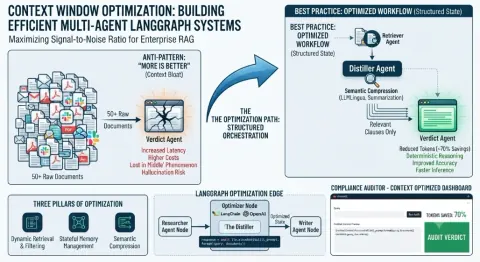
Context Window Optimization in Enterprise Multi-Agent RAG Systems
Learn how to optimize context windows in LangGraph multi-agent RAG systems using retrieval filtering, semantic compression, structured state, and a distiller agent.
- AI Agents
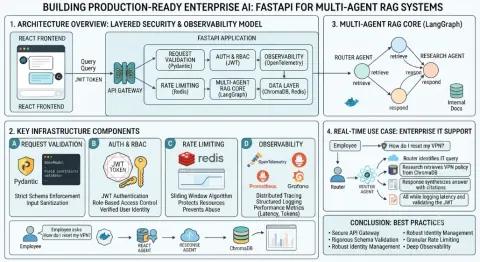
Enterprise-Grade FastAPI Architecture: Structuring Validation, Auth, Rate Limiting, and Observability for Multi-Agent AI Systems
Build a production-ready FastAPI foundation for multi-agent RAG systems with Pydantic validation, JWT authentication, Redis rate limiting, and OpenTelemetry observability.
- AI Agents
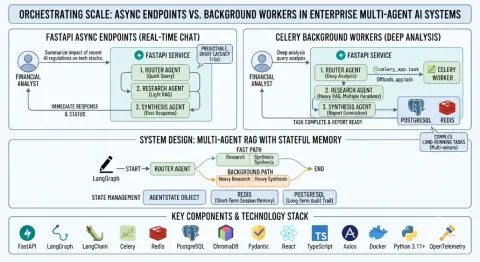
Async Endpoints vs. Background Workers in Enterprise Multi-Agent AI Systems
Learn when to use FastAPI async endpoints versus Celery background workers for scalable multi-agent RAG workflows, with LangGraph orchestration and persistent state.
- AI Agents
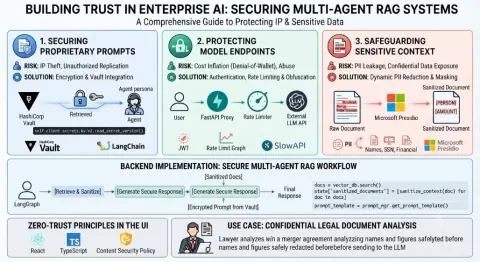
Securing Proprietary Prompts, Model Endpoints, and Sensitive Context in Enterprise RAG Systems
Secure enterprise multi-agent RAG systems by encrypting prompts, protecting model endpoints with access controls and rate limits, and redacting PII before LLM inference.
- AI Agents
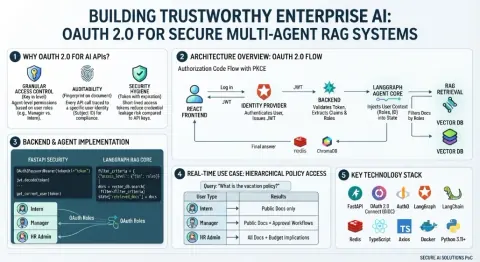
Integrating OAuth 2.0 into Enterprise Multi-Agent RAG Architectures
Learn how to secure a FastAPI multi-agent RAG application with OAuth 2.0 and OIDC, using token roles to control document retrieval and preserve user-specific sessions.
- AI Agents
Evaluating RAG Systems: A Multi-Agent LangGraph Framework for Comprehensive Quality Assessment
Build a multi-agent LangGraph framework to evaluate RAG systems using context precision, recall, faithfulness, answer relevancy, and correctness metrics.
- AI Agents
RAGAS and G-Eval: Building an Enterprise-Grade RAG Evaluation System with Multi-Agent LangGraph
Build a multi-agent LangGraph system that combines RAGAS diagnostic metrics and G-Eval LLM-as-a-judge scoring to evaluate RAG quality in production.
- AI Agents
Handling Long-Context Documents: An Adaptive Multi-Agent LangGraph Strategy for Enterprise RAG
Learn how to build a LangGraph multi-agent RAG system that profiles long documents and selects retrieval, summarization, or cross-section strategies based on each query.
- AI Agents
Multi-Layered Hallucination Defense in Enterprise LLMs: A LangGraph RAG Architecture
Build a LangGraph RAG workflow that reduces LLM hallucinations through grounded retrieval, self-consistency checks, NLI fact-checking, citation verification, and corrective regeneration.
- AI Agents
Fine-Tuning vs RAG: A Strategic Decision Framework with Multi-Agent LangGraph
Build a LangGraph multi-agent advisor that evaluates data freshness, citations, latency, budget, and risk to recommend RAG, fine-tuning, or a hybrid LLM architecture.
- AI Agents
Hybrid Search in RAG: Building an Intelligent Multi-Strategy Retrieval System with LangGraph
Build a LangGraph-based hybrid RAG search system that combines BM25 and vector retrieval, adaptive result fusion, and cross-encoder reranking for better retrieval quality.
- AI Agents
Dense vs Sparse Retrieval: Building an Intelligent Hybrid Search System with Multi-Agent LangGraph
Build a LangGraph-based hybrid search system that combines BM25 sparse retrieval and dense vector search, then uses Reciprocal Rank Fusion and reranking to improve results.
- AI Agents
Choosing the Right Embedding Model: A Multi-Agent LangGraph Selection Framework
Build a LangGraph multi-agent system that evaluates embedding models by retrieval quality, domain fit, cost, latency, language support, and deployment constraints.
- AI Agents
Mastering Chunking Strategies: A Multi-Agent LangGraph Advisor for Optimal Document Segmentation
Build a LangGraph multi-agent advisor that evaluates document characteristics and recommends RAG chunking strategies, including semantic, structure-aware, parent-child, and late chunking.
- AI Agents
Grounding in LLMs: Building Verifiable, Source-Anchored AI Systems with Multi-Agent LangGraph
Build a multi-agent LangGraph system that grounds LLM answers in retrieved sources, verifies citations, and scores confidence for transparent, traceable AI responses.
- AI Agents
Diagnosing RAG Failure Modes: A Multi-Agent LangGraph Diagnostician
Build a multi-agent LangGraph workflow that audits RAG retrieval, classifies failure modes, identifies root causes, and recommends targeted fixes using persistent failure memory.
- AI Agents
A Multi-Agent LangGraph RAG System for Bias, Variance, and Double Descent Analysis
Build a LangGraph multi-agent RAG system that analyzes training and validation curves to diagnose underfitting, overfitting, and double descent, then recommends model improvements.
- AI Agents
Eradicating Hallucinations in Enterprise RAG: A Multi-Agent Verification Framework
Build a LangGraph-based multi-agent RAG workflow that retrieves evidence, verifies generated claims, detects hallucinations, and rewrites unsupported answers.
- AI Agents
Automated Rollback Strategies for Enterprise RAG: Monitoring, Signals, and Execution
Build an enterprise RAG workflow with LangGraph that monitors latency, quality, and safety signals, then automatically rolls back model and prompt versions when thresholds are breached.