Loading
Articles by Tuhin Paul
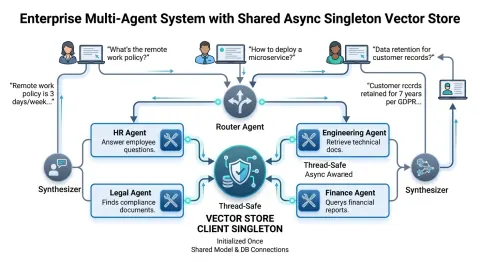
Enterprise Singleton: Thread-Safe, Async-Aware Resource Sharing in Multi-Agent LangGraph
By implementing an async-aware, thread-safe singleton pattern, we transform our multi-agent systems from resource-wasting prototypes into efficient, enterprise-grade platforms capable of handling concurrent load while minimizing infrastructure overhead.
Securing the Enterprise AI: Custom Context Managers for Resource Isolation in Multi-Agent LangGraph
In enterprise AI deployments, we often focus on the intelligence of the agents, but we neglect their infrastructure footprint. When an LLM agent enters a reasoning loop, hallucinates a bad tool argument, or crashes mid-execution, what happens to the resources it allocated?
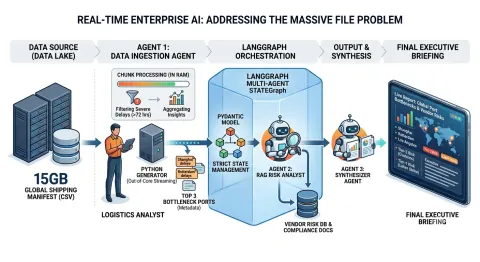
Streaming the Enterprise Data Lake: Out-of-Core CSV Processing in Multi-Agent LangGraph RAG
A standard RAG system fails here. You cannot chunk a 15GB CSV into a vector database—indexing 50 million raw shipping rows is computationally wasteful and semantically meaningless. Furthermore, passing 15GB to an LLM's context window is impossible.
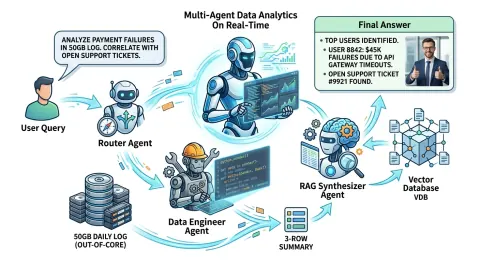
Scaling the Enterprise AI: Out-of-Core Data Processing in Multi-Agent LangGraph RAG
When a financial analyst asks, "Summarize the transaction anomalies from the last 50GB of logs and correlate them with recent customer support tickets," a standard RAG system fails. You cannot chunk 50GB into a vector database and expect an LLM to synthesize it. The LLM needs to compute over the data, not just retrieve it.
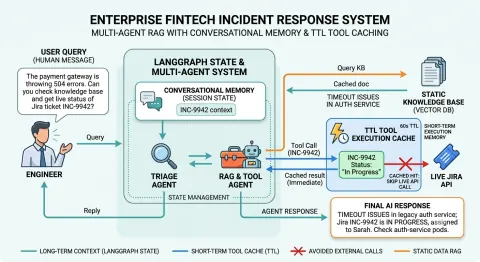
Building an Enterprise Multi-Agent RAG System: Real-Time Data, State, and TTL Caching
In enterprise environments, building a Retrieval-Augmented Generation (RAG) system is no longer just about querying a vector database. Modern enterprise AI requires multi-agent collaboration, persistent conversational memory, and strict state management.
Count N-Digit Numbers With Given Digit Sum Using Dynamic Programming
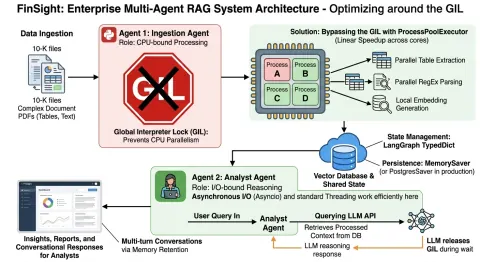
The Global Interpreter Lock is a relic of Python’s early design, but it remains a critical factor in modern system architecture. By understanding the distinction between I/O-bound and CPU-bound workloads, and knowing when to deploy multi-processing to bypass the GIL, you can build highly performant, scalable AI systems.
Designing Observability for Enterprise Multi-Agent LangGraph RAG: A Blueprint to Slash MTTR
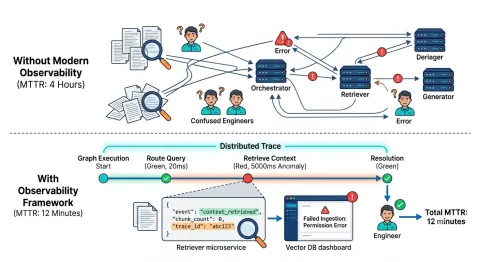
By enforcing W3C trace context propagation, strict structured JSON logging, and GenAI semantic conventions, we transform a chaotic web of microservices into a transparent, debuggable pipeline. When you integrate these patterns into LangGraph, you aren't just building an AI application; you are building an enterprise-grade system where failures are isolated, diagnosed, and resolved in minutes, not days.
Enterprise Graph-RAG: Modeling Financial Risk Networks with Multi-Agent LangGraph
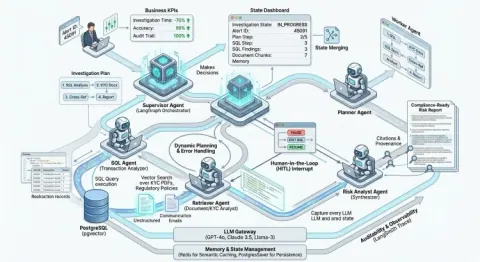
Enterprise Graph-RAG models financial risk networks with multi-agent LangGraph for real-time contagion and AML analysis.
The Paradigm Shift: From RAG to Agentic RAG
Build production-grade enterprise multi-agent RAG systems with LangGraph. Master state, memory, and deterministic workflows for AI.
Building an Enterprise Hybrid Recommendation Engine with Multi-Agent LangGraph, RAG, Memory, and State
Build an enterprise hybrid recommendation engine using LangGraph, RAG, memory, and multi-agent orchestration for scalable, explainable, and adaptive suggestions.
Architecting Real-Time, Scalable Multi-Agent Fraud Detection with LangGraph
Build scalable, low-latency multi-agent fraud detection with LangGraph, RAG, and memory for enterprise financial services.
Architecting GDPR-Compliant GenAI: An End-to-End Guide to Multi-Agent RAG with LangGraph
Build GDPR-compliant GenAI RAG systems with LangGraph. Learn multi-agent RAG, state management, and real-world healthcare use cases.
Enterprise-Grade Privacy in GenAI: PII Anonymization & Differential Privacy in Multi-Agent RAG
Secure GenAI with PII anonymization & differential privacy in multi-agent RAG. Enterprise-grade privacy for regulated industries.
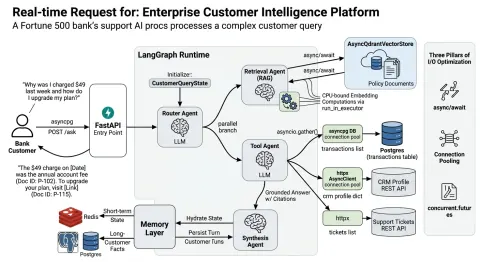
Optimizing I/O-Bound Python Microservices: An Enterprise Multi-Agent LangGraph RAG System with Memory & State
Optimize Python microservices for I/O-bound tasks using LangGraph, async/await, connection pooling, and concurrent.futures for sub-second latency.
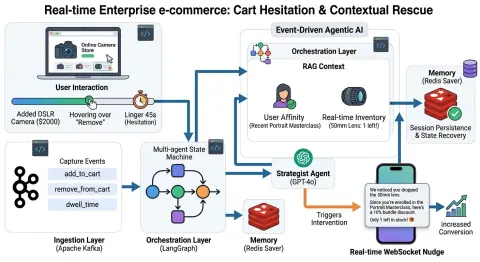
Architecting Real-Time E-Commerce Intelligence: Kafka-Driven Multi-Agent RAG with LangGraph
Build real-time e-commerce intelligence with Kafka, LangGraph, RAG, and Redis for sub-second, hyper-personalized interventions.
Orchestrating Enterprise RAG ETL with Airflow Multi-Agent Integration
Orchestrate enterprise RAG ETL with Airflow and multi-agent integration for a self-healing, cost-aware, and auditable system.
An End-to-End Guide to OAuth 2.0, Secret Management, and Multi-Agent LangGraph RAG
Build an enterprise-grade RAG system with OAuth 2.0, secure secret management, and multi-agent LangGraph for compliance.
Choosing Between AWS Bedrock, SageMaker, and Custom EC2/Kubernetes for LLM Inference
Choosing LLM inference backends: AWS Bedrock, SageMaker, or K8s. Learn the organizational decision framework and a practical LangGraph implementation.
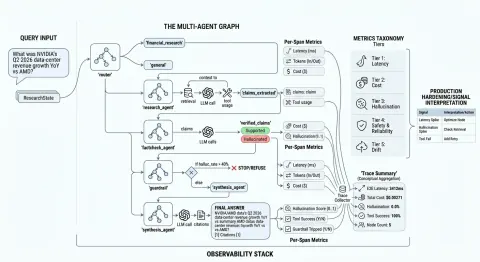
Monitoring LLM Applications in Production
Monitor LLM apps in production with a multi-dimensional observability stack: latency, cost, hallucination, safety, tools, and drift.
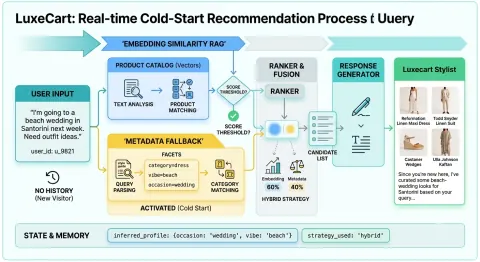
An Enterprise Multi-Agent LangGraph RAG Architecture
Explore an enterprise LangGraph RAG architecture for multi-agent systems, tackling cold-start problems with hybrid embedding and metadata strategies.
Enterprise Dynamic Pricing using Reinforcement Learning with Multi-Agent LangGraph and RAG
Enterprise dynamic pricing: RL for optimization, LangGraph for context, RAG for data. Drive profit safely.
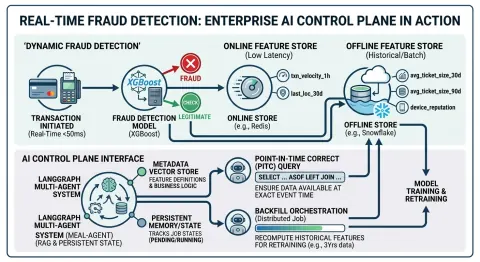
Architecting the Intelligent Enterprise Feature Store: PITC, Backfilling, and Multi-Agent LangGraph Orchestration
Build an Intelligent Enterprise Feature Store with PITC, backfilling, and Multi-Agent LangGraph RAG for scalable ML.
Building a Sub-Second Credit Scoring Engine
Build sub-second credit scoring engines with event-driven architecture, streaming feature stores, and LangGraph for instant, compliant fintech decisions.

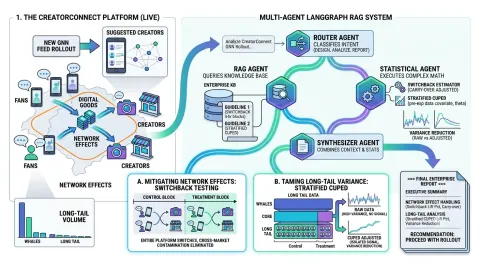
Handling Network Effects and Long-Tail Variance in Enterprise ML Rollouts
Master enterprise ML rollouts: Tackle network effects with Switchback Testing & long-tail variance with Stratified CUPED.