
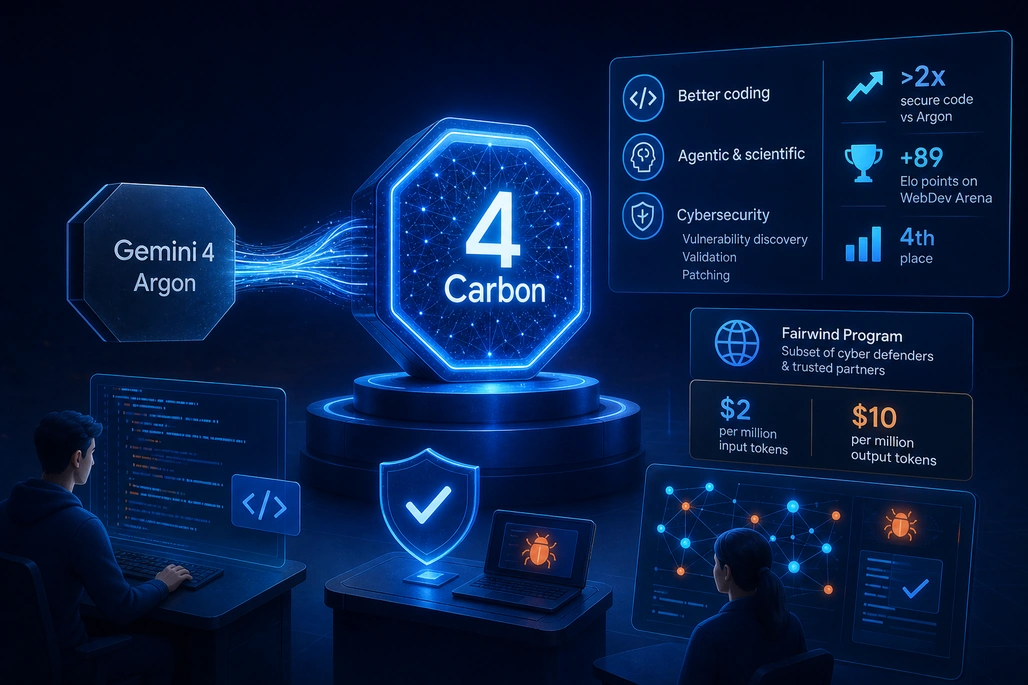
Google has announced Gemini 4 Carbon, a frontier model built as a successor to Gemini 4 Argon. Google says it improves coding, agentic and scientific tasks, along with cybersecurity capabilities including vulnerability discovery, validation and patching. Its internal testing found more than a twofold improvement over Argon in generating secure code, while Carbon gained 89 Elo points on WebDev Arena and reached fourth place. The model is initially being provided to a subset of cyber defenders and trusted partners through Google’s Fairwind Program, with broader access planned later. Google has set introductory API pricing at $2 per million input tokens and $10 per million output tokens, before prices rise to $4 and $20 respectively.
Why it matters
Developers and security teams may eventually use Carbon for software engineering, vulnerability research and code remediation, but access remains restricted while Google gathers feedback and refines safeguards. The announcement also illustrates the tradeoff between releasing more capable cyber models and conducting additional testing before wider deployment.
Key points
- Google says Carbon improves on Argon across coding, agentic, scientific and cybersecurity evaluations.
- Google reports more than a twofold increase over Argon in the success rate for generating secure code.
- Carbon gained 89 Elo points on WebDev Arena and ranks fourth with a score of 1,768.
- Carbon recorded a 0.0% attack-success rate in the Gray Swan Indirect Prompt Injection benchmark, meaning it resisted every evaluated attempt.
- Google began a staged rollout to cyber defenders through its Fairwind Program; broader access is planned, and introductory API pricing is already set.
Based on reporting by The original announcement, Ars Technica and The Verge.

Join the conversation! Your thoughts help the community grow.