
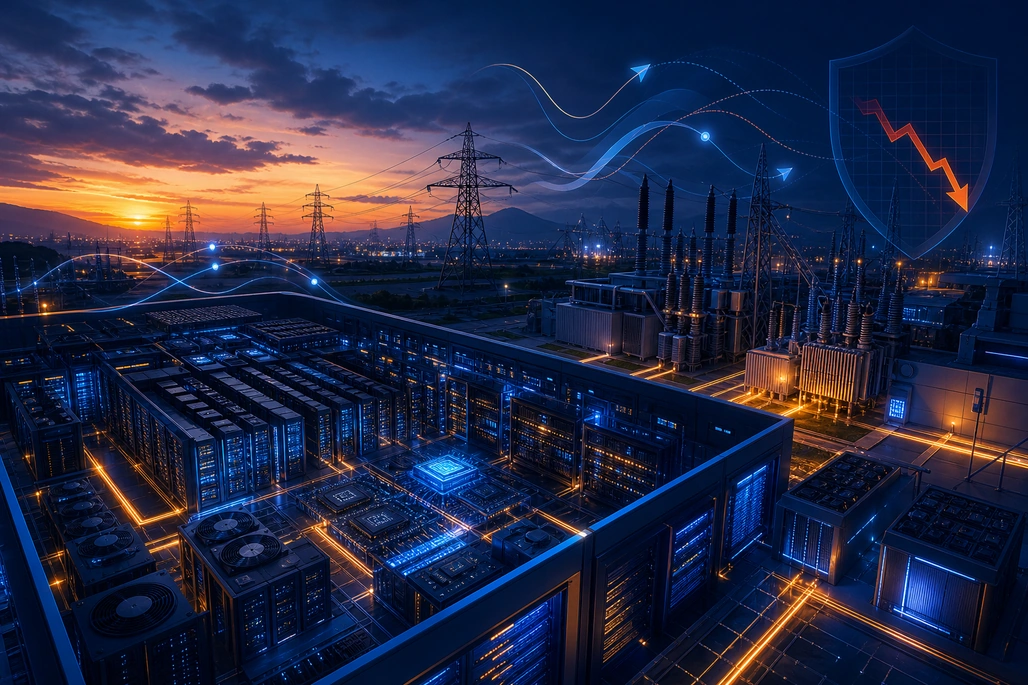
AI data center projects combine GPU hardware, power capacity and major financing needs.
Elon Musk said on October 25, 2026, in a reply on X to investor Chamath Palihapitiya, that debt markets have "almost entirely shut off" funding for companies without substantial revenue beyond AI data centers. Musk also said SpaceX had closed $40 billion in debt to buy GPUs, citing the company’s investment-grade status and revenue from Starlink and launch services; the financing terms and GPU deployment schedule were not disclosed publicly.
Key takeaways
- Musk said SpaceX closed $40 billion in debt financing for GPUs while warning that AI infrastructure borrowers face much tighter credit conditions.
- The warning matters most to neoclouds: specialized cloud providers that borrow to buy GPUs and rent computing capacity to AI companies and larger cloud platforms.
- Recent reporting has documented investor concern about debt-heavy AI infrastructure companies, including pressure on debt and equity prices.
- TeraWulf has argued that contracted power, long-term customer agreements and matched financing are central to reducing infrastructure-development risk.
What did Elon Musk announce about AI data center debt?
In the October 25 X exchange, Musk drew a distinction between SpaceX and companies whose business is primarily building AI data centers. He said SpaceX could obtain funding because it has revenue sources independent of AI infrastructure, specifically Starlink and launch services.
The statement is notable because AI data centers require large upfront spending. Operators must secure land, power capacity, cooling equipment, networking, buildings and GPUs before they can sell computing time to customers. Debt is borrowed money that must be repaid, generally with interest, so reduced lender appetite can delay or change those buildout plans.
Musk’s post did not identify the lenders, interest rate, collateral, maturity date or exact GPU supplier for the reported $40 billion financing. SpaceX is privately held, so the company is not required to publish the type of periodic financial filings required of U.S. public companies. The size and status of the transaction should therefore be understood as Musk’s public statement rather than as terms verified through a company filing.
Why are developers hearing more about AI infrastructure financing?
Developers use AI through APIs, cloud platforms and model-hosting services, but those services depend on physical infrastructure. A GPU is a processor commonly used to train and run AI models because it can perform many calculations in parallel. A data center operator finances the hardware and power systems that make those GPU services available.
One type of operator is a neocloud. These companies specialize in AI computing capacity and typically buy or lease large quantities of GPUs, then sell access to customers. Axios reported on October 21 that neoclouds have been among the companies hit hardest as investors reassess debt-funded AI infrastructure, while noting uncertainty about the eventual profitability of new data centers.
Associated Press reported on October 22 that AI-related stocks had been volatile amid concern about borrowing costs for data centers and chips. Its report cited CoreWeave as an example of an operator that borrows to acquire Nvidia AI chips and rents the capacity through the cloud. Those market moves do not prove that every AI infrastructure company will fail, but they show why financing terms have become a central issue for operators and their customers.
How does tighter credit affect AI cloud providers?
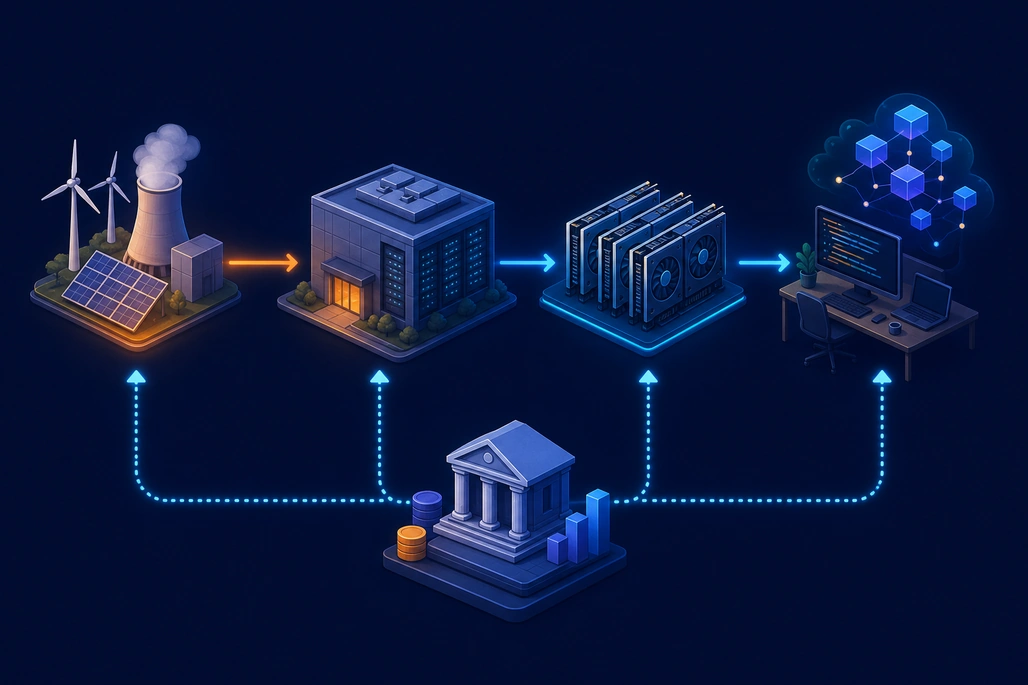
AI cloud services rely on power, data center capacity, GPU hardware and financing.
Tighter credit does not necessarily mean lenders stop lending to every data center project. It means lenders may require stronger borrowers, higher interest rates, more collateral, longer customer commitments or more equity from the company seeking financing.
| Term | Meaning for beginners | Why it matters |
|---|---|---|
| Debt financing | Borrowed money used to build or buy infrastructure. | It can speed up expansion, but payments remain due even if demand weakens. |
| Neocloud | A specialized provider of AI-focused cloud compute, often centered on GPU capacity. | Its business depends on keeping expensive hardware and data centers utilized. |
| Hyperscaler | A very large cloud provider that operates computing infrastructure at global scale. | Large balance sheets and existing revenue may make financing easier to obtain. |
| Contracted revenue | Revenue expected under a signed customer agreement. | Long-term contracts can help demonstrate that a project has a way to repay financing. |
J.P. Morgan Asset Management wrote this month that AI infrastructure spending is increasingly relying on debt markets and that recent volatility has renewed questions about whether projects can deliver attractive returns. It also described neoclouds as providers that have helped add computing capacity for hyperscalers and frontier AI labs.
For developers, the immediate practical issue is not whether to interpret one social-media post as a forecast of a market collapse. It is whether a cloud provider can continue delivering capacity, pricing and support under changing financing conditions. Teams using GPU-heavy workloads can reduce dependency risk by documenting portability requirements, monitoring service commitments and avoiding assumptions that capacity will always be inexpensive or immediately available.
What is TeraWulf’s position on power, contracts and financing?
The X trending page also presented a different view from TeraWulf’s leadership: disciplined developers with secured power, customers and financing may be able to operate through a tougher credit market. TeraWulf’s public filings and earnings materials describe a strategy of controlling power-advantaged infrastructure, signing long-duration customer contracts and aligning capital deployment with contracted demand.
In its second-quarter 2026 results, TeraWulf said it had approximately $3.0 billion in cash and restricted cash as of June 30, 2026. It also said its Justified Data Campus lease with Anthropic covered about 401 megawatts of critical IT capacity, with initial delivery expected in the second half of 2027 and full delivery expected in early 2028. These are company statements and forward-looking targets, not guarantees of future delivery or revenue.
On October 5, 2026, TeraWulf said it expanded contracted power at its Muskie Data Campus in eastern Kentucky from 500 megawatts to 1 gigawatt. The company also said it intended to seek additional senior secured debt for development, underscoring that access to financing remains important even for operators that emphasize contracted power and customers.
What is known and unknown after Musk’s warning?
Known: Musk publicly said SpaceX closed $40 billion in GPU-related debt and that financing for companies without significant non-data-center revenue had become much harder to obtain. Independent reporting published earlier in the week also described rising concern over debt-heavy AI infrastructure and neocloud economics.
Unknown: SpaceX has not publicly released the debt agreement’s full structure, pricing, lenders, collateral, GPU quantity or delivery dates. It is also not possible from Musk’s post alone to determine how broadly his assessment applies across private credit, bank lending, project finance and public bond markets, or which individual AI data center projects will obtain financing.
The near-term test for AI infrastructure providers will be whether they can pair power access and GPU supply with creditworthy customer demand and financing terms that their future revenue can support.
Frequently asked questions
What did Elon Musk say about AI data center financing?
On October 25, 2026, Musk said debt markets had largely stopped providing money to companies without substantial revenue outside AI data centers. He said SpaceX had closed $40 billion in debt for GPUs.
What is a neocloud?
A neocloud is a specialized cloud provider focused on AI computing. It commonly acquires GPUs and data center capacity, then rents that computing power to AI companies, enterprises or larger cloud platforms.
Why does data center debt matter to developers?
Debt conditions can affect how quickly providers build capacity, what they charge for GPU services and how much financial pressure they face. Developers can reduce exposure by planning for workload portability and reviewing provider commitments.
Did SpaceX disclose the terms of its reported $40 billion GPU debt deal?
No. Musk disclosed the reported amount in his X post, but the company had not publicly released details such as lenders, interest rate, maturity, collateral, GPU quantities or delivery dates.
Does tighter credit mean all AI data center projects will stop?
No. Tighter credit can make borrowing more selective and expensive rather than eliminating it. Projects with power access, long-term customer contracts and stronger financing structures may still be able to proceed.
Sources
- X — Musk Warns AI Data Center Debt Markets Are Shutting Down — October 25, 2026
- Axios — The AI trade gets a reappraisal — October 21, 2026
- Associated Press — Sharp drops for AI stocks overwhelm markets worldwide as oil prices jump — October 22, 2026
- J.P. Morgan Asset Management — Could rising AI debt derail the investment boom? — October 23, 2026
- TeraWulf — TeraWulf Reports Second Quarter 2026 Results — August 5, 2026
- TeraWulf — Form 8-K: Muskie expansion and financing strategy update — October 5, 2026

Join the conversation! Your thoughts help the community grow.