Loading
Eliminating LLM Hallucinations with Prompt Engineering Powered by GSCP
Large Language Models’ hallucinations pose critical risks in regulated fields. Combining Prompt Engineering with Gödel’s Scaffolded Cognitive Prompting reduces errors through layered validation, enabling safe, auditable AI workflows in healthcare and finance.
How Do Large Language Models Work? A Deep Dive into LLM AI
Discover how Large Language Models (LLMs) like ChatGPT work, from their training lifecycle and Transformer architecture to challenges like bias, sustainability, and security. This in-depth guide explains the mechanics of LLMs, their impact on industries, and the future of Generative AI.
LLM Observability: Why It Matters and How to Implement It
Discover what LLM observability is, why it’s critical for building reliable AI systems, and practical approaches for monitoring, debugging, and improving large language models in production.
From Syntax to Semantics: Fine-Tuning NLP Models for Precision and Power
Fine-tuning in NLP adapts large language models to specific tasks or domains using methods like full fine-tuning, prompt tuning, and LoRA, improving accuracy, efficiency, and real-world applicability.
Rethinking Large Language Model Architectures: Toward Self-Learning, Language-Grounded, and Data-Efficient AI
A deep dive into evolving LLM architectures, focusing on making AI more self-learning, language-grounded, and data-efficient for smarter, more adaptable models with reduced training overhead.
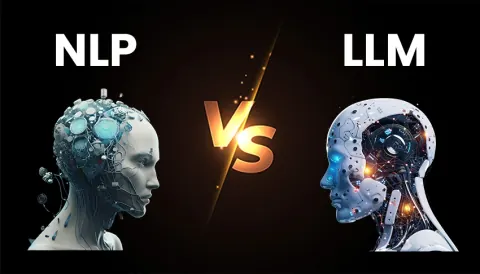
Understanding the Difference Between NLP and LLM
Learn how NLP and LLMs differ in scope, techniques, capabilities, and real-world use cases, from text analysis to generation and conversational AI.
Prompt Security in AI: Why a Validation Layer is Necessary for Every Company
Prompt Validation Layers (PVLs) secure AI systems by filtering sensitive data, enforcing compliance, and mitigating risks in prompts, making them essential infrastructure for safe, scalable, and responsible enterprise AI deployment.
Private AI for Healthcare: How PT-SLMs Ensure Compliance, Confidentiality, and Clinical Accuracy
Learn how Private AI models like PT-SLMs protect patient data, meet healthcare compliance standards, and deliver clinically accurate insights.
What is a key concern when sending data to AI systems?
Learn the privacy, security, intellectual property, and compliance risks of sending data to LLMs, plus practical steps to protect sensitive information.
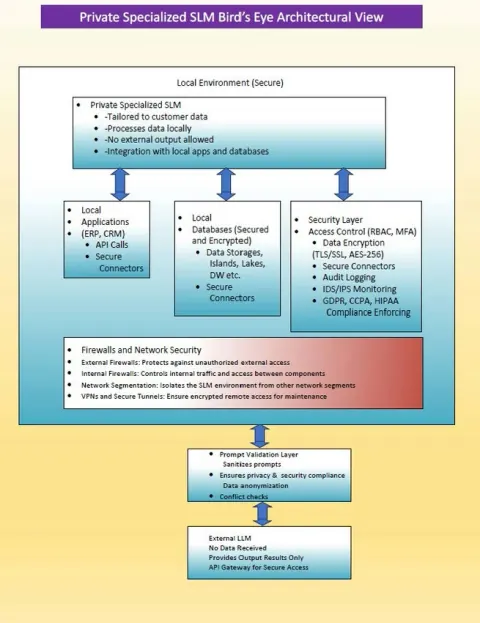
Private Specialized Small Language Model (SLM) Architecture
Learn how private specialized small language models can process sensitive data locally using secure APIs, encryption, access controls, and integrations with ERP and CRM systems.
Learn Fine-Tuning Llama 3.1
This article provides a step-by-step guide on fine-tuning the Llama 3.1 language model using Python and the Hugging Face Transformers library. It includes code examples, explanations, and best practices for achieving optimal performance.
Unlock Small Language Models Deep Dive Parameters Loss Optimization RAG
Learn how small language models are trained using parameters, forward passes, cross-entropy loss, and optimization algorithms such as gradient descent and Adam.
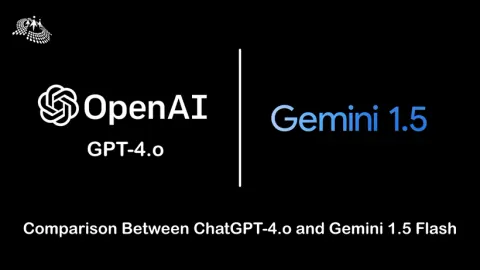
Comparison Between ChatGPT-4o and Gemini 1.5 Flash
Compare ChatGPT-4o and Gemini 1.5 Flash across speed, context windows, reasoning, code generation, multimodal analysis, and practical use cases.
What is Code Llama?
Learn what Meta's Code Llama is, how it generates and completes code, its model variants, supported languages, benefits, and current limitations.