Loading
How to Integrate LLM-Based Chat Features into Existing Web Applications
Learn how to add LLM-powered chat to an existing web application using a frontend interface, backend API, chat history, and optional RAG knowledge retrieval.
What Is Function Calling in LLMs and How Do Developers Use It?
Learn how LLM function calling uses structured JSON to invoke validated backend tools, APIs, and workflows. Covers schemas, server-side execution, security, and real-world use cases.
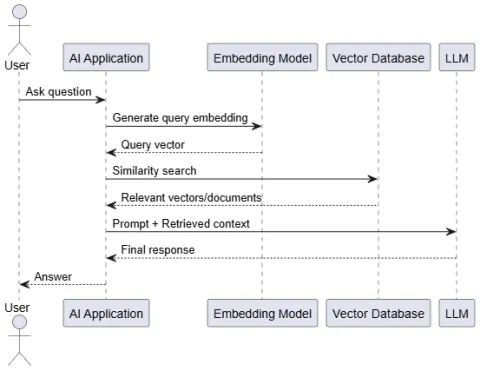
How to Implement Retrieval-Augmented Generation (RAG) in a Production System?
Design and operate a production RAG system with document ingestion, embeddings, vector search, grounded prompts, caching, security, monitoring, and scaling.
Why LLMs Are So Expensive?
Why are LLMs costly? This in depth guide explains training cost, inference cost, GPU infrastructure, attention scaling, KV cache memory, architecture internals, and why some models are more expensive than others.
What Are Large Language Models (LLMs) and How Do They Work?
Explore Large Language Models (LLMs): how they work, their uses in AI, and key considerations for enterprise deployment in cloud environments.
Building Knowledge Graphs with Microsoft GraphRAG and Azure OpenAI
Unlock AI's potential with GraphRAG! Build knowledge graphs using Microsoft GraphRAG and Azure OpenAI to answer complex questions beyond standard RAG. Learn how!
Vector storage in AI
Unlock AI's potential with vector storage! Enables semantic search, reduces hallucinations, and powers intelligent applications like chatbots and RAG systems.
Context Window in Large Language Models (LLMs)
Explore the context window in LLMs: its impact on performance, limitations due to self-attention, and trade-offs in RAG systems. Learn how it shapes LLM behavior.
From LLMs to PT-SLMs: How GSCP-15 Turns Generic Models into Governed, Enterprise-Grade Delivery
Discover PT-SLMs: tailored small language models for enterprise. Learn how GSCP-15 ensures governed, cost-effective, and reliable AI delivery at scale.
How Do Developers Reduce Hallucinations When Using LLMs in Production Apps?
Learn practical ways to reduce LLM hallucinations in production using RAG, constrained prompts, validation, monitoring, and safe fallback responses.
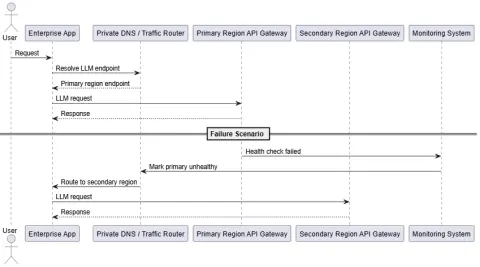
Enterprise-Grade Private LLM Deployment Architecture: Secure, Autoscaling, Multi-Region, and Internet-Isolated
Ensure LLM resilience with a secure, autoscaling, multi-region architecture. Achieve near-zero downtime, regulatory compliance, and enterprise-grade availability.
Understanding LLM Generation (Decoder) Parameters (Sample/Inference Parameter): Control, Creativity, and Output
Master LLM text generation! Control creativity, length, & repetition with temperature, top-k, top-p, penalties, & more. Fine-tune outputs for any task.
The New Wave: LLMs, PT-SLMs, and GSCP-15 as the Enterprise Stack for Trustworthy AI
Discover the future of enterprise AI: LLMs, PT-SLMs, and GSCP-15. Build trustworthy, governed, and cost-effective AI systems for lasting competitive advantage.
The LLM Era Gets Serious: What Changes Next and Why It Matters
LLMs are evolving from impressive demos to dependable infrastructure. The future lies in control, context management, verification, and cost-effective integration.
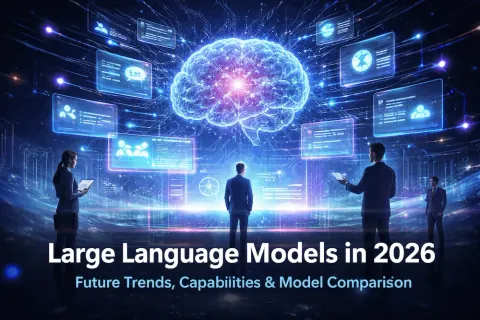
Large Language Models in 2026: GPT-5 vs Claude vs Llama and the Future of AI Models
LLMs in 2026: Specialization, multimodality, open-source competition, & practical safety. Explore technical advances, product shifts, & future trends.
NotebookLM Explained – How Google’s AI Notebook Is Redefining Knowledge Work
Unlock insights with Google's NotebookLM! This AI notebook analyzes your documents, providing accurate summaries and answers. Revolutionize research and knowledge work.
What are AI hallucinations
AI hallucinations occur when language models generate confident but incorrect or fabricated information. Learn what causes AI hallucinations, why they happen in large language models, real world risks, and how developers and architects can reduce them in production systems.
Different Types of AI Hallucinations
Learn the different types of AI hallucinations in large language models, including factual, reasoning, contextual, and conversational hallucinations, and understand why they matter for developers and architects building production AI systems.
How LLMs Generate Responses
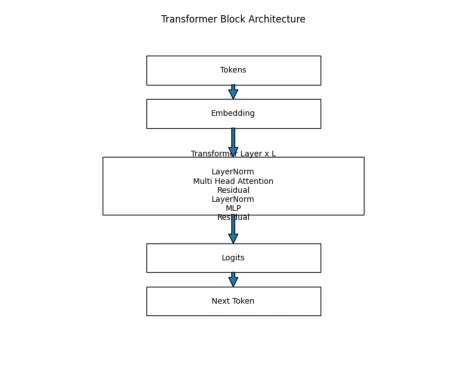
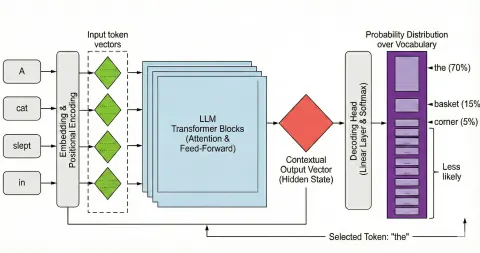
Learn how large language models generate responses step by step. Understand tokenization, embeddings, attention, and next-token prediction to see why LLMs sound confident, how they work internally, and why hallucinations occur.
LLMs And GSCP-15: Turning Raw Models Into Governed Reasoning Systems
Why LLMs Need A Governing Mind Around Them Large language models are astonishingly capable pattern machines. With the right prompt, they can write code, draft contracts, design interfaces, and summarize complex logs. But under all the capability sits a very simple objective: predict the next token. That objective explains almost all of their bad behavior. They hallucinate because the next token that fits the pattern is not always the truth. They drift off spec because there is no native concept of a contract that must be honored. They break policies because their goal is fluency, not compliance.
🔮 Micro-LLMs vs Large LLMs: The Future of Lightweight AI Models
Micro-LLMs are compact, fast, on-device AI models designed for privacy, low cost, and real-time performance. This summary explains their benefits, differences from large LLMs, and why they drive the future of everyday AI.
Large Language Models: What They Really Change In Work And Software
LLMs are transforming work & software, shifting from research toys to invisible infrastructure. Learn how they work, their impact, and future implications.
Major Challenges LLMs Face When Working With Healthcare Data
Healthcare data is complex, sensitive, and heavily regulated. Discover the major challenges large language models face with PHI privacy, accuracy, hallucinations, multimodal data, specialty knowledge, and clinical deployment, and why the future belongs to safer, specialty specific healthcare models.
How Large Language Models (LLMs) Work
Learn how Large Language Models (LLMs) work in simple, natural language. Understand tokenization, embeddings, transformers, attention, training, inference, hallucinations, applications, prompt engineering, and the future of AI.
Beyond Chatbots: Auto-Regressive LLMs as Real-Time Enterprise Forecasting Engines
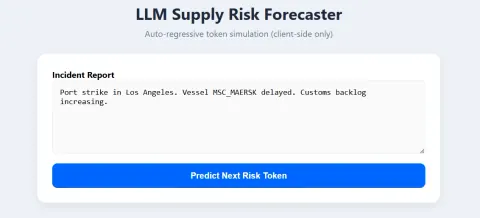
Unlock real-time enterprise forecasting with auto-regressive LLMs. Predict supply chain disruptions & prevent stockouts using token-level predictions. #LLMs