Loading
Topic
system architecture
9 posts about system architecture by 5 contributors.
Know system architecture? Share what you know with developers who are learning it.
+ Follow system architectureBe the first to follow this
- Articles
- 9
- Contributors
- 5
Everything about system architecture
- Article · .NET
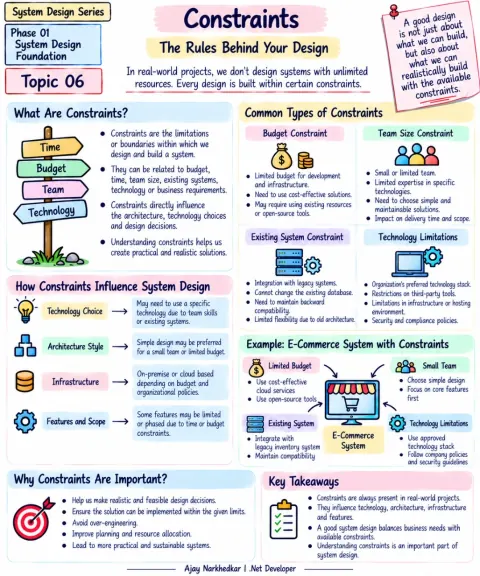
Constraints in System Design: The Rules That Shape Your Architecture
Learn how real-world constraints such as budget, team size, existing systems, technology limitations, and delivery timelines influence System Design. This practical guide explains how .NET developers can balance business requirements with real-world limitations to create simpler, maintainable, and realistic software architectures.
- Article · .NET
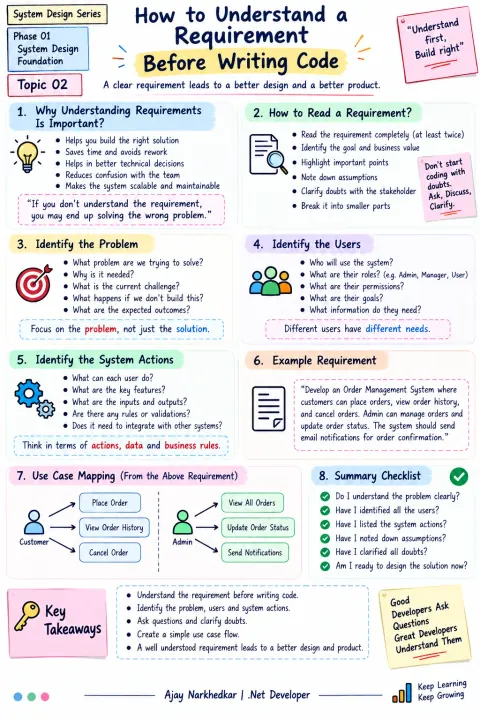
How to Understand a Requirement Before Writing Code
Learn how .NET developers can understand and break down software requirements before writing code. This practical guide explains how to identify the problem, users, system actions, use cases, business rules, data, and functional and non-functional requirements using a real-world Order Management System example.
- Article · .NET
What Actually is System Design?
Learn what System Design really means from a .NET developer's perspective. Understand how requirements, APIs, data, traffic, performance, availability, and scalability come together to build reliable real-world applications.
- Article · Software Architecture/Engineering
How to Design a Scalable Notification System for Large Applications?
Learn how to design a scalable notification system for large apps! Ensure fast, reliable delivery via SMS, email, & push. Handle millions of users efficiently.
- Article · Software Architecture/Engineering
What Are the Most Common Performance Bottlenecks in Distributed Systems?
Discover common performance bottlenecks in distributed systems like network latency, database issues, and resource contention. Learn to optimize your cloud applications.
- Article · Software Architecture/Engineering
How to Design Scalable Backend Systems for Millions of Users?
Learn how to design scalable backend systems for millions of users! Master microservices, load balancing, caching, and more for high performance and reliability.
- Article · Software Architecture/Engineering
Domain Driven Design (DDD) for Beginners
Domain Driven Design (DDD) helps teams build software that meets real needs. To start, focus on understanding the problem your software solves. Talk to users to learn their needs. Use simple language to describe your ideas. Create a shared vision with your team. This way, everyone works towards the same goal.
- Article · .NET
Enterprise Text-to-Speech System: Architecture, HLD and UI
Explores the architecture, high-level design (HLD), and user interface (UI) of an enterprise text-to-speech (TTS) system. It delves into the technical aspects of integrating speech synthesis into enterprise applications, highlighting system components, design strategies, and the user experience.
- Article · Software Architecture/Engineering
Priciples of Scalable System Design
The principles of scalable system design focus on creating architectures that can efficiently handle increasing loads. Key aspects include load balancing, fault tolerance, and performance optimization.