
Amazon EMR 8.2 updates Spark processing, table formats, and governed data access.
AWS has released Amazon EMR 8.2, an LTS release for Amazon EMR on EC2, Amazon EMR on EKS, and Amazon EMR Serverless. AWS posted the announcement on November 17, 2026, while the EMR Spark 8.2.0 release guide lists November 18, 2026 as its initial release date. The release packages Apache Spark 4.1.3, Apache Iceberg 1.11.0, and Delta Lake 4.2.0, and adds tools for governed data access, concurrent Delta Lake writes, and Spark scaling. AWS announced Amazon EMR 8.2 here.
Key takeaways
Amazon EMR 8.2 is an LTS release with standard support through November 17, 2029.
Multiple EMR clusters can now write to the same Delta Lake table in Amazon S3 without a DynamoDB log store.
Iceberg materialized views can refresh changed data instead of recomputing supported source operations in full.
EMR Serverless adds performance-optimized, balanced, and cost-optimized Spark scaling profiles, with balanced as the default for new 8.2 jobs and sessions.
EMR on EKS now uses Spark Operator version 2, based on open-source Spark Operator 2.5.0.
What changed in Amazon EMR 8.2?
Amazon EMR is AWS's managed service for running big-data frameworks such as Apache Spark. A release label selects a tested bundle of the operating system, runtime, and data-processing software for an EMR cluster, EKS workload, or Serverless application.
EMR 8.2 moves its included Spark runtime to Apache Spark 4.1.3, Iceberg to 1.11.0, and Delta Lake to 4.2.0. Those choices matter because Spark is the processing engine, while Iceberg and Delta Lake are table formats that help teams manage large analytical datasets in object storage. Apache Iceberg 1.11.0 includes Spark 4.1 runtime support, and Delta Lake's release matrix lists Delta Lake 4.2.x as compatible with Spark 4.1.x. Apache Iceberg's release page and Delta Lake's compatibility table confirm those upstream version relationships.
Component | Version in EMR 8.2 | Why a beginner should care |
|---|---|---|
Apache Spark | 4.1.3 | Runs distributed SQL, Python, Scala, Java, R, and .NET data jobs. |
Apache Iceberg | 1.11.0 | Manages analytical tables and snapshots in object storage. |
Delta Lake | 4.2.0 | Adds transaction controls and table management for data lake files. |
AWS classifies EMR Spark 8.2.0 as Long Term Support. Its release guide gives the version standard support through November 17, 2029 and an end-of-life date of November 18, 2029. That longer support window can help teams that want to standardize a production data platform instead of changing runtime versions frequently. The EMR 8.2 release guide lists the support dates and component versions.
Data governance and concurrent Delta Lake writes
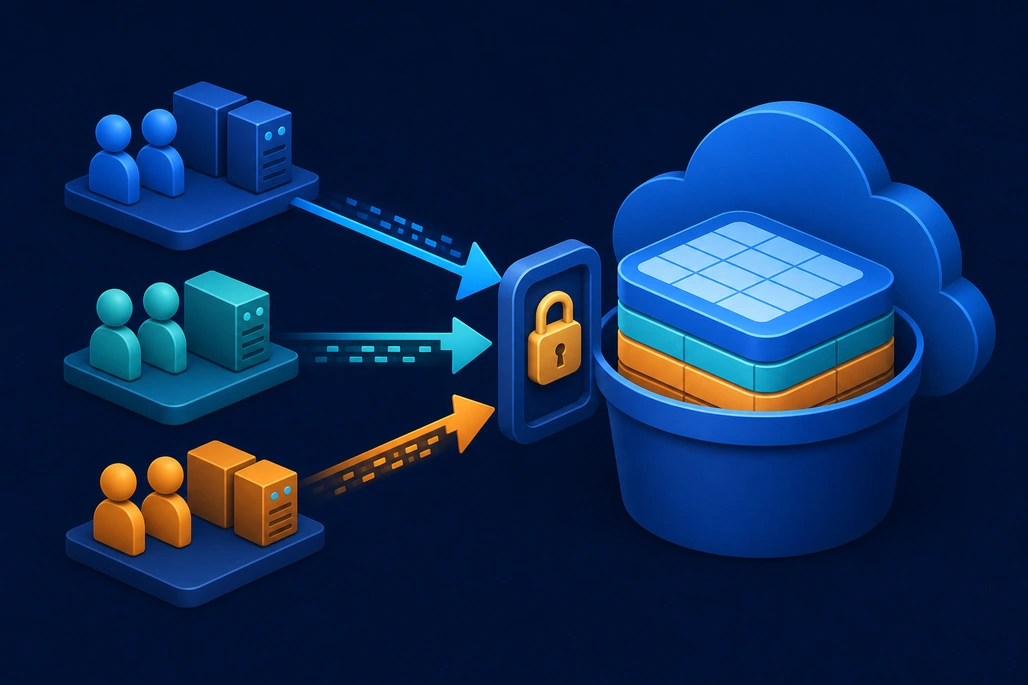
EMR 8.2 adds concurrent Delta Lake writes and broader governed access controls.
The main change is around data access and shared tables. AWS says EMR 8.2 allows multiple clusters to write concurrently to the same Delta Lake table stored in Amazon S3 by using S3 conditional writes. AWS says this removes the need for a DynamoDB log store in that setup.
For a beginner, this means separate Spark jobs can work with one Delta Lake table without a separate DynamoDB component used to coordinate the table log. Teams should still test their own write patterns and failure handling before moving production pipelines to the new approach.
EMR 8.2 also expands AWS Lake Formation fine-grained access control. The coverage now includes materialized views, governed user-defined functions, more Iceberg operations, and more Spark SQL features. AWS also added trusted identity propagation for Spark steps and interactive sessions, so downstream checks in Lake Formation and Amazon S3 can evaluate and audit access as the original federated user rather than only as the job role.
Another governance feature is OpenLineage-based lineage capture in the AWS Glue Data Catalog. Lineage records help a team see which jobs read data and which datasets they produced. That can make it easier to investigate a failed pipeline or understand the downstream effect of changing a source table.
Iceberg materialized views can refresh only changed data
EMR 8.2 lets data engineers define an Iceberg materialized view in SQL for a stage of a pipeline. A materialized view stores precomputed query output. Instead of calculating the whole query every time, AWS says EMR can incrementally refresh changes for projections, inner joins, filters, and SUM and COUNT aggregations.
This is useful when a pipeline repeatedly builds the same cleaned or aggregated dataset for reports. The feature does not mean every SQL query can refresh incrementally, so developers need to confirm that their query shape is among the supported operations before designing around it.
Iceberg 1.11.0 was released by the Apache Iceberg project in May 2026 and includes Spark 4.1 support. Apache Spark 4.1.3 was released in July 2026. EMR 8.2 packages those specific versions rather than asking users to assemble compatible Spark and table-format dependencies themselves. Apache Spark's release news and the Apache Iceberg 1.11.0 announcement provide the upstream context.
What changes for EC2, Serverless, and EKS users?
The features differ by how you run EMR. EMR on EC2 gives teams control of clusters and instances. EMR Serverless runs jobs without managing clusters. EMR on EKS runs Spark workloads on Kubernetes.
Deployment option | EMR 8.2 change | What to watch |
|---|---|---|
EMR on EC2 | Spark Connect support on multi-primary clusters and Secret Agent improvements. | AWS says user-provisioning latency can drop by up to 97% under high job concurrency with runtime roles. |
EMR Serverless | Three Spark scaling profiles: performance-optimized, balanced, and cost-optimized. | Balanced becomes the default for 8.2 jobs and sessions when no profile is set. |
EMR on EKS | Spark Operator version 2 and trusted identity propagation. | The operator update is based on open-source Spark Operator 2.5.0. |
For EMR Serverless users, the default change needs attention. In EMR 8.2, AWS applies the balanced scaling profile if a job or session does not explicitly choose one. Balanced and cost-optimized profiles ask for executors more slowly and use fewer of them than the performance-optimized option, so a job can take longer while consuming fewer resources. Teams that need the earlier scaling behavior can set spark.emr-serverless.scalingProfile=performance-optimized. AWS's scaling profile documentation describes the defaults and configuration property.
On EKS, trusted identity propagation carries a federated user's identity context into batch jobs and Spark Connect or Livy sessions. AWS says Lake Formation fine-grained access control and S3 Access Grants can then authorize and audit the request against the submitting user. The EMR on EKS 8.2 notes also confirm the Spark Operator version 2 update.
Availability, pricing, and upgrade planning
AWS says Amazon EMR 8.2 is available in every AWS Region where Amazon EMR is available. AWS has not announced a separate license fee for the 8.2 release. EMR pricing remains based on the deployment model and the resources used. For example, EMR on EC2 charges are added to EC2 and any attached EBS charges, while EMR on EKS and EMR Serverless bill based on their applicable compute and memory usage. Amazon EMR pricing provides the current deployment-specific details.
Developers upgrading should first run representative Spark jobs in a test environment. Check dependency compatibility, table operations, Lake Formation policies, and any Serverless workload that currently depends on the former dynamic-allocation defaults. AWS documents fixes and behavior changes in the EC2 release notes, but it has not published one universal migration checklist for every existing EMR application.
Based on reporting by Amazon Web Services, Inc., Amazon Web Services, Apache Software Foundation and Apache Iceberg.



Join the conversation! Your thoughts help the community grow.