
AWS has added a direct web search API to Amazon Bedrock AgentCore.
AWS made the Amazon Bedrock AgentCore Web Search API generally available on November 10, 2026, giving applications, custom AI agent loops, and data pipelines a direct way to search the web with one AWS API call. The API, named InvokeWebSearch, returns ranked web results from an Amazon-operated index and is available in six AWS Regions, including US East (N. Virginia), US East (Ohio), and US West (Oregon). AWS published its detailed implementation post on November 11, 2026.
Key takeaways
The new
InvokeWebSearchoperation lets your code search the web without creating an AgentCore Gateway first.Each result includes a text extract and may include a title, URL, and publication time.
The API uses standard AWS IAM permissions and Signature Version 4 authentication, so you do not manage a separate search API key.
Web Search costs $7 per 1,000 queries, and the direct API route does not add AgentCore Gateway charges.
You can filter results by domain and publication date, request 1 to 25 results, and use AWS PrivateLink for calls from a VPC.
What AWS launched in Amazon Bedrock AgentCore
The new API exposes AgentCore Web Search directly to application code. Before this release, developers used AgentCore Gateway to add web search as a Model Context Protocol, or MCP, tool. That remains the AWS-recommended route for many agent workloads, especially when a team needs one MCP endpoint for several tools and centrally managed policies.
The direct API is for a simpler case: your application already has its own code that decides when to search. A dashboard that tracks product announcements, a job that checks package advisories, or an agent loop written with LangChain can call InvokeWebSearch and handle the returned data itself.
AWS says the API searches an index that Amazon operates. A result always includes a text extract. When available, it also includes the page title, source URL, and publication timestamp. The AWS announcement says search queries stay in AWS and are not sent to a third-party search engine.
How beginners can make their first call
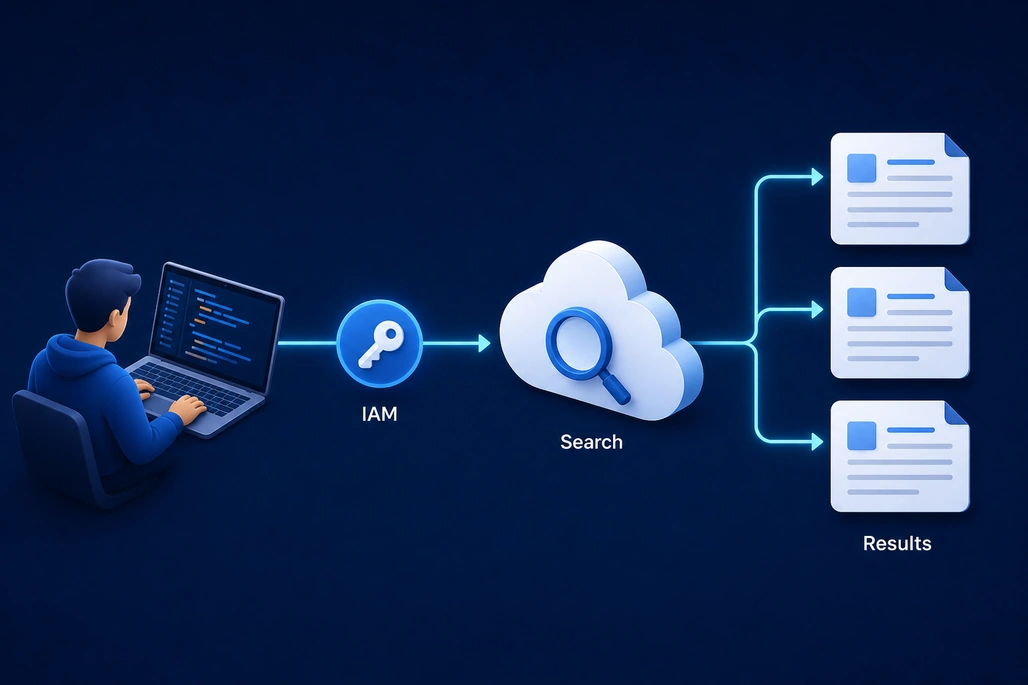
The API uses IAM authentication and returns ranked source results to application code.
You need an AWS account, credentials available to the AWS CLI or an AWS SDK, and access to a supported Region. The key permission is bedrock-agentcore:InvokeWebSearch on the AWS-managed web search tool. There is no gateway, search-index resource, or separate API key to create.
For a quick test, AWS documents this AWS CLI command. It asks for up to five results for a current Amazon EKS query:
aws bedrock-agentcore invoke-web-search \
  --web-search-id web-search.v1 \
  --search-query "latest EKS features" \
  --max-results 5
If the command returns an access-denied error, the identity running it does not have the required IAM permission. A least-privilege policy can grant only this action on the managed tool in one Region:
{
  "Version": "2012-10-17",
  "Statement": [
    {
      "Effect": "Allow",
      "Action": "bedrock-agentcore:InvokeWebSearch",
      "Resource": "arn:aws:bedrock-agentcore:us-west-2:aws:tool/web-search.v1"
    }
  ]
}
Replace us-west-2 with the Region your application uses. The account portion of this ARN is literally aws because AWS owns the managed search tool, not the customer account.
What you can control in each search request
The API requires two fields: webSearchId, which is currently web-search.v1, and searchQuery. The search query must be 1 to 200 characters long. You can ask for 1 to 25 results, and AWS returns up to 25 when maxResults is not supplied.
Option | What it does | Limit or format |
|---|---|---|
Domain filter | Includes or excludes selected domains, such as official vendor documentation. | Up to 100 included and 100 excluded domains |
Date filter | Returns pages published inside a time range. | RFC 3339 UTC dates, inclusive bounds |
Result count | Sets the maximum number of ranked results. | 1 to 25 results |
Search text | Defines the web search query. | 1 to 200 characters |
For beginners, domain filtering is a practical first control. If an assistant is meant to answer AWS setup questions, restricting a query to aws.amazon.com and docs.aws.amazon.com can reduce unrelated results. The filter improves where the agent looks, but developers still need to check the returned sources before presenting important claims as facts.
When to use the API instead of AgentCore Gateway
AWS positions the API and Gateway as two ways to use the same search capability. Use the direct API when your code needs raw search results and you want to own retries, caching, validation, and orchestration. This fits existing applications, scheduled pipelines, and custom agent frameworks.
Use AgentCore Gateway when an MCP-compatible agent needs to discover and call web search as a tool. Gateway is also the route to consider when one administrator needs to apply domain restrictions across multiple agents, or when an application needs JSON Web Token authentication in addition to IAM.
The direct API authenticates callers with IAM only. AWS documentation also notes an availability difference: the Web Search Gateway connector is available in AWS GovCloud (US-West), while the direct Web Search API is not.
Pricing, availability, and operational limits
AWS prices AgentCore Web Search at $7 per 1,000 queries. The direct API uses that same per-query rate and does not carry Gateway charges because no Gateway request is involved. This means 10,000 search queries cost $70 before considering the cost of the model, compute, storage, or other AWS services used by the application.
The API is available in US East (N. Virginia), US East (Ohio), US West (Oregon), Europe (Ireland), Asia Pacific (Tokyo), and Asia Pacific (Sydney). AWS sets a default quota of 10 requests per second for each account in each Region. Customers can request a quota increase through AWS Support.
For private workloads, applications in a VPC can reach the AgentCore data plane through an interface VPC endpoint using AWS PrivateLink. AWS says this route keeps traffic between the VPC and the API on the AWS network and does not require an internet gateway, NAT gateway, or proxy.
Framework support and what to watch for
AWS says langchain-aws version 1.9.3 and later adds support for the AgentCore web search tool, while AgentCore Python SDK version 1.26.0 and later includes a WebSearchClient. The langchain-aws 1.9.3 package was released on November 10, 2026, the same day AWS announced general availability.
Search results are evidence for an application or agent, not a finished answer. Your code should preserve source URLs, show citations where users need them, and check important statements against the returned pages. AWS's acceptable-use terms also require applications to retain and display the source citations and links included with results.
Developers should also plan for normal service failures. AWS documents validation errors for invalid filters or request sizes, access-denied errors for missing IAM permissions, and throttling errors when an account exceeds its quota. Retrying throttling and temporary service errors with exponential backoff is the documented approach.
Based on reporting by Amazon Web Services, 9to5Amazon and PyPI.

Join the conversation! Your thoughts help the community grow.