
Full fine-tuning updates all weights in a model instead of only adapter layers.
Amazon Web Services published new guidance on November 18, 2026, showing developers how to use Full Fine-Tuning (FFT) in Amazon SageMaker AI Serverless Model Customization. FFT updates every model weight instead of training only small adapter weights, giving teams a managed option for deeper LLM customization without provisioning GPUs, setting up clusters, or managing distributed training.
Key takeaways
AWS used FFT and LoRA to fine-tune Qwen3-4B on 110,000 coding instruction-response pairs.
In AWS's code-generation experiment, FFT reached 90.0% semantic correctness at more than 100,000 training examples.
LoRA trains a smaller set of adapter weights, while FFT updates all weights and needs more compute.
AWS recommends treating FFT hyperparameters carefully because aggressive training can reduce general model knowledge.
Serverless Model Customization supports jobs through SageMaker AI Studio and the SageMaker Python SDK.
What AWS published for SageMaker AI developers
The new AWS Machine Learning Blog post is a practical guide to choosing FFT or Low-Rank Adaptation, known as LoRA, for a custom large language model. AWS ran its comparison using supervised fine-tuning on Qwen3-4B and a code dataset containing 110,000 instruction-response pairs.
Full fine-tuning was already announced for SageMaker AI Serverless Model Customization on August 3, 2026. AWS said then that the capability supported more than 25 open-weight models and was available in US East (N. Virginia), US West (Oregon), Asia Pacific (Tokyo), and Europe (Ireland). The November 18 post adds experiment details, benchmark results, and starting hyperparameters for developers deciding when to use it.
For beginners, the practical point is simple. Fine-tuning changes a base model using examples from a specific task. A team might fine-tune a model on internal support responses, product documentation, or code examples so it produces answers in a consistent format and better understands that work.
How FFT differs from LoRA
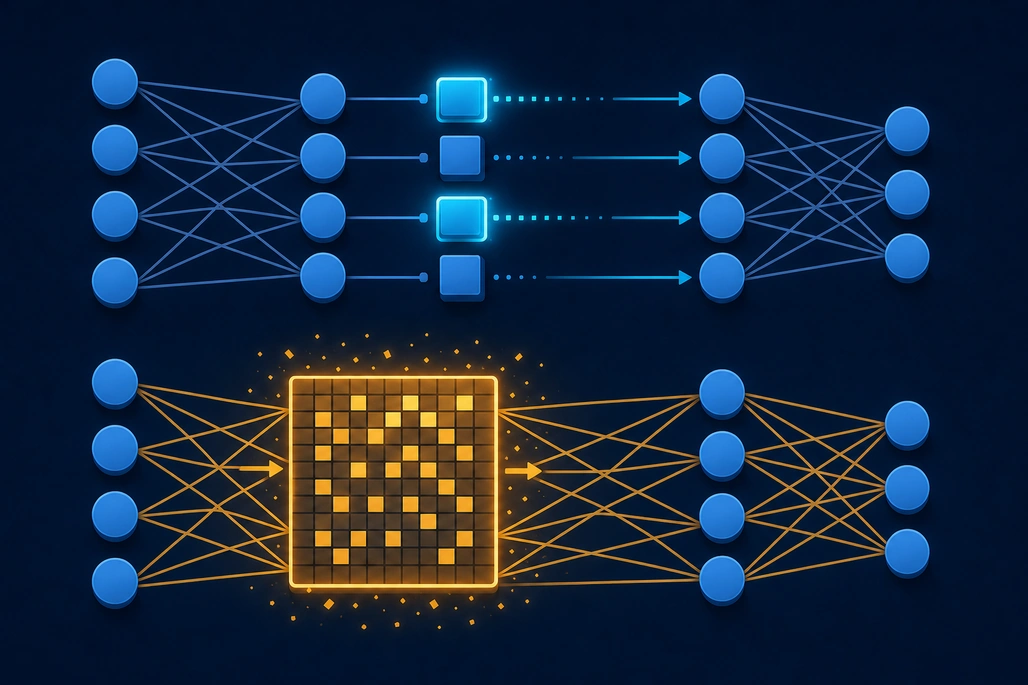
LoRA changes adapter weights, while FFT updates the complete model.
LoRA keeps the original model weights frozen and trains smaller low-rank matrices that act as adapters. The original LoRA research describes this approach as a way to reduce the number of parameters that must be trained for a downstream task. That can mean lower training cost and faster experiments.
FFT takes a different path. It updates all weights in the base model. AWS documentation describes LoRA as lower cost and faster, while it describes FFT as higher compute with deeper customization. Neither choice is automatically best. The right method depends on the task, data quality, data volume, budget, and the level of change the model needs.
Training type | What changes | Where it fits | What to watch |
|---|---|---|---|
LoRA | A small set of adapter weights | Quick, lower-cost adaptation for a focused task | It may have less capacity for deep task changes |
FFT | All base-model weights | Large, high-quality datasets and complex domain adaptation | Higher compute and a greater risk of losing general capabilities |
AWS reported that FFT pulled ahead as its code-training dataset grew beyond 100,000 examples. In that specific experiment, FFT reached 90.0% on its LLM-as-Judge semantic-correctness measure. This is an AWS benchmark result, not a guarantee that FFT will produce the same gain for every dataset or model.
Why model forgetting is the main risk with FFT
Updating every weight can help a model learn detailed domain patterns. But it can also overwrite parts of the broad knowledge learned before fine-tuning. This is commonly called catastrophic forgetting.
AWS tracked this risk with MMLU, a benchmark covering 57 multiple-choice subjects, including mathematics, history, computer science, and law. In the AWS experiment, MMLU served as a guardrail for checking whether a code-focused customization reduced general knowledge.
The company found that training loss alone was not enough to judge an FFT job. A validation set that looks similar to the training examples can still show good results while broader capabilities get worse. Developers should therefore test a customized model on task-specific data and on tests for abilities they do not want to lose.
Starting settings AWS tested
AWS said its test results pointed to a learning rate of 2e-5 as a safe starting point for a dataset larger than 100,000 examples. Its baseline configuration for preserving general knowledge used a global batch size of 8, a 5% warmup ratio, and a learning rate of 2e-5.
The post also found that three epochs produced its best LLM-as-Judge correctness score of 90.0% in the reported tests. Training longer than three epochs degraded every configuration AWS tested. These are experiment-specific starting points, not universal values. A different base model, dataset, context length, or task can need different settings.
from sagemaker.train.sft_trainer import SFTTrainer
from sagemaker.train.common import TrainingType

trainer = SFTTrainer(
    model=base_model_id,
    training_type=TrainingType.FULL,
    training_dataset=training_dataset,
    validation_dataset=val_dataset,
    sagemaker_session=sess,
    role=role,
)
trainer.hyperparameters.learning_rate = 2e-5
trainer.hyperparameters.global_batch_size = 8
trainer.train(wait=False)
The important line is TrainingType.FULL. AWS said developers can switch to LoRA by changing it to TrainingType.LORA while leaving the rest of the trainer setup in place.
What beginners should do before launching an FFT job
Start by deciding whether training is required at all. SageMaker AI documentation recommends prompt engineering when the model mainly needs a different tone, format, or style. It recommends retrieval-augmented generation, or RAG, when the problem is missing current or private knowledge that can be supplied at inference time.
Use fine-tuning when the model must consistently learn behavior, style, or domain expertise from examples. If the first goal is a small change with a limited dataset, LoRA is a sensible baseline. Move to FFT when controlled evaluations show that LoRA cannot reach the required quality and the team has enough clean examples to support deeper training.
For serverless jobs, developers specify the base model, datasets, training type, and hyperparameters. SageMaker AI handles GPU allocation, checkpoints, metrics, and cleanup. AWS says actual charges are usage-based; the November 18 guidance does not publish a fixed FFT job price, so teams should check current SageMaker AI pricing before running large experiments.
Based on reporting by Amazon Web Services, arXiv and MLCommons Science Working Group.


Mahesh ChandTOP 10Posted Nov 19, 2026, 9:55 AM EST
Great insights