
AWS published a deployment workflow for running OpenFold3 structure predictions in SageMaker JumpStart.
AWS published a November 13, 2026 walkthrough for deploying OpenFold3-preview through Amazon SageMaker JumpStart. The managed deployment lets developers submit biomolecular structure prediction jobs for proteins, DNA, RNA, small-molecule ligands, and complexes from their own AWS accounts, using SageMaker asynchronous inference and Amazon S3 for job input and output. AWS's OpenFold3 deployment guide describes the configuration.
Key takeaways
- OpenFold3-preview is available in SageMaker JumpStart with model ID
huggingface-proteinfolding-openfold3. - The JumpStart walkthrough deploys OpenFold3 0.4.1 with the
of3-p2-155kcheckpoint. - Jobs run asynchronously because a structure prediction can take minutes, while typical real-time endpoints have a 60-second response limit.
- Supported SageMaker endpoint instances are
ml.g6.2xlarge,ml.g6.4xlarge, andml.g6.12xlarge. - Endpoints are billed while running, including when idle, so AWS recommends cleanup or scale-to-zero settings.
What AWS announced for OpenFold3
The new AWS post is a detailed deployment guide, rather than the first announcement that OpenFold3 was in the JumpStart catalog. AWS said on September 14, 2026 that OpenFold3 models had become available in JumpStart. The November 13 guide shows how to deploy the model on an asynchronous endpoint, submit requests, read the results, use multiple GPUs, provide precomputed multiple sequence alignments, or MSAs, and configure endpoint autoscaling.
OpenFold3 is an all-atom biomolecular structure prediction model developed by the OpenFold Consortium and the AlQuraishi Lab at Columbia University. Its documentation says the preview model supports standard and non-canonical protein, RNA, and DNA chains, along with small molecules. It also supports multi-query jobs and distributed predictions across multiple GPUs.
For a beginner, “structure prediction” means giving the model biological sequences and asking it to estimate their three-dimensional arrangement. A protein sequence is a string of amino-acid letters. A ligand is supplied as a SMILES string, which is a text representation of a small molecule. The service returns predicted structures in mmCIF files, a common structural-biology format, together with confidence data.
How the AWS workflow works
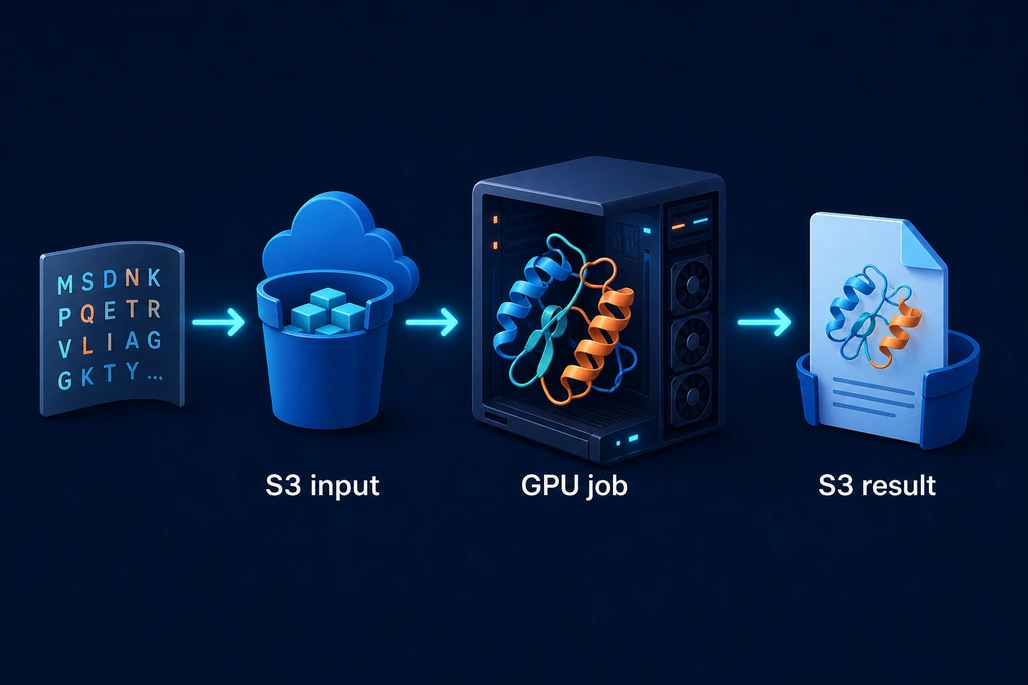
SageMaker asynchronous inference stores requests and results in Amazon S3.
The managed workflow uses SageMaker Asynchronous Inference because structure prediction is slower than a normal API request. You place a JSON request file in an Amazon S3 location, call the SageMaker InvokeEndpointAsync API, and receive the output and failure locations immediately. The endpoint processes the queued request, then writes either a result or error details back to S3.
A request can contain one or more named queries. Each query contains chains that should be folded together as a complex. Chain types can be protein, dna, rna, or ligand.
{
  "queries": {
    "example": {
      "chains": [
        {
          "molecule_type": "protein",
          "chain_ids": ["A"],
          "sequence": "YOUR_PROTEIN_SEQUENCE"
        }
      ]
    }
  }
}
AWS sets the asynchronous invocation timeout to as much as one hour in its example. You can poll the S3 output location, or configure Amazon Simple Notification Service notifications. This is useful for a batch of scientific jobs because a team can submit several requests without building its own queue service.
What you need before deployment
The AWS walkthrough requires an AWS account, a SageMaker AI execution role, an S3 location for request and result files, and SageMaker Python SDK version 3. It also requires service quota for at least one ml.g6.4xlarge endpoint instance in the AWS Region where you deploy.
A beginner should pay close attention to IAM and S3 permissions. AWS says the endpoint execution role should have read and write access only to the S3 prefix used for this workflow. The identity running the deployment needs permissions to create, describe, invoke, and delete the model, endpoint configuration, and endpoint, plus iam:PassRole.
The walkthrough uses network isolation for the endpoint. AWS says this can help keep sequences within the customer’s AWS account. But the S3 request and result objects still contain sequences and predicted structures. AWS recommends a dedicated bucket or prefix, server-side encryption with a customer-managed AWS KMS key where needed, restricted bucket policies, and lifecycle policies for files that do not need to be retained.
Choosing an instance and controlling cost
| Use case | AWS recommendation | Reason |
|---|---|---|
| Individual exploration | ml.g6.2xlarge or ml.g6.4xlarge | One GPU processes one prediction at a time at the lowest supported hourly cost. |
| Concurrent team requests | ml.g6.12xlarge | It can run four predictions in parallel when configured for four concurrent invocations. |
| High-throughput screening | ml.g6.12xlarge with autoscaling | It is intended for higher per-instance throughput and can scale out based on queue depth. |
AWS warns that SageMaker endpoints are billed per instance-hour while they are running, even when there are no jobs. Asynchronous endpoints can scale to zero when their queues are empty, which avoids idle endpoint time between experiments. Developers also need to delete endpoints after testing if scale-to-zero is not configured.
AWS notes that G6 capacity can be limited in some Regions. If a deployment fails with InsufficientInstanceCapacity, the documented options are to retry later, use another supported instance type, or deploy in another Region where the model is available.
How to read an OpenFold3 result
By default, OpenFold3 generates five diffusion samples for each query, so one query returns five candidate structures. The output includes mmCIF structure files and confidence files. AWS says the aggregated confidence file includes sample_ranking_score, which you can use to select a candidate structure for review.
The service also returns confidence metrics including pLDDT, PAE, and PDE. These values help a developer judge where a predicted structure is more or less reliable, but they do not replace experimental validation. AWS's example opens mmCIF files in tools such as PyMOL, ChimeraX, or Mol*, and uses py3Dmol to display a prediction inside a notebook.
OpenFold3 version differences to watch
The AWS JumpStart guide specifically identifies the deployed model as OpenFold3 0.4.1 and the of3-p2-155k checkpoint. The upstream OpenFold3 GitHub repository lists version 0.5.1 as its latest release and includes later releases such as 0.4.5 and 0.5.0. That means the SageMaker JumpStart deployment described by AWS is not the same as the newest upstream repository release.
For production work, developers should record the model version, checkpoint, instance type, input data, MSA settings, and confidence results for every run. The OpenFold3-preview technical report describes the project as a prerelease system, and the AWS guide also calls the model a research preview. Teams should treat predictions as computational evidence to review, rather than a final biological answer.
Frequently asked questions
What can OpenFold3 predict in SageMaker JumpStart?
OpenFold3 can predict structures for proteins, DNA, RNA, small-molecule ligands, and complexes that combine those molecules. Input sequences and ligand SMILES are placed into a JSON request.
Why does OpenFold3 use asynchronous inference?
Structure prediction may take several minutes, which is longer than the 60-second limit AWS cites for real-time endpoint responses. Asynchronous inference queues the job and writes the completed result to Amazon S3.
Which SageMaker instances support OpenFold3?
AWS lists ml.g6.2xlarge, ml.g6.4xlarge, and ml.g6.12xlarge as supported instances for the JumpStart model.
Does OpenFold3 in JumpStart keep sequence data private?
The endpoint runs with network isolation, which AWS says can help keep sequences within an AWS account. Developers must still secure the S3 locations that store input requests and output structures.
Is the SageMaker JumpStart model the latest OpenFold3 release?
No. AWS's November 13, 2026 guide deploys OpenFold3 0.4.1, while the upstream OpenFold3 GitHub repository lists 0.5.1 as its latest release.
Based on reporting by Amazon Web Services, OpenFold Team, OpenFold3 Team and OpenFold3 Project.



Join the conversation! Your thoughts help the community grow.