Loading
Blogs by Prasad Raveendran
- Web3
Navigating the Next Wave: A Deep Dive into HTTP/3
The internet is always changing, with new technologies popping up to make things faster, safer, and more efficient. One of these new things people are talking about is HTTP/3. Let's take a closer look at what HTTP/3 is and why it's important for the future of the internet.
- .NET
Dynamic Registration of FluentValidation in .NET Minimal API
In the landscape of .NET development, validation is a critical aspect of ensuring data integrity and application robustness. FluentValidation is a widely adopted library that provides a clean and expressive way to define validation rules in .NET applications. In this blog post, we'll explore how to streamline the process of registering FluentValidation classes dynamically in .NET Minimal APIs. This approach reduces manual overhead and enhances the maintainability of validation logic in your applications.
- .NET
Dependency Injection Registration in .NET Core with Custom
In this blog post, we'll explore a clean and elegant approach to streamline dependency injection registration using custom attributes in .NET Core. By leveraging custom attributes, we can annotate our service implementation classes with metadata that dictates their lifetime scope, such as scoped, transient, or singleton.
- .NET
Structured Logging with Sensitive Data Sanitization using Serilog
However, logging sensitive data like passwords or personal information can pose security risks. In this blog post, we'll delve into implementing structured logging with Serilog and sanitizing sensitive data before logging it, utilizing the Console sink as an example.
- .NET
Explore Enumeration classes in .NET
Enums in C# have long been the go-to choice for defining a fixed set of related constants. However, they come with limitations that can hinder flexibility and extensibility in certain scenarios. In this blog post, we will explore a powerful alternative in .NET: Enumeration Classes. We'll delve into what enumeration classes are, how they can be implemented, and why they offer a compelling alternative to traditional enums.
- .NET
Minimal APIs with Carter in .NET 8.0
Carter is a library for building HTTP APIs in .NET. It simplifies the process of defining and organizing endpoints in your application. Here's a step-by-step guide on how to use Carter with Minimal API
- .NET
Comparison of xUnit, NUnit, and MSTest in .NET Core Testing
Testing is an integral part of the software development life cycle, ensuring the reliability and correctness of your code. In the .NET Core ecosystem, developers have several testing frameworks to choose from, each with its own set of features and conventions.
- .NET
Synchronization in Multithreading with lock and Semaphore in .NET 6.0
Multithreading is a potent technique enabling applications to concurrently execute multiple threads, thereby enhancing performance and responsiveness. However, along with its benefits, there arise challenges related to the synchronization and coordination between these threads. In the realm of .NET 6.0, two indispensable constructs for orchestrating synchronization are the 'lock' keyword and the Semaphore class.
- .NET
Demystifying CORS in .NET 6.0 Minimal APIs
Cross-Origin Resource Sharing, commonly known as CORS, plays a pivotal role in contemporary web development by empowering servers to regulate the domains permitted to access their resources. This blog post delves into the management of CORS in .NET 6.0 Minimal APIs.
- .NET
Handling Exception with 'When' Clause in Catch Block
C# 6.0 introduced several language enhancements to make code more expressive and developer-friendly. One notable addition was the introduction of the 'When' clause in catch blocks, providing developers with a powerful tool for more refined exception handling.
- C#
Understanding the Declaration Pattern in C#
In the realm of C# programming, developers often encounter scenarios where they need to check and extract information from objects in a concise and readable manner. The declaration pattern in C# provides an elegant solution to this problem. This blog post will explore the declaration pattern, its syntax, and how it can be applied to enhance code readability and maintainability.
- Angular
Simplifying Angular Development with the Facade Pattern
Angular, as a robust framework, provides developers with the tools to build complex and feature-rich applications. However, as applications grow, managing different parts of the system can become challenging. This is where design patterns, such as the Facade Pattern, come into play.
- .NET
How to Create Channels in .NET?
Channels in .NET are a fundamental addition to the asynchronous programming model. They provide a way to pass data between producers and consumers in a thread-safe manner, enhancing performance and scalability in applications.
- .NET
.NET 8.0 Keyed Service Registration with Dependency Injection
Dependency Injection (DI) in .NET provides a mechanism for managing the dependencies between various components within an application. When registering services, it allows specification of service lifetimes, service types, and their corresponding implementations.
- .NET
Exploring C# 12 Features
As technology evolves, programming languages continue to advance, offering developers new tools and features to enhance their productivity and simplify complex tasks. In the world of .NET development, C# remains a prominent language, constantly evolving to meet the needs of modern software development. C# 12, the latest iteration of this language, introduces several compelling features that streamline code, improve readability, and empower developers. In this blog post, we'll delve into five thrilling enhancements in C# 12 that particularly captivate my interest.
- .NET
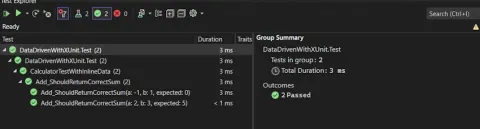
Data-Driven Testing with xUnit in .NET 8.0
Data-Driven Testing with xUnit in .NET Core empowers developers to efficiently test code by systematically providing different input data and verifying corresponding expected outcomes. xUnit offers multiple approaches such as [InlineData], [ClassData], [MemberData], and custom data sources, allowing for diverse ways to parameterize tests
- AI
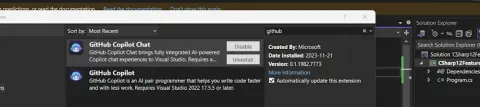
GitHub Copilotchat and GitHub Copilot
In the continuously changing realm of software development, the rise of AI-powered coding aides has ignited a revolution in how programmers engage in their work. GitHub Copilot and GitHub Copilotchat serve as prime illustrations of this revolutionary trend, presenting pioneering functionalities aimed at simplifying coding duties and reshaping the overall developer journey.
- .NET Core
A Deep Dive into Parallel.ForEach and List.ForEach
Parallel processing has become an essential aspect of modern software development, allowing developers to exploit the power of multi-core processors for improved performance. In C#, two commonly used methods for parallel execution are Parallel.ForEach and List.ForEach. In this blog post, we'll explore the nuances of these two approaches, their differences, and when to choose one over the other
- SQL
Demystifying IDENTITY and SCOPE_IDENTITY() in SQL
In the realm of SQL databases, the management of identity columns plays a pivotal role in maintaining data integrity. Two commonly used functionalities, @@IDENTITY and SCOPE_IDENTITY(), aid in retrieving recently generated identity values after an INSERT operation. Understanding the nuances between these two is crucial for developers and database administrators
- SQL
Mastering Group By and OVER Clause in SQL
In the realm of SQL, two powerful tools—GROUP BY and the OVER clause—play pivotal roles in data manipulation and analysis. Understanding these tools is essential for harnessing the full potential of SQL queries. Let’s delve into their nuances and explore how they facilitate data aggregation and window functions.
- .NET Core
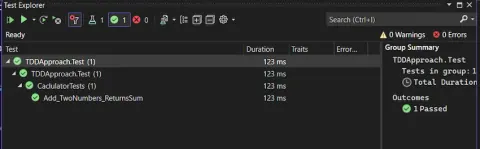
Power of Test-Driven Development (TDD) in .NET Core
In the world of software development, Test-Driven Development (TDD) stands as a powerful approach to crafting robust, maintainable code. This methodology, particularly in .NET Core, promotes writing tests before writing the actual code. By following this approach, developers ensure that their code meets the intended requirements and remains resilient to changes over time. In this blog, we'll delve into the fundamentals of TDD using XUnit and Moq in a .NET Core environment and showcase its implementation through an illustrative example.
- .NET
Iterative vs. LINQ Approach in .NET
When working with collections of objects in C#, you may often need to transform or map the items from one list to another. This process is a common task in software development, and C# offers two primary methods to achieve it: the Iterative approach and the LINQ (Language-Integrated Query) approach. In this blog post, we will explore both methods and discuss their use cases.
- .NET
Understanding WaitAll and WhenAll in .NET
Asynchronous programming has become an integral part of modern software development, and .NET Core (now known as .NET 5, .NET 6, .NET 7, and later .NET 8) provides powerful tools to simplify asynchronous operations. Two essential methods, WaitAll and WhenAll, are at your disposal when working with tasks. These methods allow you to manage and coordinate multiple asynchronous operations efficiently. In this blog post, we will explore WaitAll and WhenAll in .NET Core and understand their differences and use cases.
- SQL
Understanding Common Table Expressions (CTEs) in SQL
In today's data-driven world, SQL is a critical tool for managing and querying databases. However, as the complexity of our data and queries grows, so does the challenge of writing and maintaining SQL code. Common Table Expressions (CTEs) offer an elegant solution to this problem. In this blog post, we'll explore CTEs, what they are, how to use them, and why they are invaluable for database professionals
- .NET
Software Architecture In .NET Using Architecture Tests
Architectural testing in C# involves evaluating the overall structure and design of a software application to ensure that it meets certain architectural principles and requirements. While static code analysis tools assist in verifying or promoting general best practices, NetArchTest can be utilized to generate unit tests that enforce architectural rules in your .NET and .NET Core applications. These rules encompass guidelines related to class design, naming conventions, and codebase dependencies.