Loading
Building Retrieval-Augmented Generation (RAG) in C#
Learn how retrieval-augmented generation grounds an LLM in your own data, build a working RAG app in C#, and know when to add hybrid search, GraphRAG or evals.
Building Atlassian Forge Apps With the New Hosted LLM API
Learn how to configure Atlassian Forge LLMs, call hosted Claude models with @forge/llm, and build a Jira issue summarization feature.
OpenAI and Anthropic sharply cut LLM prices amid growing competition
OpenAI and Anthropic lowered prices for several models between July and September 2026. OpenAI cut GPT-5.6 Luna’s API prices by 80% and later introduced GPT-6 Sol and GPT-6.1 Sol at lower rates, while Anthropic priced Opus 5.5 below Opus 5. The announcements point to improved inference and serving e
How to Run a Local AI Model on Windows with Windows ML and llama.cpp
Learn how to run a GGUF language model locally on Windows with llama.cpp and call its OpenAI-style HTTP API from a C# application.
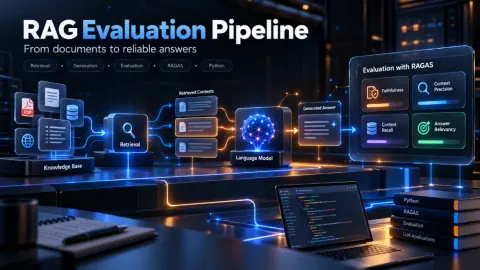
How to Build a RAG Evaluation Pipeline With Python: Metrics, RAGAS, and Testing
Learn how to evaluate a Python RAG pipeline with RAGAS using faithfulness, context precision, context recall, and answer relevancy metrics.
Debugging LLM Outputs: A Systematic Approach with LangGraph and Observability
Learn how to trace and debug LLM outputs with LangGraph, Graph RAG, Neo4j, FastAPI, and a React observability dashboard for compliance AI workflows.
Differential Privacy in LLM Fine-Tuning: Securing Enterprise Knowledge with Multi-Agent Architectures
Learn how to apply differential privacy to LLM fine-tuning with DP-SGD and Opacus, using a LangGraph multi-agent workflow to track privacy budgets, validate leakage, and audit training data.
Optimizing LLM Pipelines with Advanced Caching Strategies: An Enterprise Multi-Agent Approach
Build an enterprise LLM documentation assistant using LangGraph, Redis semantic caching, Graph RAG, and Neo4j to reduce latency and cost while keeping answers fresh.
How KV Cache Routing Can Make LLM Inference Faster
Learn how KV cache-aware routing reuses cached transformer attention states to reduce repeated prompt processing, lower latency, and improve GPU efficiency in LLM inference.
How to Fine-Tune an Open-Source LLM and Integrate It into an ASP.NET Core Application
Learn how to fine-tune an open-source LLM with PyTorch, Hugging Face, PEFT, and LoRA, then expose it through an inference API for an ASP.NET Core application.
RAG vs Fine-Tuning: Which Approach Should .NET Developers Use for Enterprise AI?
Compare RAG and fine-tuning for enterprise .NET AI applications, including when to use retrieval for changing knowledge and tuning for specialized model behavior.
Auditing Fine-Tuned LLMs for Training Data Leakage and PII Exposure
Learn how to audit fine-tuned LLMs for training data leakage and PII exposure using data sanitization, adversarial testing, output scanning, and release gates.
Learning LLM for .Net developers
Learn what an LLM (Large Language Model) is, how it works, and key concepts including tokens, tokenizers, prompts, training, inference, prompt engineering, hallucinations, RAG, memory, and deterministic AI output.
Designing Cost-Aware Multi-Model Routing for Enterprise AI APIs
Learn how to design cost-aware multi-model routing for enterprise AI APIs using model quality, latency, token costs, availability, fallback policies, and workload-specific routing strategies.
Benchmarking Semantic Chunking for Enterprise Document Retrieval
Benchmark semantic chunking strategies for enterprise document retrieval by comparing retrieval accuracy, context quality, latency, token usage, chunk sizes, and downstream question-answering performance.
Benchmarking Model Routing by Cost, Latency, and Answer Quality
Benchmark LLM model-routing strategies by comparing inference cost, response latency, answer quality, reliability, and workload-specific model selection across multiple models.
Benchmarking .NET Lambda Cold Starts with Durable Workflows
Benchmark .NET Lambda cold starts with Durable Workflows. Optimize performance, understand overhead, and make informed architectural decisions.
Benchmarking .NET Lambda Cold Starts with Durable Workflows
Benchmark .NET Lambda cold starts with durable workflows. Understand latency, optimize performance, and improve serverless application efficiency.
Running Applications on Kubernetes: Production Patterns Beyond Basic Deployments
Master Kubernetes production patterns: health checks, resource controls, scaling, config management, and controlled updates for reliable apps.
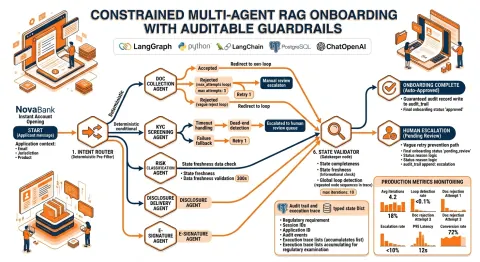
Deterministic Guardrails for Digital Banking Onboarding RAG
Secure digital banking onboarding with deterministic RAG. Prevent loops, dead ends, and chatter for regulatory compliance & conversion.
Benchmarking Chunking Strategies for Enterprise RAG Systems
Optimize enterprise RAG systems by benchmarking chunking strategies. Maximize retrieval accuracy, minimize costs, and build reliable AI applications.
Designing Cost-Aware AI Routing Strategies Across Multiple LLM Providers
Optimize LLM costs with a cost-aware AI routing architecture. Reduce expenses, enhance resilience, and manage budgets effectively.
Building AI Evaluation Dashboards with MLflow and Databricks
Build AI evaluation dashboards with MLflow & Databricks for GenAI. Move beyond accuracy to measure faithfulness, relevance, and cost.
Comparing GraphRAG and Traditional RAG for Enterprise Knowledge Retrieval
GraphRAG enhances enterprise knowledge retrieval by combining vector search with knowledge graphs for complex, multi-hop queries.
Benchmarking Embedding Models for Enterprise Semantic Search Applications
Benchmark embedding models for enterprise semantic search & RAG. Optimize accuracy, latency, and cost with a .NET framework.